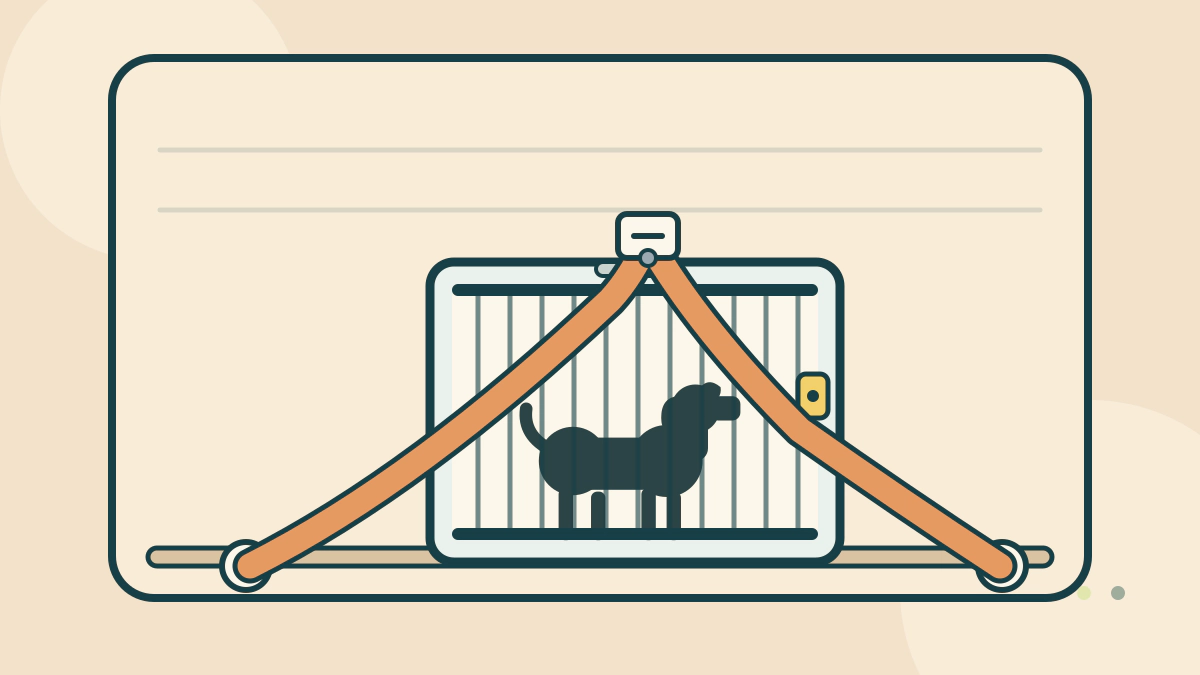
Check who tested a pet harness, crate or carrier, at what speed and with what test-dog weight before trusting a crash-test label.
What does crash-tested mean for a pet restraint?
Treat crash tested as a claim to verify, not a government standard. No federal motor vehicle safety standard covers pet harnesses, crates or carriers. A 1983 NHTSA interpretation says an accessory that secures a pet to a seat belt has no federal standard or testing requirement.
That does not make every product equal. The buyer has to ask who ran the test, at what speed, with what test-dog weight and in what installation. The AVMA says product data is limited, encourages evidence-based crash testing, and prefers a properly sized enclosure or safety harness to a loose pet.
What an independent pet crash test involves
The Center for Pet Safety is a nonprofit testing and advocacy group. Its studies used specially designed crash-test dogs, not live animals, and referred to the 30 mph crash condition in FMVSS 213, the child-restraint standard.
The 2013 and 2015 studies used MGA Research, an independent NHTSA-contracted test facility. A manufacturer’s own video is not the same as a third-party report.
CPS also runs a voluntary certification program. It says it accepts no funding from pet product manufacturers and lists certified models in a public directory.
Match the claim to the tested size
A rating can be real and still not cover the product in your cart. Results usually apply to one size, one test-dog weight and one set of straps or hardware.
| Claim or label | Question to ask | Useful evidence |
|---|---|---|
| Crash tested | Who ran the test, to what protocol and at what speed? | A third-party report, not only a video |
| 5-star rated | Which CPS program, model and size? | A current CPS listing for that exact product |
| Rated for a 75 lb dog | Is that the test-dog weight or a marketing size limit? | The test report and CPS listing |
| Includes tie-down straps | Were those straps part of the tested system? | CPS listing and installation instructions |
Gunner Kennels says its G1 kennels in Small, Medium and Intermediate are 5 Star Crash Tested per the Center for Pet Safety, and that the Intermediate earned the first CPS 5-star crate rating in 2016 with its tie-down straps. The CPS directory lists the G1 in those three crate sizes. That supports those tested configurations only.
Apply the same rule to any brand. Find the exact model on the tester’s list and read the size and hardware notes. If it is not listed, ask the maker for the full report.
Fit the restraint to the dog
The AVMA says a carrier should let the pet lie down, stand up and turn around, but should be small enough that the pet is not thrown around in a sudden stop. A crate that is too large gives the dog room to hit the walls.
CPS’s 2015 carrier report defines success as fully containing the test dog before, during and after the crash. Ask whether the maker publishes that result for the exact size.
Weight matters more than breed. Use the dog’s current weight and the maker’s chart, then compare it with the test-dog weight. A product rated for a 75 lb dog was not necessarily tested with a 75 lb dummy in every size.
Installation is part of the restraint
A crate only helps if it stays in place. The 2015 CPS studies tested products that claimed crash testing and found that straps, brackets and connection points can fail even when the box survives.
Follow the maker’s instructions exactly. Use the tie-down points and straps named in the tested configuration. A CPS harness case study warns that extension tethers increase the risk of injury. A cargo hook that holds a bag is not necessarily rated for a crash load.
The vehicle matters too. A crate needs space and suitable anchors. How to secure luggage in an SUV explains seatback limits and tie-down ratings. Check the owner’s manual for cargo and anchor limits.
Check before you buy
- Identify the exact model, size and included hardware.
- Look for the product on the CPS certified list or another independent tester’s list.
- Read the test report for speed, test-dog weight and pass criteria.
- Confirm the product fits your vehicle and can be anchored as tested.
- Keep the receipt, instructions and test listing with the product.
After a crash, inspect the vehicle and the restraint. How to check for hidden damage after a crash covers the vehicle. Replace any restraint that is damaged or that the maker says should not be reused. NHTSA vs IIHS crash tests explains why the protocol matters.
Frequently asked questions
Does crash tested mean certified?
No. Crash tested can mean the maker ran its own test. Certification usually means an independent organization tested the product and listed the exact model.
At what speed are pet restraints tested?
CPS’s studies used the 30 mph crash condition from FMVSS 213, the child-restraint standard. A maker may use a different speed or protocol, so compare the test report, not just the headline.
Is a crate safer than a harness?
Neither is automatically safer. A crate that fits and is anchored as tested can contain the pet. A harness avoids a large box in the cabin but depends on fit and routing. The AVMA prefers either a sized enclosure or a designed harness.
Can I just use a collar and a seat belt?
No. A vehicle harness is not the same as a walking harness, and a collar is not designed to take crash loads. Use a restraint tested as a complete system with the vehicle belt or anchor.
Bottom line: A crash-test label is the start of the check, not the end. Confirm the tester, the exact size and the installation, then follow the maker’s instructions every trip. More family-vehicle guidance is in Family Teen and Accessible Vehicles.