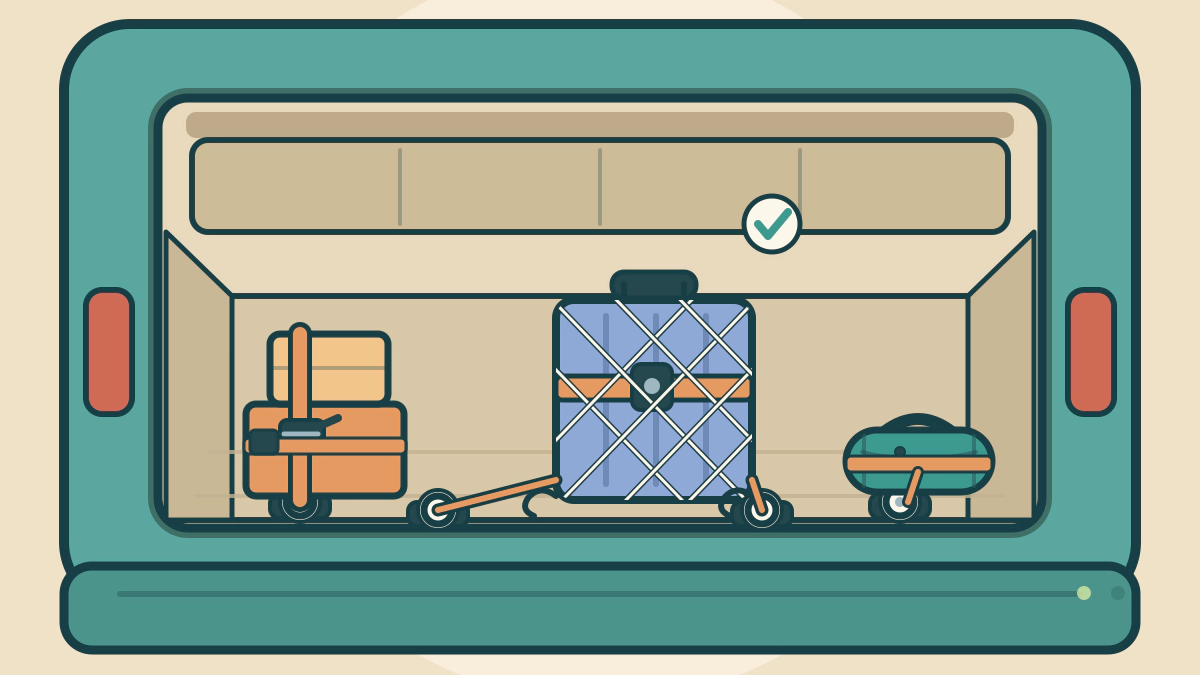
Load an SUV so luggage stays low and restrained, the seatbacks stay below their limit, and the tie-downs and airbag paths remain usable.
How should luggage be secured in an SUV?
Put luggage low, forward and restrained, and never stack it above the seatbacks. A packed cargo area is not a barrier. The seatback, the tie-downs and the airbag openings each have a job, and a load that covers or overloads them can turn into a hazard in a sudden stop.
Why an unsecured load is a hazard
NHTSA says about 850 people are killed and almost 19,000 more are injured each year in crashes involving objects in the road. All 50 states and the District of Columbia have laws about unsecured loads, and NHTSA’s guidance is to tie cargo down with rope, netting or straps, avoid excessive cargo and double-check the load.
Those figures are about objects in the road, not cargo inside a cabin. The same physics applies inside an SUV: a heavy case that is not restrained keeps moving when the vehicle stops.
The seatback is a barrier, not a shelf
The 2025 Subaru Outback owner’s manual is direct: never stack luggage or other cargo higher than the top of the seatback, because it could tumble forward and injure passengers in a sudden stop or crash. The manual also says to secure all objects, especially long items, so they are not thrown around.
A 2006 NHTSA denial of a petition describes sled tests at 48 km/h and 64 km/h with unrestrained simulated luggage. The petitioner’s video showed cargo hitting the seatback, a seat latch failing and the seatback moving forward. NHTSA denied the rulemaking and said five years of crash data found no matching case, but the test still shows why a seatback is not a cargo shelf.
Make sure the seatbacks are locked upright after you fold or return them. The manual says an unsecured seatback can fold down in sudden braking, and objects may move out of the cargo area.
Use the tie-downs within their rating
The Outback’s cargo area has several tie-down hooks for a luggage net or ropes. They turn down from storage recesses, and the manual gives a maximum load of 50 kg (110 lbs) per hook. The manual limits them to light cargo.
The rating is per hook, not per load. Four hooks do not automatically mean four times the capacity for one heavy item, because the load may not share equally. Check the owner’s manual for your vehicle; the number and rating vary by model. Roof rope hooks have their own marked limit.
Keep airbag paths and seat functions clear
Do not pack rigid items against the side trim where a side airbag deploys. Subaru’s cargo separator, a partition between the second row and the cargo area, is described as having open areas on both sides for proper airbag deployment. Any partition you add should do the same.
The separator listing also shows why accessories need reading: it is not for use with child seats that require tether straps, and it cannot be used with an installed cargo cover.
Load heavy items low and forward
Ford’s 2025 towing guide says to keep the center of gravity low and to secure the load so it cannot shift during cornering or braking. For an SUV, that means heavy cases go on the floor, ahead of lighter bags, and long items run along the floor with both ends restrained.
Distribute weight from side to side as well. Ford’s guide says a load should be balanced from side to side to optimize handling and tire wear.
A load plan for a family trip
| Load | Where it goes | What to check |
|---|---|---|
| Heavy suitcases and coolers | Cargo floor, toward the rear seat | Below the seatback top; within payload |
| Long items | Along the floor, both ends tied | Tie-down rating per hook |
| Small loose items | Closed bin or cargo net | Net or bin maker’s limit |
| Pet partition or cargo separator | Behind the second row | Airbag openings; tether and cover restrictions |
| Overflow gear | Roof rack or hitch carrier | The rack’s own load limit |
Payload is part of the same decision. Towing capacity versus payload capacity explains why passengers, luggage and tongue load share one limit. If the cargo area is the reason you are choosing a vehicle, how to rank SUVs by cargo usability and Acura MDX seating and cargo configurations show what to compare. More equipment guidance is in Car Accessories and Equipment.
Frequently asked questions
Can I stack luggage above the seatbacks if it is strapped down?
No. The vehicle manual says not to stack cargo higher than the seatback top, because it can tumble forward.
How much weight can the cargo tie-down hooks hold?
On the 2025 Subaru Outback, the manual gives 50 kg (110 lbs) per hook and limits the hooks to light cargo. Ratings differ by vehicle, so check your own manual.
Will a cargo separator protect passengers from luggage?
It can help keep cargo behind the second row, but only if it is fitted for the vehicle and does not block airbag deployment or a child-seat tether. Follow the separator maker’s fit instructions.
Should heavy items go on the roof instead?
Usually not. A roof load raises the center of gravity, and the manual warns that heavy roof loads make the vehicle more prone to tipping over. Keep dense, heavy items low inside the vehicle and use the roof for bulky, lighter gear within its limit.
Bottom line: Restraint matters more than packing order. Keep the load below the seatbacks, tie heavy items to rated points, leave the airbag paths open and recheck the load before you drive.