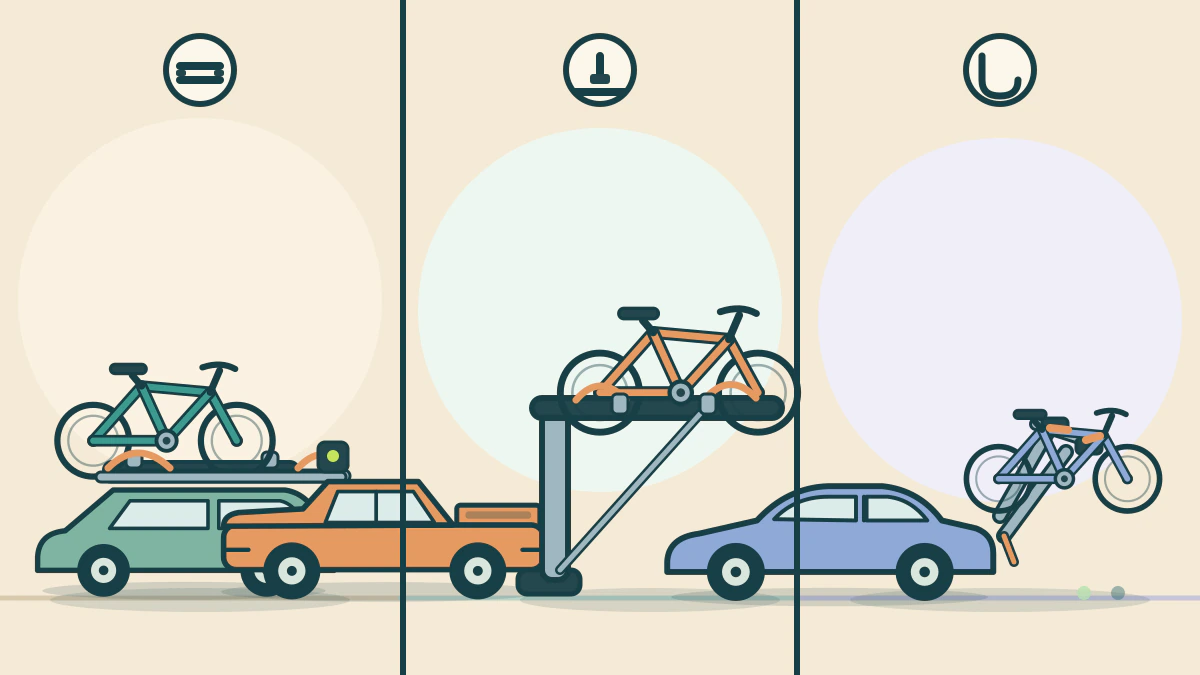
Compare roof, hitch and trunk bike racks by how they carry weight, which vehicle limit applies, and how to match a rack to your bikes.
Which bike rack type fits your car or SUV?
Roof, hitch and trunk racks all carry bikes, but they load the vehicle in different places, so each one is limited by a different rating. A roof rack adds weight high on the body. A hitch rack pushes down on the receiver. A trunk rack pulls on the lid or hatch with straps. The safe choice is the one whose weakest limit still covers your bikes.
Roof racks: the vehicle’s roof limit comes first
The 2025 Subaru Outback owner’s manual says the total weight of the crossbar attachments and the loaded cargo must not exceed 67.5 kg (150 lbs). That figure includes the carriers and the bikes. The manual also says the crossbars must never be used independently to carry cargo, and that heavy roof loads raise the center of gravity and make the vehicle more prone to tipping over.
Roof racks keep the hitch free and leave the rear hatch usable. They also add height, wind noise and a load that must be lifted overhead. A roof-mounted bike carrier sold for the Outback fits most 20 to 29 inch wheel bikes with tires up to 2.6 inches wide, according to Subaru’s accessory brochure. That is a fit statement, not a weight rating. On a tall SUV, lifting a heavy bike can be the practical limit before the scale is.
Hitch racks: check tongue weight and the receiver label
A hitch rack slides into a receiver and carries bikes behind the vehicle. Because it presses down on the hitch, its weight acts like tongue load. Ford’s 2025 RV and Trailer Towing Guide defines tongue load as the weight that presses down on the trailer hitch and includes it in the vehicle’s cargo weight. The guide sets 200 lbs as the maximum tongue load for trailers up to 2,000 lbs, 10 percent of loaded trailer weight for conventional trailers over 2,000 lbs, and 15 percent for fifth-wheel trailers. A hitch rack follows the same principle.
The rack has its own rating too. Subaru lists a two-bike hitch platform at 100 lbs total, a four-bike hitch rack at 150 lbs total, and a lighter two-bike rack at 70 lbs total. A 100 lb rack rating covers both bikes together. The receiver label is also part of the chain; Ford says the label affixed to the hitch receiver provides both its weight-carrying and weight-distributing capacities. Use the lowest of the vehicle’s tongue limit, the receiver label and the rack’s bike capacity.
E-bikes deserve a careful check. Subaru’s platform carrier is described as designed to transport e-bikes, but its two-bike rating is still 100 lbs total. Add the actual weights of both bikes and the rack itself. Do not assume the bike count fits.
Trunk racks: straps, body panels and line of sight
A trunk rack hangs from the trunk lid or hatch with hooks and straps. It needs no receiver and stores smaller than a roof or hitch rack, but it contacts painted panels and glass, and it can sit close to the rear window and lights. Follow the rack maker’s fit list and load limit, and check that straps do not pull on a spoiler, rear wiper, camera or sensor. You may also need to remove it to open the trunk or hatch fully.
Compare the three types
| Rack type | What carries the load | Main limit to check | Trade-off |
|---|---|---|---|
| Roof | Crossbars and roof rails | Roof limit, including bars, carriers and bikes | Keeps hitch free; lifting and height |
| Hitch | Receiver and hitch structure | Tongue weight, receiver label and rack rating | Easy loading; rear access can be blocked |
| Trunk | Straps and body panels | Rack maker’s fit list and load limit | No hitch needed; paint, glass and access concerns |
Secure the rack and the bikes before every trip
NHTSA’s guidance says to tie cargo down with rope, netting or straps, cover it where appropriate, avoid excessive loads, and double-check. Check the rack’s bolts or pins, bike arms and straps after loading. Subaru’s brochure tells buyers to check state law about license plate visibility and recommends roof carriers for solid disc wheels to avoid blocking taillights. Read the exact model year manual, because limits differ by model, trim and year. The towing capacity versus payload capacity guide explains why a hitch load uses payload; how to rank SUVs by cargo usability covers the vehicle side; more equipment guidance is in Car Accessories and Equipment.
Frequently asked questions
Can I carry an e-bike on a roof rack?
Only if the combined weight of the rack, the carrier and the bike stays under the roof limit. E-bike weights vary, so weigh the bike or use the maker’s figure.
Does a hitch bike rack count against tongue weight?
Yes. A hitch rack presses down on the receiver, so its loaded weight belongs in the same downward-load check as tongue weight. The vehicle’s tongue limit, the receiver label and the rack’s own rating all apply.
Are trunk racks safe on an SUV?
They can be, if the rack maker lists the vehicle and the straps fit without touching glass, spoilers, wipers or sensors. A trunk rack may not fit a large hatch or a spoiler, and it can limit rear access.
What is the most important number to check?
The lowest rating in the system. Compare the roof or tongue limit, the receiver label and the rack’s total bike capacity, then use the smallest figure. Bike count alone does not prove the rack is within its limit.
Bottom line: Match the rack to the mounting point, then add up every pound it puts on the vehicle. The lowest rating among the vehicle, the receiver and the rack is the one that decides whether the setup is safe.