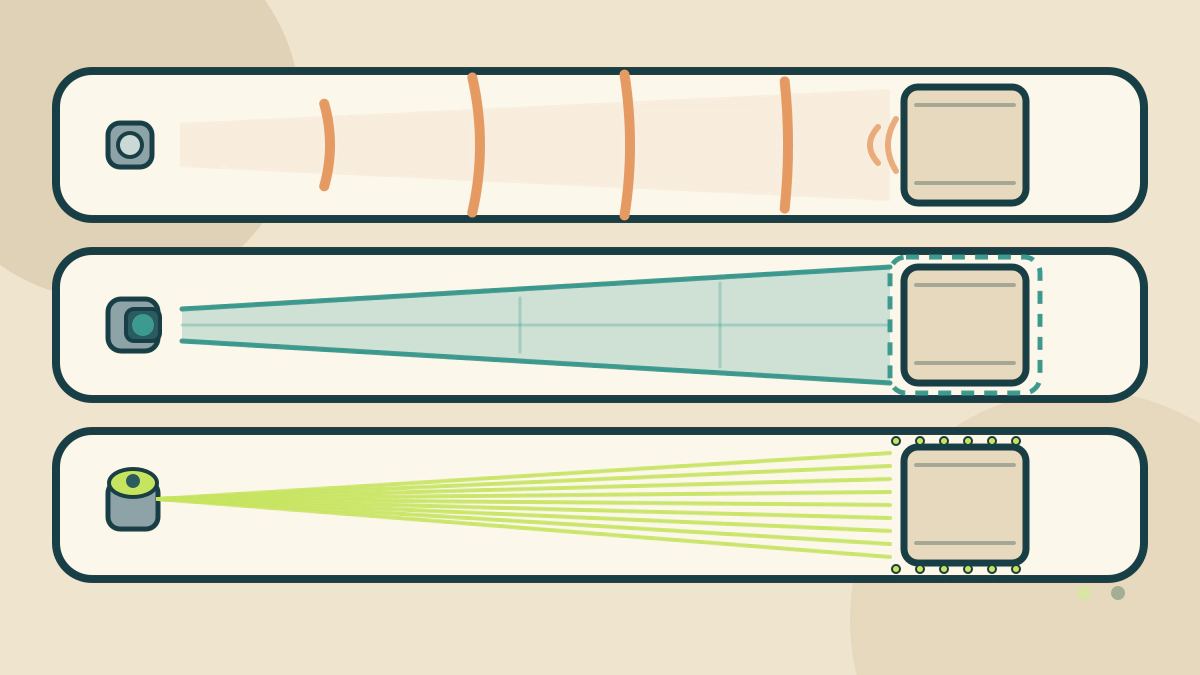
Cameras, radar and lidar sense the road in different ways. Compare what each measures, where it struggles and why cars combine them.
What is the difference between radar, camera and lidar?
Cameras capture visible-light images, radar measures radio-wave reflections, and lidar measures how long laser light takes to return. The three produce different data and fail under different conditions, which is why driver-assistance systems often combine them.
A NHTSA report on ADAS sensor degradation defines each type. Cameras are passive sensors that record light. Radar transmits radio waves and reads the reflection. Lidar emits light and measures time of flight to estimate distance.
IIHS makes the same point: front crash prevention can use cameras, radar or lidar to judge whether the car is getting too close to the vehicle ahead (IIHS advanced driver assistance).
What a camera contributes
A camera reads the scene in detail: lane markings, signs, vehicle shapes, taillights and pedestrians. That makes it the natural sensor for lane-keeping, sign recognition and many automatic-braking systems.
Mazda’s 2025 CX-5 manual lists one forward camera supporting high-beam control, driver attention alert, lane-keep assist, traffic-sign recognition, city braking, radar cruise control, traffic jam assist and smart brake support (Mazda forward camera).
The same manual lists the weak spots. The camera may struggle in rain, fog or snow, when the windshield is dirty, fogged or icy, when the vehicle ahead is very low, when headlights are off at night, in low sun or high beams, on sharp turns or steep slopes, and when the car is tilted by a heavy load.
The DOT report adds that camera performance depends on light passing through glass with minimal distortion. A chipped, dirty or poorly replaced windshield can degrade what the camera sees.
What radar contributes
Radar sends out radio waves and listens for returns. It measures distance and relative speed well, and it works in darkness because it does not depend on visible light. The DOT report notes that radar passes through plastic bumper covers that block cameras.
On the 2025 Mazda CX-5, the front radar sits behind the front emblem. It supports distance recognition, radar cruise control, smart brake support and traffic jam assist by detecting radio waves reflected off a vehicle ahead (Mazda front radar).
Radar has blind spots. Mazda warns that it may miss vehicles whose rear surfaces reflect radio waves poorly, such as an unloaded trailer, a load platform covered by a soft top, a hard plastic tailgate or a round-shaped vehicle. Low vehicles, heavy rain, snow, sandstorms, ice or dirt on the emblem, strong radio sources, curves, narrow lanes and very short gaps can also interfere.
The trade-off is resolution. Radar is good at answering “how far and how fast” and weaker at answering “what is it.”
What lidar contributes
Lidar uses light instead of radio. The DOT report describes it as an active sensor that emits a light pulse and measures the time of flight back to the source. That yields distance measurements and a detailed three-dimensional view of the surroundings.
Lidar has moved from test vehicles into more production platforms, but it is not universal. The DOT report describes it as entering production, while camera and radar remain primary in deployed driver assistance. IIHS lists it as one option for front crash prevention, not a requirement.
A lidar unit adds precise shape and position data. It does not replace the camera’s ability to read a sign or a lane marking, and it does not replace the driver.
Why cars combine sensors
| Sensor | What it measures | Strengths | Common limits |
|---|---|---|---|
| Camera | Visible-light images | Signs, lanes, object detail | Darkness, glare, dirty glass, weather |
| Radar | Radio-wave reflections | Distance and speed in dark or light | Poor reflectors, interference, low detail |
| Ultrasonic | Sound echoes | Close range at parking speed | Very short range, soft or thin objects |
| Lidar | Laser time of flight | Precise 3D shape and position | Cost, complexity, limited production use |
The 2025 Mazda CX-5 uses a forward camera, a front radar, rear radars, ultrasonic sensors and surround cameras across its assistance features. No single device covers every job.
Sensor fusion can also change how a car behaves when one sensor is degraded. The DOT report found that system response ranged from shutting a feature down, to reduced performance, to no visible impact, depending on redundancy and software.
What this means when you shop
Feature names vary by brand, and a “driver assistance” package may use different hardware by model year. Check the owner’s manual for the sensors your car has, what each feature can do and when it pauses.
Do not read “lidar” as a synonym for self-driving. NHTSA describes these systems as assistance for an attentive driver, not a replacement (NHTSA driver assistance).
For the limits of automatic braking, see automatic emergency braking limitations. For pedestrian detection, see pedestrian detection in modern cars. Older buyers can compare feature behavior in driver assistance features for older adults. The Car Technology and Electronics hub collects the wider set of guides.
Frequently asked questions
Is lidar better than radar and cameras?
Not in every way. Lidar offers precise three-dimensional measurements, radar measures distance and speed through darkness and some coverings, and cameras read signs, lanes and object detail. A good system combines their strengths.
Does my car have lidar?
Most current driver-assistance systems rely on cameras, radar and ultrasonic sensors. Lidar is entering production on more vehicles but is not standard across the market. Check the window sticker, the owner’s manual or the manufacturer’s specification.
Which sensor works best in fog or heavy rain?
None works perfectly. IIHS notes that sensors may not function well in low light or bad weather, and Mazda’s manual lists rain, fog, snow and road spray as limits for its camera and radar. The car may reduce or pause a feature.
Can these sensors see through dirt or damage?
No. A dirty windshield can block a camera, and ice, snow or dirt on the front emblem can affect radar. The DOT report found that road grime and improper repairs significantly reduced sensor range and returned signal quality. Keep sensor areas clean and have damage inspected.