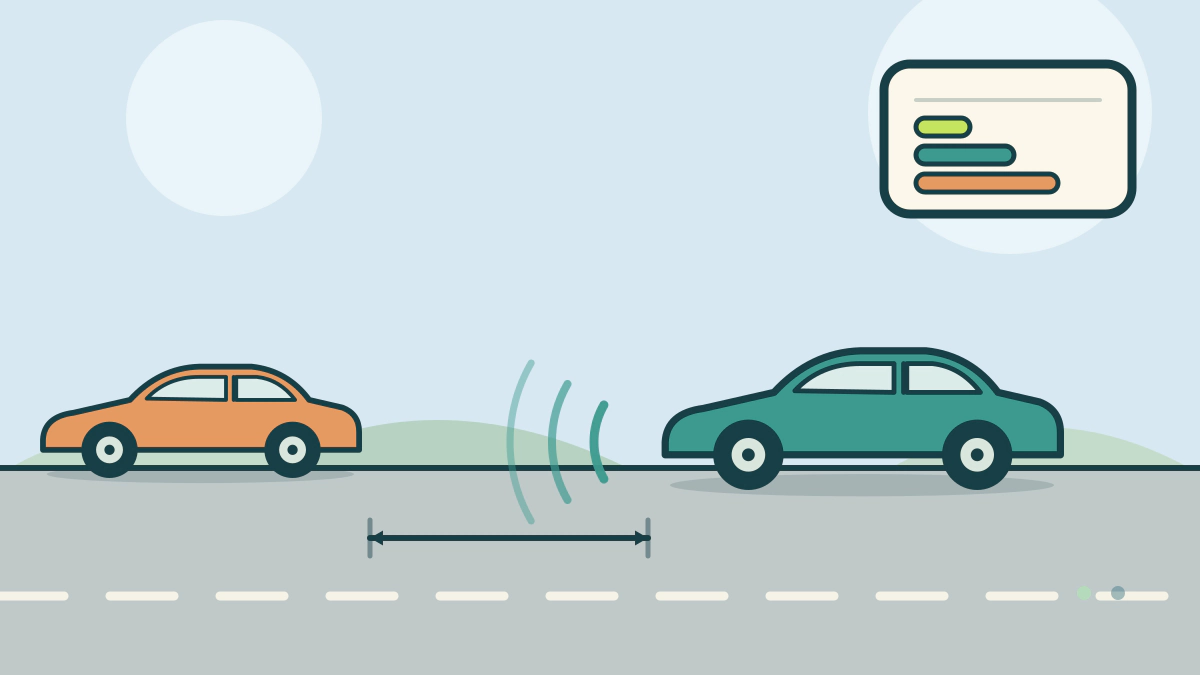
Understand what adaptive cruise control controls, how following-distance settings work in real numbers, and where the owner's manual says it can fail.
What does adaptive cruise control do?
Adaptive cruise control holds a speed you set and adjusts it to keep a chosen gap behind the vehicle ahead; it does not steer, and the driver remains responsible for the lane, the speed limit and anything the system misses. NHTSA’s description is close to that: the system adjusts speed to keep a preset distance to the car in front. That makes it a convenience function, not a collision-avoidance guarantee.
This is one of several driver aids covered in the Car Technology hub, and it differs from the simpler cruise control covered in how to use cruise control efficiently.
What the system controls and when it operates
On a 2024 Kia Telluride, Smart Cruise Control uses a front camera and front radar, plus corner radar on some versions. The manual says it detects the vehicle ahead and maintains the desired speed and minimum distance.
The driver sets three things: the speed, the headway distance, and on some cars the acceleration and reaction behavior.
Kia lists the conditions on its operating conditions page. The gear must be in D. With no vehicle ahead, the set speed range is about 5 to 120 mph. With a vehicle ahead, it can work from 0 to 120 mph. It will not operate if the driver’s door is open, the parking brake is applied, or stability control and anti-lock braking are actively intervening.
Pressing the driving assist button sets the current speed. If you press it between 0 and 20 mph, Kia says the set speed becomes 20 mph.
What the distance settings mean
The gap is not a fixed number of car lengths. Kia publishes approximate distances at 56 mph on its distance settings page:
| Setting | Approximate gap at 56 mph |
|---|---|
| Distance 4 | 172 ft (52.5 m) |
| Distance 3 | 130 ft (40 m) |
| Distance 2 | 106 ft (32.5 m) |
| Distance 1 | 82 ft (25 m) |
Kia says the system keeps the last distance setting after a restart or after a temporary cancel. A close setting saves space in traffic but leaves less room to react. In rain or poor visibility, the larger setting is the better starting point.
Stop and go, cancel and resume
In traffic, Kia says the vehicle stops if the car ahead stops and starts again when it moves. After the vehicle has been stopped for a certain time, a message asks the driver to press the accelerator or a switch to start moving.
Where adaptive cruise control gets into trouble
The manual’s limitation list is long and worth reading in full. The short version: curves, cut-ins, stopped or slow vehicles, motorcycles and bicycles, pedestrians, animals, heavy rain, snow, fog, low sun, dirty sensors and construction zones all reduce performance.
On a curve, Kia warns that the system may not detect a vehicle in the same lane and may accelerate to the set speed. A vehicle in the adjacent lane can also cause an unnecessary slowdown. When a car cuts in, detection may be late until it is fully inside the sensor’s view.
The collision warning has limits too. Kia says it may not warn when the front vehicle is very slow or stopped, or when the distance is already short. The driver has to watch the road, not the gap display.
It is not self-driving
IIHS’s safeguard ratings add a useful rule for shoppers: a good system should not resume automatically after a lengthy stop or when the driver is not looking at the road. The same page says there is no evidence that partial automation makes driving safer. That is a design choice, and it shows why two cars with the same feature name can behave differently. For the wider distinction, see driver assistance versus self-driving.
How to use it without trouble
Set a speed at or below the limit. Leave a larger gap than usual in rain. Keep a foot ready near the brake in traffic. Cancel before exits, toll booths and construction zones. Clean the camera and radar areas, and read the section in your own manual, because the button logic varies by brand.
Frequently asked questions
Does adaptive cruise control steer the car?
No. It controls speed and following distance only. Lane keeping or lane centering is a separate system, and even then the driver must steer. Kia’s manual says Smart Cruise Control does not substitute for safe driving.
Does it work in stop-and-go traffic?
When following a vehicle that stops, the Telluride stops too and can move again when that vehicle moves. After a longer stop it asks the driver to press the accelerator or a switch. Do not treat that behavior as a guarantee at every light or crossing.
Why does the car slow down when the lane ahead is clear?
A curve, a guardrail or a vehicle in the adjacent lane can confuse the radar. Kia warns about both. The system may also react to a car that is merging or drifting near your lane. Take over if the behavior does not match the road.
Does adaptive cruise control replace the driver?
No. It adjusts speed and following distance only, and Kia’s manual says Smart Cruise Control does not substitute for safe driving. The driver must watch the road and be ready to brake when the system misses a stopped vehicle or a cut-in. Lane keeping is a separate system.