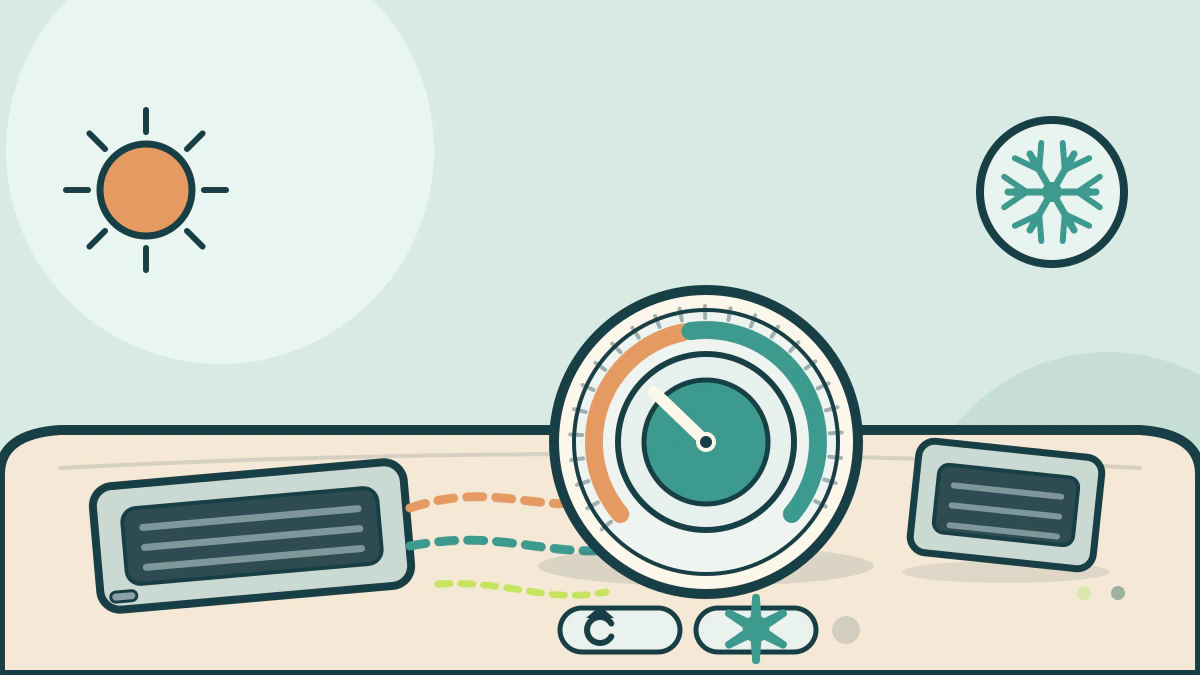
Learn how automatic climate control uses a setpoint and sensors to hold cabin temperature, and why the fan, vents and defogger behave as they do.
What automatic climate control actually controls
Automatic climate control holds the cabin near a temperature you set by changing fan speed, airflow direction, air intake and air conditioning for you.
In a Kia manual, pressing AUTO hands the modes, fan speeds, air intake and air conditioning to the system once you set a temperature. Touching the fan, mode, A/C or defrost control takes that one function back to manual while the rest stay automatic. Read the Kia automatic operation page for the exact sequence.
Honda describes the same idea in different words. Its system selects the mix of heated and cooled air that raises or lowers the interior temperature as quickly as possible. See the 2025 Pilot manual.
That is the real difference from a manual system. A manual system gives you a blend and a fan speed. An automatic system gives you a target and adjusts the parts itself.
The setpoint is a target, not a vent temperature
The number on the dial is what the system aims for in the cabin. It is not the temperature of the air leaving the vents.
Kia’s temperature control page says the setting moves in 1°F steps, or 0.5°C in Celsius, between Lo and HI. At the lowest setting the air conditioning runs continuously. Kia also suggests 72°F (22°C) with AUTO for effective climate control.
So 72 on a cold morning does not mean 72-degree air from the vents. It means warm air first, then less warm air, until the cabin approaches 72.
The sensors behind the setting
| Sensor or input | What it tells the system | Typical effect |
|---|---|---|
| Interior temperature sensor | How warm or cool the cabin is | Raises or lowers fan speed and blend |
| Sunlight sensor | How much sun is loading the cabin | Adds cooling when the cabin is sunlit |
| Outside temperature | How cold or hot the outside air is | Limits cold-air blow at startup and aids defrost |
| Humidity or moisture sensor | Whether the windshield is fogging | Switches to defrost, fresh air and A/C |
| Setpoint | The temperature the occupant chose | The target for all of the above |
Honda locates a sunlight sensor in the top of the dashboard and a temperature sensor next to the steering column. Its sensor page says not to cover them or spill liquid on them.
Honda’s feature page adds that navigation-equipped models can use GPS to track the sun’s position and adjust for it.
Hyundai’s auto defogging system senses moisture at the inside of the windshield. Below 14°F (-10°C) it may not work normally. The manual says not to remove the sensor cover at the top of the glass.
Kia’s warning is simpler. Never place anything over the sensor on the instrument panel. A phone, a clip-on air freshener or a stack of papers can sit right where the system samples the cabin.
Why the fan runs hard, then calms down
At startup the cabin is far from the setpoint, so the system uses a large temperature difference and a high fan speed. As the cabin approaches the target, it reduces both.
Honda notes one deliberate exception. In cold weather the fan may not start immediately when AUTO is pressed, to avoid blowing cold air on the occupants.
Air conditioning is not only for hot weather. Running it with fresh air helps dry the cabin and clear the windshield, which is why automatic defog routines switch the compressor on.
What it does not do, and what it costs
- It cannot fix a restricted cabin filter or a weak blower. If airflow drops at every setting, check the filter. See when to change a cabin air filter.
- Air conditioning still costs fuel. DOE and EPA say it can cut a conventional car’s fuel economy by more than 25% in very hot conditions, especially on short trips. See Fuel Economy in Hot Weather.
- An automatic defog routine can override your fan and recirculation settings while it clears the glass.
DOE’s advice is to air out a hot cabin first and avoid idling with the A/C before driving. Most A/C systems cool faster while the car is moving.
For plug-in hybrids and EVs, pre-cooling or preheating while still plugged in can extend range, because the cabin is conditioned from the grid rather than the battery. See EV battery preconditioning.
When the system seems wrong
A few symptoms point to sensors rather than mechanics. If one side stays cold and the other hot in a dual-zone car, a blend door or sensor may be at fault.
Do not remove sensor covers or dash panels to test a theory. Hyundai warns that damage to the sensor cover may not be covered by warranty.
Start with the simple checks. Clear anything sitting on the dash sensor, replace a clogged cabin filter, and confirm the system is not in manual mode. If the problem remains, a shop with manufacturer service information can read the climate-control codes. The Car Technology hub covers related features.
Frequently asked questions
Does a higher setting make the car heat faster?
No. A higher number moves the target, not the maximum output. The system already uses full heat when the cabin is far below the setpoint.
Why does the fan blow cold air at first in winter?
The heater core needs engine heat before it can warm the air. Kia advises lowering the blower right after a cold start and raising it after a few minutes, and Honda says the fan may delay starting for the same reason.
What is the difference between AUTO and manual A/C?
AUTO lets the system choose fan speed, airflow, intake and compressor operation for your setpoint. Manual mode fixes the function you touch while the rest may stay automatic, depending on the model.
Why does automatic climate control fog the windows?
Recirculation traps moisture from passengers and wet clothing. Honda recommends fresh air in normal use, and the defrost control runs the A/C to dry the air before directing it at the glass.