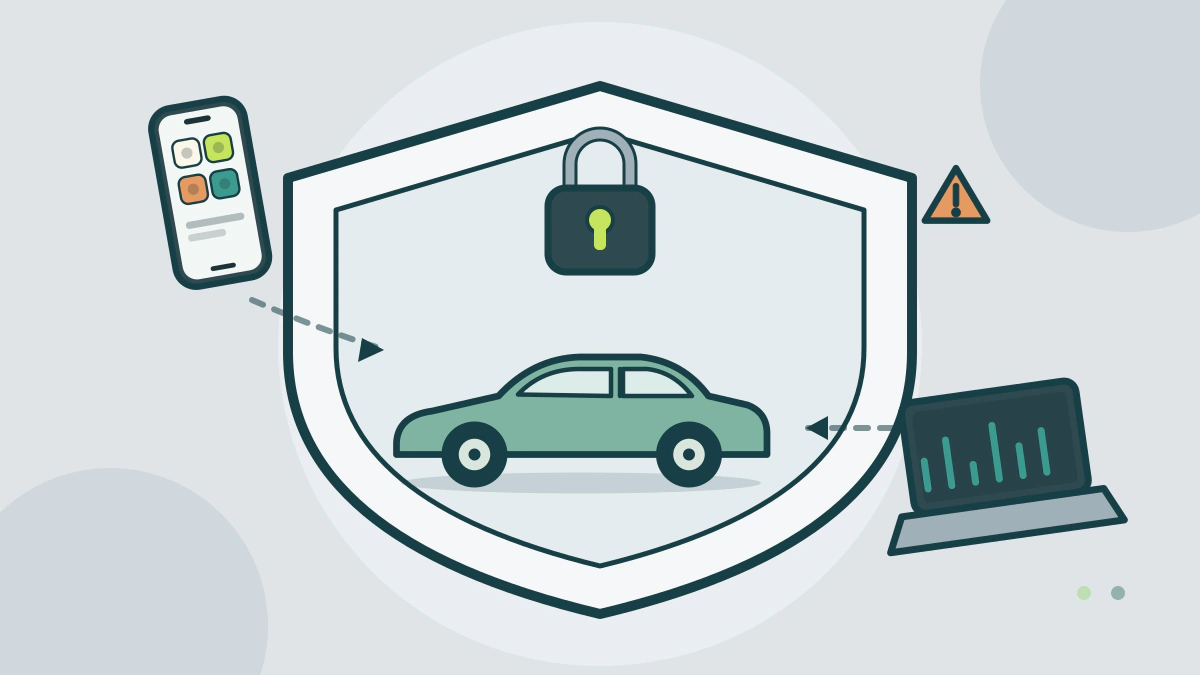
Understand the realistic cyber risks in a connected car, from keyless relay theft and data collection to accessory ports and delayed software updates.
How likely is a hacker to take over your car?
Remote, movie-style takeover is not the everyday risk. The realistic threats are data collection, keyless relay theft, insecure accessories and software that lags behind known fixes. Modern cars are computers on wheels, and most problems look like ordinary computer problems.
That framing helps. You already know not to plug an unknown drive into a laptop or ignore updates for years.
A car adds a safety dimension. Brakes, steering and driver assistance depend on electronic systems, so a security failure can become a crash risk, not just a privacy annoyance.
What NHTSA means by layered vehicle security
NHTSA’s vehicle cybersecurity page says the agency promotes a multi-layered approach that focuses on a vehicle’s entry points, both wireless and wired. It describes four elements: protecting safety-critical control systems, detecting and responding to incidents quickly, designing systems that recover from an attack, and sharing information across the industry.
That is guidance for manufacturers, not a set of consumer rules. NHTSA’s 2022 best practices are voluntary, and the agency says they cover topics such as over-the-air updates and aftermarket devices.
The practical message for a driver is that security is spread across many layers. No single app or setting protects the whole car.
The risks a driver can act on
| Risk | How it works | What helps |
|---|---|---|
| Keyless relay theft | Two devices extend a fob signal to the car | Signal-blocking pouch, motion-sleeping fob, steering lock |
| Aftermarket dongle | A plug-in device talks to the diagnostic port or app | Buy from established vendors; remove devices you do not use |
| Unknown USB device | A data-capable port accepts more than power | Use your own cable and a charging adapter you trust |
| Public Wi-Fi or Bluetooth | An open network or paired device can expose data | Turn off unused radios; avoid sensitive logins on public links |
| Fake app or message | A lookalike app or renewal notice harvests credentials | Download from official stores; contact the maker directly |
| Delayed updates | Known flaws stay open when software is old | Install manufacturer updates; check recalls by VIN |
Keyless relay theft is the most concrete example. The relay attack guide explains how the signal is extended and why layers such as a pouch and a sleeping fob matter.
The diagnostic port deserves respect. A device that reads fault codes can also send commands on vehicle networks. That makes unknown bargain dongles a poor bet.
USB ports vary. Some provide power only; others carry data. Treat a data-capable port as you would any public computer port, and use your own charging adapter when in doubt.
Data collection is a security issue too
Connected cars log location, speed, braking, trips and sometimes camera or biometric data. The FTC’s technology blog on car data says such data can be sensitive and that its collection and disclosure can threaten privacy and finances.
In January 2026 the FTC finalized an order with General Motors and OnStar. The agency alleged that precise geolocation and driving behavior data was collected and sold without adequate notice or consent. The order requires affirmative consent, data access and deletion, and a way to disable precise geolocation collection where the technology allows.
That is one case, not a verdict on every brand. The lesson is to read the privacy notice, check app permissions and look for data-sharing controls in the car and the phone app. The connected-car subscription guide covers how a paid plan can broaden that collection.
Updates, recalls and software
Software fixes arrive in two main ways: at a dealer or service center, and over the air through the car’s modem. Both depend on the manufacturer actually issuing the fix and the owner accepting it.
Install updates when the car is parked and charged, and do not interrupt the process. A failed update can leave a module offline, which is a separate problem from an attack. Follow the screen prompts and the owner’s manual rather than guessing.
Recalls are the other channel. A safety recall may include a software remedy, and the repair is free. Check your VIN at NHTSA’s recall lookup and act on notices.
Be skeptical of anyone who contacts you about a “security update” and asks for payment or a code. Manufacturers do not need your password to install a recall remedy.
A short owner checklist
- Install manufacturer software updates promptly.
- Keep the key fob in a signal-blocking pouch at home.
- Remove unknown diagnostic dongles and accessories.
- Review the car app’s permissions and data-sharing settings.
- Check for open recalls by VIN twice a year.
- Use a known cable and avoid unknown USB devices.
If you suspect a safety-related defect, report it to NHTSA. Security researchers have a separate vulnerability disclosure route through the Department of Transportation.
No checklist makes a car immune, and no driver can audit its code. The aim is to reduce the easy paths and to keep the software current.
Frequently asked questions
Can someone hack my car through my phone?
A phone connection is one entry point among many. The bigger everyday risk is data collection through the car’s own apps. Keep the phone updated and review app permissions.
Is keyless entry always unsafe?
No, but keyless systems are exposed to relay attacks. A fob that sleeps when still, a signal-blocking pouch and a steering lock each raise the effort required. Use more than one measure.
Do over-the-air updates improve security?
They can, by delivering fixes without a dealer visit. They also depend on the manufacturer issuing the update and the owner installing it. Never interrupt an install.
Should I use a public Wi-Fi network in the car?
Prefer your phone’s own connection or a trusted network. Public Wi-Fi can expose logins and data, and a car hotspot is only as secure as its configuration. Avoid banking or account changes on an open network.
Bottom line: the useful defenses are boring ones: current software, known accessories, careful pairing and a clear view of what the car collects.