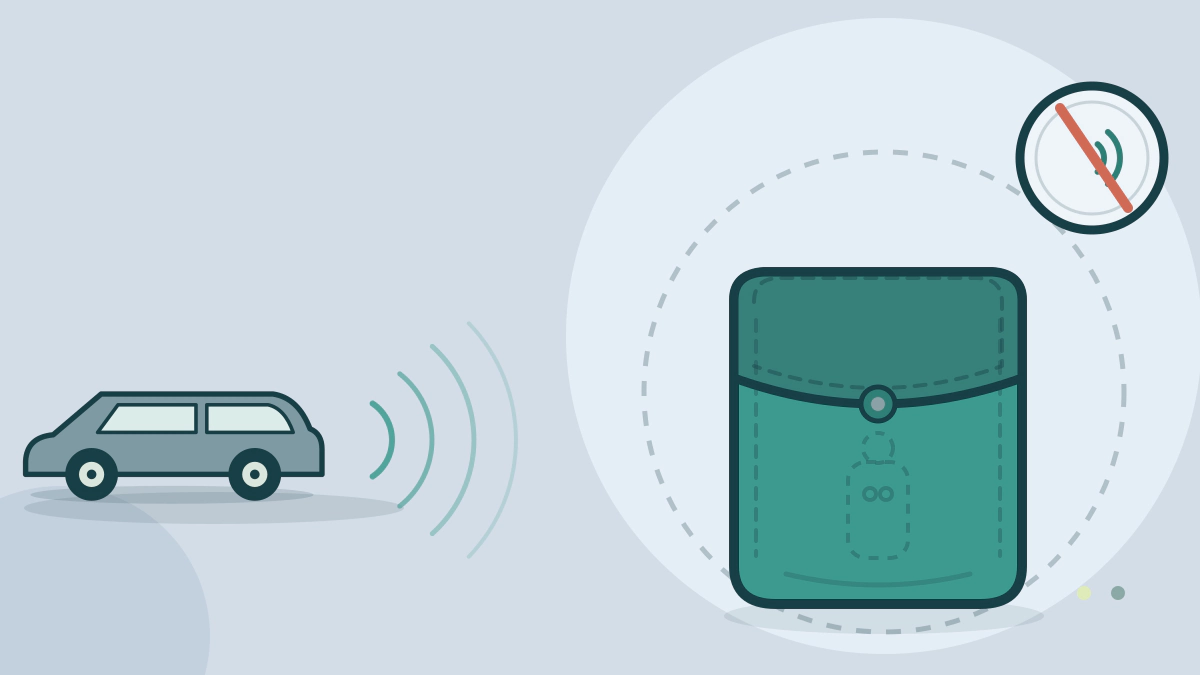
See how a relay attack extends a key fob signal to open and start a keyless car, and which countermeasures actually interrupt the chain.
How a relay attack steals a car without the key
A relay attack uses two devices to extend the reach of a keyless fob, so the car believes the key is right beside it. One device picks up the fob signal near the house. The other repeats it at the car.
Zurich Insurance describes two thieves working together. One stands near the building with a device that grabs the fob signal from inside. The signal is amplified and passed to a second device at the car, which unlocks and can be started. Read Zurich’s account.
AAA’s insurance page says the common method uses an antenna to pick up the fob signal, amplify it, and unlock and start the car at a distance where the key would not normally work. It can take less than 60 seconds and works best when the fob sits near an exterior door.
The car is not being hacked in the usual sense. It receives a valid answer over a longer path, so the unlock can look like a normal owner action.
Why push-button start changes the risk
Any car that unlocks and starts on proximity is a candidate.
The Insurance Institute for Highway Safety’s research arm found a sharp break in one model’s theft data. Theft claim frequency for 2016-24 Chevrolet Camaros, which have keyless push-button start, peaked at 18.3 claims per 1,000 insured vehicle years in March 2024. Cars from 2010-15 with keyed ignition sat near 1.3. See the IIHS news summary.
That does not prove every one of those thefts was a relay attack. It does show that entry and start hardware changes the risk picture. Keyless entry alone gets a thief inside. Keyless ignition lets them drive away.
The countermeasures that break the chain
| Measure | What it does | How to check it |
|---|---|---|
| Fob sleep or battery-saving mode | Stops the fob from receiving radio waves, so it cannot answer a challenge | The key indicator flashes as the manual describes; any key button cancels it |
| Faraday pouch or sealed metal box | Blocks the radio path between the fob and a relay device | Seal the fob inside, sit in the car, and try to start |
| Distance from the car | Keeps the fob out of reach of a device at the wall | Toyota says keep it more than 6 ft (2 m) from the vehicle |
| Passive entry off | Requires a deliberate unlock instead of automatic detection | Tesla: Controls > Safety > Passive Entry |
| PIN to drive | Adds a code after entry, so a relayed start is not enough | Tesla: Controls > Safety > PIN to Drive |
| Motion-based sleep | The fob stops responding after it has not moved | Kia: the detection function pauses; lift the key to wake it |
Toyota’s 2023 Corolla manual describes battery-saving mode. The fob stops receiving radio waves, and while the mode is set the smart key system cannot be used. Pressing any key button cancels it. The same page says not to leave the electronic key within 6 ft (2 m) of the vehicle and notes that the smart key system can be deactivated in advance.
Kia’s smart key page describes a related behavior. If the key is not moved for some time, the detection function pauses, and lifting the key activates it again.
Tesla’s support page lists two separate settings. PIN to Drive requires a four-digit code before the car can be driven. Require Manual Entry disables passive entry, so an authenticated phone key no longer unlocks the doors as you approach.
AAA recommends a signal-blocking bag made of conductive metal mesh. It also gives a practical test. Sit in the driver’s seat, seal the fob in the bag, and try to unlock or start the car. If the car responds, the bag is not blocking the signal.
Layering beats one gadget
A pouch only works while the fob is inside it. A sleeping fob only works until someone presses a button. A driving PIN covers the gap after entry, but it does not stop a thief from getting into the car.
That is why the useful approach is layered. Keep the fob sealed or asleep at home. Keep it away from exterior walls and the front door. Use the vehicle’s own settings to require a deliberate unlock or a PIN. Add a visible steering-wheel lock if the car is high risk.
Zurich also suggests an OBD lock to block the diagnostic port. That addresses a different path: programming a new key through the port instead of relaying the existing one.
The Car Technology hub covers related features. If a fob stops working entirely, see how to replace a key fob battery. If the car still will not start, see car won’t start but lights come on.
Habits that quietly undo the protection
- Leaving the key on a hook beside the front door. AAA ties higher risk to fobs stored near the car.
- Using a pouch that is not fully sealed, or one that has worn through.
Frequently asked questions
Can a relay attack start the car or only open it?
It can do both when the car has keyless ignition. Once the car accepts the relayed signal, the start button works and the thief can drive away.
Does a Faraday pouch stop keyless theft completely?
Only while the fob is sealed inside and the pouch still blocks radio signals. It does nothing when you carry the key, so pair it with a PIN.
Do all keyless cars have a battery-saving or sleep mode?
No. Toyota documents a battery-saving mode, and Kia documents a pause when the key has not moved, but other brands may not offer either. Search your owner’s manual for “battery-saving” or “key sleep.”
Is a steering wheel lock worth adding to a keyless car?
It does not prevent entry, but it adds time after entry. Use it as one layer beside a sealed fob and a driving PIN.