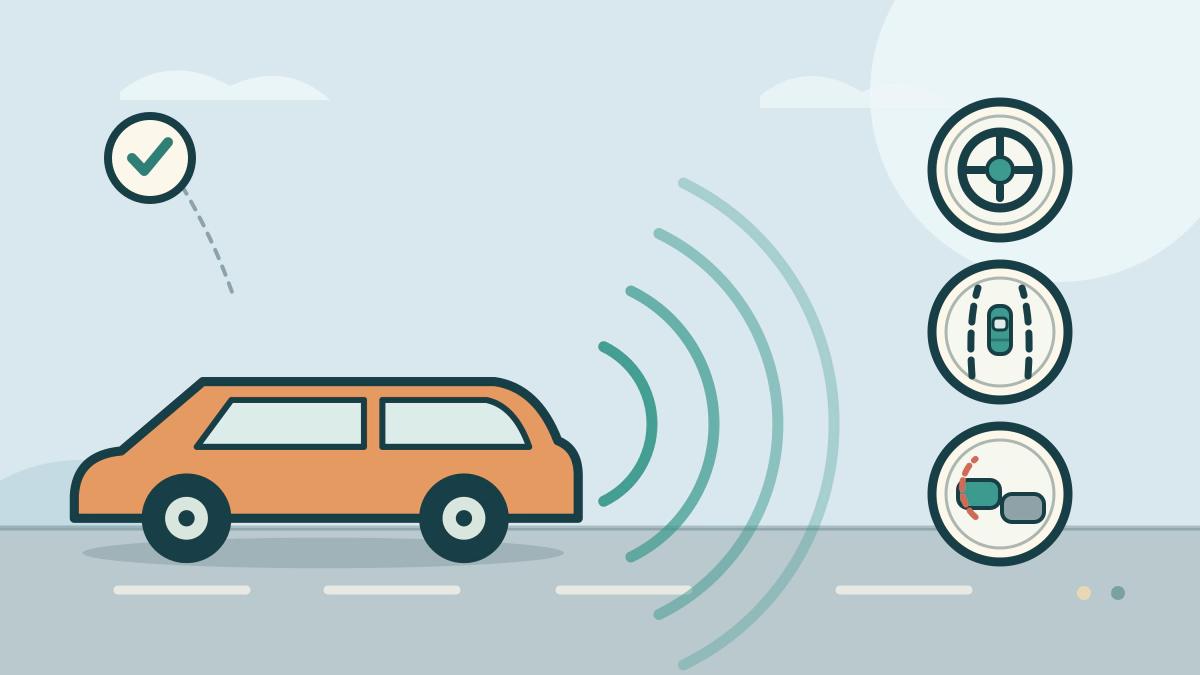
See which driver assistance systems fit older drivers' crash patterns, what IIHS and NHTSA say, and where each aid still fails.
Which driver assistance features matter most for older adults?
Look first at features that address the situations where older drivers are more likely to have certain crashes: intersections, merging and lane changes. Backing aids also matter because IIHS finds them especially effective for drivers 70 and older. IIHS reports that functional impairments can become especially evident when turning left, merging or changing lanes (IIHS older drivers).
Not every older driver has those impairments. NHTSA says age alone should not decide driving ability. The point is to match a feature to a documented crash pattern, then learn where it stops working.
Match the aid to the crash pattern
IIHS data show that among passenger vehicle drivers in fatal crashes in 2024, multiple-vehicle crashes at intersections accounted for 43 percent of crashes for drivers 80 and older, compared with 24 percent for drivers 16 to 59. IIHS notes that failure to yield the right of way is the most common error by senior drivers in crashes.
| Crash situation | Feature to look for | What it does | Where it stops |
|---|---|---|---|
| Rear-end crash risk | Forward collision warning and automatic emergency braking | Warns, then brakes if the driver does not | May not detect every object or condition; the driver must still respond |
| Lane change or merge | Blind spot warning | Alerts when a vehicle is in a monitored zone | Limited coverage; it does not clear the lane |
| Unintended drift | Lane departure warning and lane keeping assistance | Warns or applies steering to return to the lane | Depends on visible lane markings |
| Backing | Rearview camera, rear cross-traffic warning and rear automatic braking | Shows the area behind, warns of crossing traffic, can brake | The camera does not show everything; look and use mirrors |
| Night driving | Automatic high beams | Switches between high and low beam | Sensors can be fooled; the driver must still watch |
NHTSA describes each system and notes which only warn and which can act (NHTSA driver assistance technologies). A warning system does not brake for you.
What the evidence says for older drivers
IIHS reports that front crash prevention, blind spot detection and lane departure warning have each been shown to reduce crashes. Combined, the three might be relevant to up to a fifth of older drivers’ annual crash involvements, 18 percent of their injuries and a quarter of their fatalities.
Highway Loss Data Institute studies found lower claim rates for all age groups with front crash prevention and lane departure warning, but drivers under 65 benefited more than those over 65. A system that warns in a way a driver misses, or that arrives on a vehicle the driver does not understand, will not deliver the full benefit.
Rearview cameras and rear parking sensors have been shown to be especially effective for drivers 70 and older in preventing police-reported backing crashes, IIHS says.
Why the newest car is not automatically the safest for you
IIHS notes that older drivers tend to drive older vehicles that are less likely to have side airbags with head and torso protection. That is an argument for checking the model year and standard equipment, not just the badge.
But a newer vehicle with a screen full of menus can add distraction. AARP’s safety-feature guide adds that new owners need time to learn how each system works and what its warnings mean (AARP). Practice before trusting a warning in busy traffic.
The limits that do not disappear
NHTSA is clear that a backup camera is not a replacement for mirrors or turning around to look. It also says forward collision warning and lane departure warning only warn; they do not take action.
IIHS research found that inadequate surveillance, including looking but not seeing, was the most frequent error by crash-involved drivers 70 and older. A sensor can watch a zone, but it cannot restore a driver’s scan pattern. That is why blind spot monitoring cannot replace mirror checks and why assistance is not self-driving; the difference is explained in driver assistance versus self-driving.
How to set up and practice a system
Start with the owner’s manual. Find the section for each feature and learn the warning display, the sound, the sensitivity setting and the conditions that disable it. NHTSA tells buyers to review the manual for the vehicle’s technology.
Then test the feature deliberately. In an empty parking lot, note how the warning appears before a stationary object. On a quiet road, learn how lane departure warning reacts to a marked edge. In a driveway, check the camera view and the rear cross-traffic alert with a passenger helping.
Ask the dealer whether software updates are included and whether any feature requires a subscription after a trial. Confirm that the settings you choose stay set after the car is restarted. The family and accessible vehicle hub and the car features guide for older drivers cover the seat, visibility and access items that matter alongside these systems.
Frequently asked questions
Do driver assistance features replace the need for good vision?
No. They add information or a brief intervention, but the driver still has to see the road, read signs and judge gaps. NHTSA recommends correct glasses or contact lenses when driving.
Is automatic emergency braking the same on every car?
No. Systems differ in which objects they detect, how early they warn and whether they can brake at low speed. NHTSA explains the general function, but the owner’s manual for the specific model gives the limits.
Should an older driver turn off lane keeping assistance?
Only if the system’s steering correction is confusing or unwanted. If you turn it off, you take back the full steering task. Practice with it on a quiet road first and read the manual before changing the setting.
Can these features lower insurance costs?
Some insurers offer discounts for vehicles with certain safety systems, but the rules vary by company and state. Ask for a quote with the specific vehicle identification number rather than assuming a feature will reduce the premium.