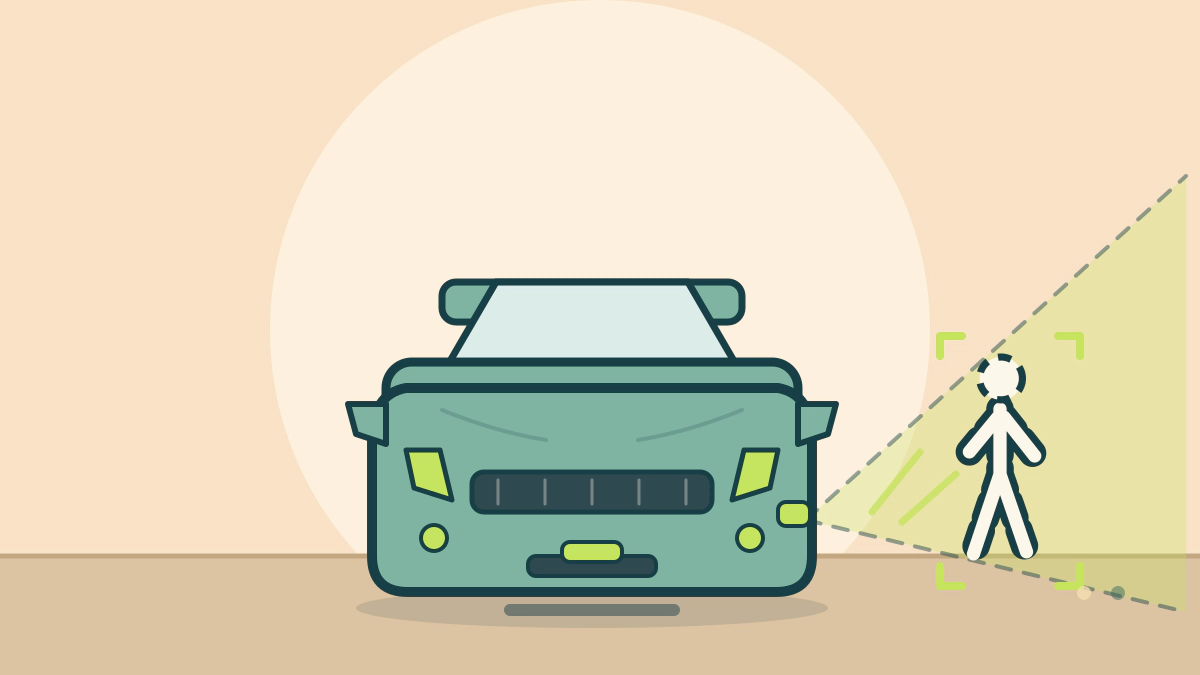
Pedestrian detection uses cameras and radar to warn or brake for people in the car's path, but crash data shows the benefit shrinks sharply at night on unlit roads.
What pedestrian detection can and cannot see
Pedestrian detection uses forward-facing cameras and radar to warn you about a person in the car’s path, and many systems brake automatically, but its benefit drops sharply in the dark and on roads without streetlights. The technology supplements your eyes; it does not replace them.
NHTSA describes pedestrian automatic emergency braking as a system that uses forward sensors to detect a pedestrian in the path and applies the brakes if the driver has not acted (NHTSA driver assistance technologies). The wording is important: the system acts when the driver has not.
How a car decides that a person is in its path
Camera-based systems look for the shape, size and motion of a person. Radar adds distance and closing speed. The car compares what it senses with what it expects and decides whether a collision is likely.
A pedestrian who steps out from between parked cars gives the system very little time and very little visible shape. NHTSA lists a pedestrian darting or stepping out mid-block as one of the common crash types between pedestrians and cars (NHTSA pedestrian safety).
The test scenarios that set the benchmark
IIHS evaluates pedestrian front crash prevention with an adult and a child dummy in three scenarios. A child crosses in daylight at 12 and 25 mph with parked vehicles blocking the view. An adult crosses in the dark at 12 and 25 mph. An adult walks along the lane in the dark at 25 and 37 mph (IIHS pedestrian test).
| Scenario | Speed tested | Lighting | Why it is included |
|---|---|---|---|
| Child crosses from between parked cars | 12 and 25 mph | Daylight | Short dummy and a blocked view |
| Adult crosses the road | 12 and 25 mph | Dark | Common crossing crash |
| Adult walks along the lane | 25 and 37 mph | Dark | Same-direction walking crash |
| Federal pedestrian AEB requirement | Above 6.2 and below 45.3 mph | Day or dark, clean dry track | Minimum legal performance |
The table also shows what the benchmark leaves out. The IIHS runs stop at 37 mph, there is no rain or snow, and the dummies are standard adults and children. The federal rule goes to 45.3 mph, but it tests on a clean, dry surface with no precipitation or fog (same rule).
What the crash data says
IIHS reports that vehicles with automatic braking that detects pedestrians had a 27% lower rate of pedestrian crashes than vehicles without the technology. Injury crash rates were 30% lower (IIHS pedestrians and bicyclists). Those are meaningful reductions across a large population of vehicles.
The same research found no difference in crash risk at night on roads without streetlights. That is the clearest limit in the data. The feature helps most where there is light and contrast, and it can add little where a person is hardest to see.
Why speed and vehicle shape still dominate
Pedestrian risk rises steeply with impact speed. IIHS cites an average serious-injury risk of 18% at 20 mph, 32% at 25 mph, 67% at 35 mph, 90% at 45 mph and 97% at 55 mph. A system that shaves a few miles per hour can still help, but it cannot turn a 45 mph impact into a 20 mph one.
Vehicle shape matters as well. IIHS found that vehicles with hoods more than 40 inches off the ground were about 45% more likely to cause pedestrian fatalities than vehicles with hoods under 30 inches and sloped front ends. Taller, blunter front ends also knock people down and run them over more often.
What the driver still controls
Detection cannot compensate for speed, glare, a dirty windshield or a sensor that is out of calibration. Keep the area in front of the camera clean, repair windshield damage, and have the system checked after glass or bumper work.
NHTSA’s pedestrian guidance still asks drivers to slow down, watch for pedestrians everywhere, and take extra care at night or in bad weather (NHTSA pedestrian safety). The practical rule is to drive so you could stop for what you can see, not for what the car might detect.
The related AEB limitations article covers the speed and weather boundaries in more detail. For the rear blind spot, see rear cross-traffic alert. The Car Safety and Recalls hub collects the wider set of safety guides.
Frequently asked questions
Does pedestrian detection work in the dark?
It can, but the benefit is smaller. IIHS found no reduction in pedestrian crash risk at night on roads without streetlights, even though the same systems reduced crashes overall. Headlights, street lighting and bright clothing all change what the camera sees.
Can pedestrian detection see a child?
The federal and IIHS tests include a child-size dummy crossing in daylight. IIHS’s commercial-vehicle results found some vehicles detected the child at a distance and then lost it as the vehicle got closer. A child is shorter, moves unpredictably and is often hidden by parked cars.
Does the system brake by itself?
Many pedestrian detection systems include automatic emergency braking. The federal AEB rule requires pedestrian braking on new light vehicles built from September 1, 2029. Warning-only systems also exist, so check the owner’s manual for what your car actually does.
Is pedestrian detection the same as a backup camera?
No. Pedestrian detection looks forward and is designed for people in or near the forward path. A backup camera shows the area behind the car and is not a substitute for mirrors or looking over your shoulder. Rear cross-traffic alert covers a different blind area.