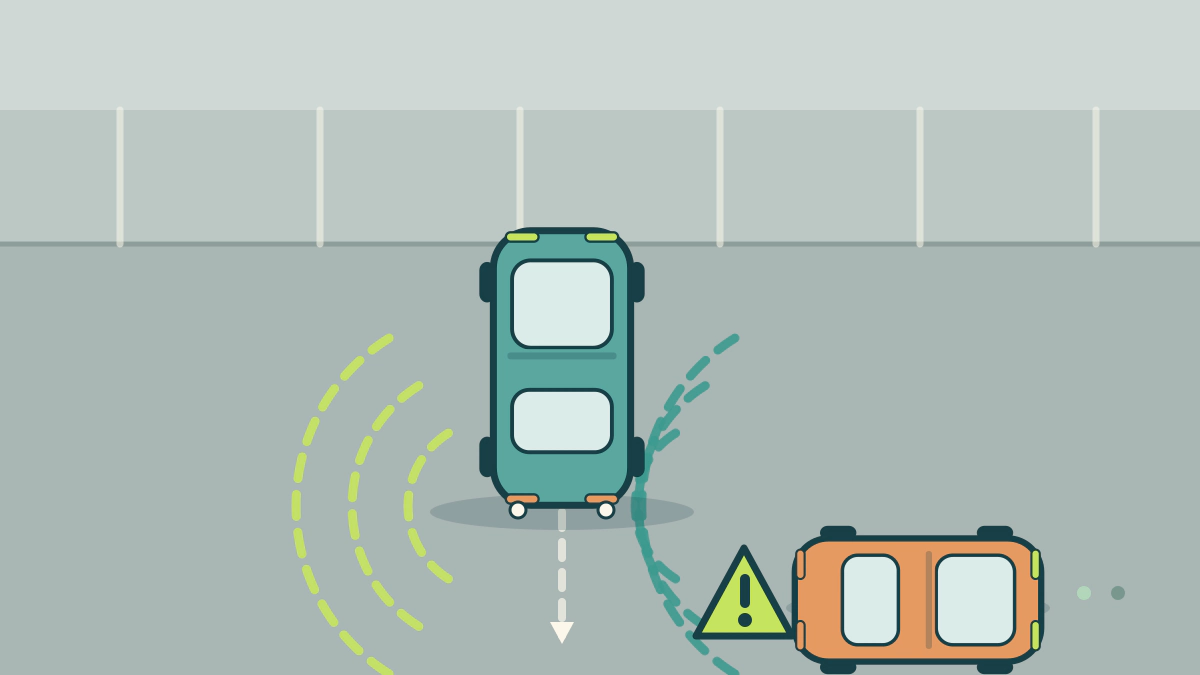
Rear cross-traffic alert warns about vehicles crossing behind you while reversing, but it covers only part of the scene and never brakes for you.
What rear cross-traffic alert actually monitors
Rear cross-traffic alert warns you when a vehicle is approaching from the side while you reverse, but it only covers part of the scene and cannot clear the path for you. It is a warning system, and that word sets its limits.
NHTSA describes rear cross traffic warning as a system that alerts the driver of potential collisions, while in reverse, that may be outside the view of the backup camera (NHTSA driver assistance technologies). Sensors at the rear corners, usually radar or camera-based, watch for movement crossing behind the car.
It is not the same as a parking sensor. Parking sensors watch for nearby obstacles directly behind the bumper at low speed. Cross-traffic alert looks farther out to the sides for traffic that will cross your path.
Warning, braking and camera are three different jobs
A backup camera shows an image. Rear cross-traffic alert warns. Rear automatic braking can apply the brakes. NHTSA says backup cameras are not a replacement for mirrors or turning around to look, and that caution applies to every layer.
IIHS groups these features under rear crash prevention. Its ratings award credit for rear cross-traffic alert and parking sensors, but automatic braking carries the most weight because research shows it produces the biggest crash reductions (IIHS rear crash prevention). Ratings run from basic to advanced to superior.
| Feature | What it does | What it does not do |
|---|---|---|
| Backup camera | Shows the area behind the car | Replace mirrors or a shoulder check |
| Parking sensors | Warn about nearby obstacles behind the bumper | Detect cross traffic at a distance |
| Rear cross-traffic alert | Warns of traffic crossing behind the car | Brake for you |
| Rear automatic braking | Applies the brakes if a crash is imminent | Cover every angle or every object |
| Mirrors and a shoulder check | Show the scene directly | See through a solid pillar or cargo |
What the IIHS rear tests measure
IIHS tests rear autobrake at 4 mph in four scenarios. The car reverses toward a stationary vehicle with a 16-inch overlap, at a 45-degree angle, at a 10-degree angle, and toward a fixed pole. Runs are made straight back and from the left and right. A vehicle earns points when it avoids the target or reduces speed to less than 1 mph (same page).
Notice what that means. The rating tests automatic braking performance at walking-pace speeds. Cross-traffic alert itself earns credit for being present, not for how well it detects a bicycle, a pedestrian or a fast car. A good rating is not a measurement of every real reversing situation.
Where the warning can miss
Cross-traffic alert works best when the crossing vehicle is large, moving at a moderate speed and inside the sensor’s field of view. A bicycle moving fast along a sidewalk, a pedestrian walking behind a parked SUV, or a car approaching at a sharp angle can be harder to catch.
Dirt, snow, ice and rain on the rear sensors or camera reduce performance. A trailer or bike rack can block the view. Some systems pause when a trailer is connected or a door is open, so read the owner’s manual for the conditions that switch yours off.
The federal AEB rule covers forward collisions only. It does not set a rear cross-traffic alert performance standard, so systems differ more than the feature name suggests.
A reversing routine that uses the warning properly
Start slow. Reverse only after checking the mirrors, the camera image and the area over both shoulders. Pause when the alert sounds and look for the source instead of assuming the path is clear when the chime stops.
In a busy lot, back into the space when you arrive so you can drive out forward later. NHTSA’s pedestrian guidance says to be extra cautious when backing up and look for pedestrians (NHTSA pedestrian safety). That remains the driver’s job, even with sensors.
Why the feature is worth having but not trusting
Rear cross-traffic alert adds a useful second set of eyes in a bad blind spot. It does not replace the slow roll, the head check and a clear line of sight. Treat a quiet system as “no warning received,” not as “nothing is there.”
For the forward version of the same problem, see automatic emergency braking limitations. For sensor service after glass or bumper work, see ADAS camera calibration. The Car Safety and Recalls hub covers the wider set of safety systems.
Frequently asked questions
Does rear cross-traffic alert brake the car?
Usually not. It warns. Rear automatic braking is a separate function that applies the brakes, and IIHS rates it separately. Some vehicles combine the two, so check the owner’s manual for your trim.
Why does my rear cross-traffic alert turn off?
Some systems pause when a trailer or bike rack blocks the sensors, when a door is open, or when the sensors are obstructed. The owner’s manual lists the conditions. A persistent warning usually means a sensor fault or a blockage.
Can it detect pedestrians and cyclists?
It is designed mainly for vehicles crossing behind you. Pedestrians and cyclists may be detected by some systems, but they are narrower and can move unpredictably. Do not assume the alert covers them.
Is a backup camera enough on its own?
No. NHTSA says backup cameras are not a replacement for mirrors or turning around to look. The camera has a limited field of view, and children or low objects can fall outside it.