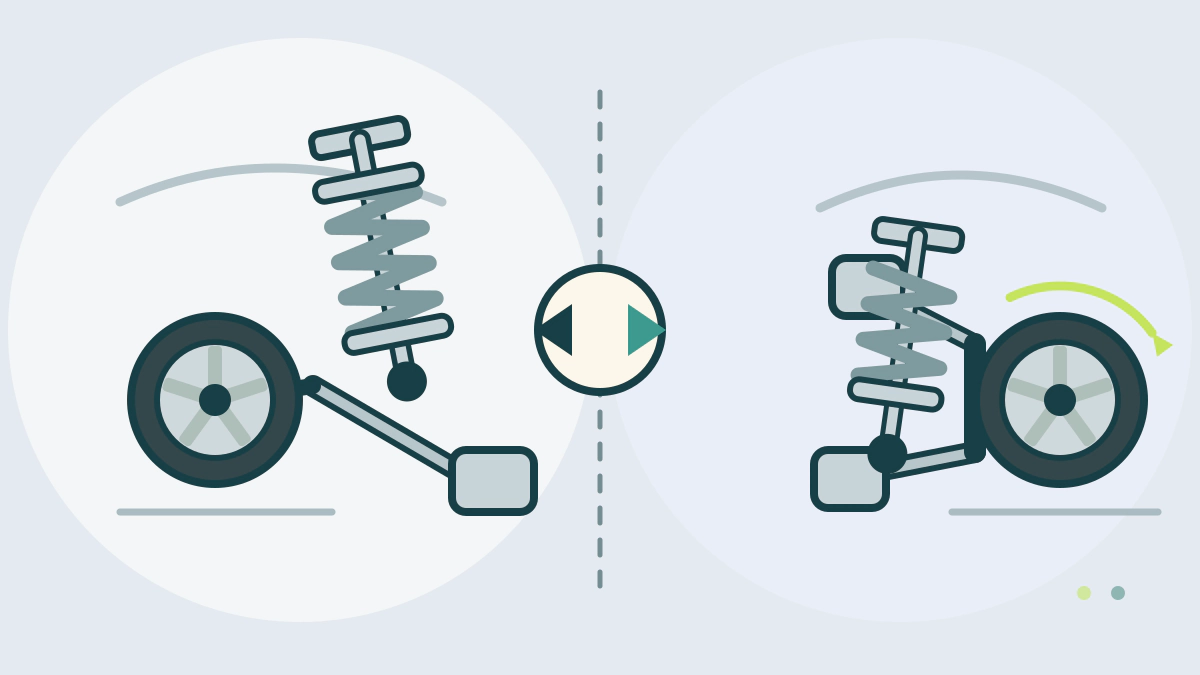
Compare MacPherson strut and double-wishbone front suspension by load path, wheel-angle control, packaging and service needs, with real manufacturer examples.
Which suspension layout is better?
Neither layout is automatically better. A MacPherson strut is compact and simple, while a double wishbone uses two control arms to locate the wheel more precisely. Both are independent front suspension designs. The difference is how they hold the top of the wheel and where they send the road forces.
Acura’s 1986 Legend release calls the MacPherson strut’s simplicity attractive. The same release says the company chose a double wishbone for that car because it wanted low damper friction and better camber control (Acura Legend). That is a useful starting point, not a verdict for every car.
What a MacPherson strut actually does
In a MacPherson layout, the strut is a load-bearing member. It combines the spring, the damper and the upper pivot in one assembly. The lower control arm and the steering tie rod handle the rest.
Acura’s 2006 RSX release is unusually direct about the consequence. It says the strut is responsible for load bearing, so drive forces during suspension compression can sometimes influence steering precision. Acura used inversely wound front springs so the torsional forces from the two springs cancel each other out (Acura RSX).
The same release describes a Control-Link version that adds a link to vary toe change through the suspension travel. It also notes that the compact layout made room for a high-mounted steering gearbox and longer tie rods.
What a double wishbone changes
A double wishbone uses an upper and a lower wishbone-shaped arm. Acura says its 2021 TLX uses two wishbone-shaped control arms in place of the more common MacPherson strut setup. The company says the design gives more precise control of camber, caster and toe, and maximizes tire-to-ground contact (Acura TLX).
The 1986 Legend release adds the mechanical reason. With two arms, the damper does not have to locate the wheel, so it is not load-bearing. The upper arm can also be angled for anti-dive and anti-lift control. Unequal-length arms spread the loads and allow compliant bushings (Acura Legend).
Where the forces go
The biggest difference is the load path. In a strut layout, the spring and damper are part of the structure that holds the wheel. In a double wishbone, the arms locate the wheel and the damper can be mounted to do its own job.
| Question | MacPherson strut | Double wishbone |
|---|---|---|
| Upper wheel pivot | The strut mount | The upper control arm |
| Spring and damper loads | Carried through the strut | Arms locate the wheel; damper is not load-bearing |
| Camber, caster and toe | Set by the strut and lower arm | Set by two arms for more precise control |
| Packaging | Compact; leaves room for engine and steering gear | More arms and pivots to package |
| Acura example | 2006 RSX front | 2021 TLX front |
Those are tendencies, not guarantees. Links, mounts and bushings can change how either design behaves.
Why packaging decides so much
Honda says its Civic Si front MacPherson struts optimize component packaging and crash performance (Honda Civic Si). The RSX release makes the same point in more detail: the compact front end freed space for the engine and cabin and allowed a high-mounted steering gearbox.
A double wishbone can also be packaged tightly. The Legend release says its double wishbone was compact enough to allow more underhood space and a lower hood line. The cost is the extra arm and its pivots, which add parts and service points.
What the driver notices
Camber control matters because it changes how the tire sits on the road as the body leans. Acura credits the TLX’s double wishbone with more precise control of that angle. But the RSX release also claims its Control-Link MacPherson front suspension had performance comparable to a double wishbone.
That is the honest answer for a buyer. The layout sets the ceiling and the trade-offs. Springs, dampers, bushings, tires and alignment decide how much of that ceiling the car actually uses. A well-tuned strut car can feel sharper than a neglected double-wishbone car.
Wear and service differences
Both layouts have bushings, ball joints, dampers and mounts that wear. A MacPherson strut adds one important service difference: the coil spring is part of the strut assembly and the strut carries the wheel load. Replacing it means compressing the coil spring, so the work follows a factory procedure and needs the right tool. For most owners, a shop is the safer choice. For the symptoms of a worn damper, see bad strut versus bad shock.
A double wishbone spreads the load across more joints, so there are more places to inspect. Use the owner’s manual and the maker’s service information for inspection points and torque values.
Whichever layout is under the car, the steering feel still depends on tires and alignment. Why a steering wheel shakes at highway speeds covers the checks that come before suspension replacement.
This comparison belongs to the Automotive Mechanical Systems hub.
Frequently asked questions
Is MacPherson strut suspension worse than double wishbone?
Not automatically. A double wishbone gives the designer more control over wheel angles, but a MacPherson layout can be tuned to perform well. Packaging, cost and the intended use often decide the choice.
Why do so many cars use MacPherson struts?
The layout is compact and uses fewer parts. Honda says it optimizes packaging and crash performance, and its RSX release says the design freed space for the engine and cabin.
Can a car with MacPherson struts handle well?
Yes. Acura claimed its Control-Link MacPherson front suspension had performance comparable to a double wishbone. Tires, dampers, bushings and alignment still matter more than the layout label.
What wears out first in either layout?
Bushings, ball joints, damper mounts and the dampers themselves are common wear points. A MacPherson strut also carries the spring, so its mount and bearing deserve a close look during inspection.