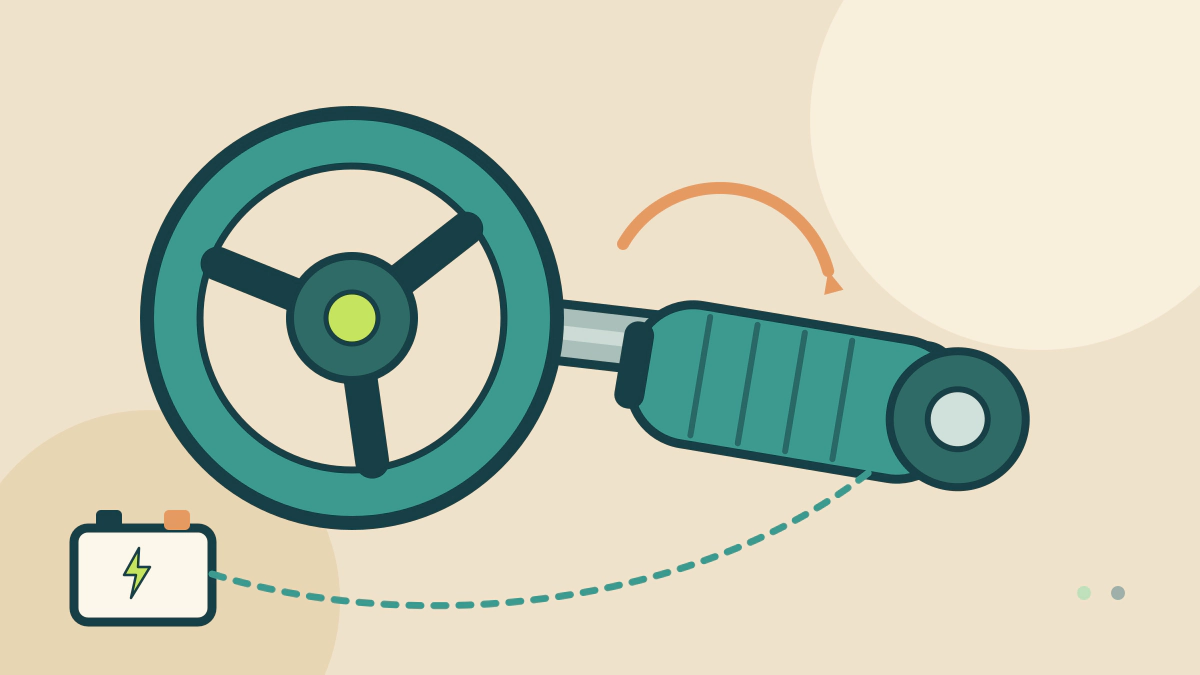
Electric power steering uses a motor, sensors and a control module to assist the driver. See the main layouts and what an EPS warning light means.
What does electric power steering do?
Electric power steering uses an electric motor to reduce the effort needed to turn the steering wheel, while a mechanical connection still links the wheel to the steering rack. Toyota describes its system in those terms: an electric motor reduces the effort needed to turn the wheel (2025 RAV4 Hybrid owner’s manual).
The driver still turns a column and a rack. The motor adds force. That separates electric power steering, or EPS, from steer-by-wire, which removes the mechanical connection entirely. It also separates EPS from the older hydraulic system, where a pump pressurizes fluid to provide the assist.
The parts in the assist loop
A typical system watches the driver’s input, calculates how much help to add, and applies it through a motor and a gear set. NHTSA’s study of a generic column-assist system lists the main pieces.
| Part | Job in the system |
|---|---|
| Steering wheel torque sensor | Measures the force the driver applies |
| Steering angle sensor | Measures how far and how fast the wheel turns |
| EPS control module | Calculates the assist from the sensor signals |
| Power-assist motor | Produces the assist torque |
| Gear set and steering column | Combines motor torque with the driver’s input |
The report describes the control module commanding motor torque, which reaches the column through a gear set such as a planetary gear (NHTSA DOT HS 812 575). The exact parts vary, but the loop is the same: measure, calculate, assist.
Where the motor adds its force
The motor does not have to sit in the same place. NHTSA describes two common arrangements. In a column-assist system, the motor adds torque at the steering column. In a rack-assist system, it adds torque at the rack and pinion (NHTSA).
Honda’s 2018 Odyssey uses a third arrangement: dual-pinion electric power steering. One pinion carries the driver’s physical input, and a supplemental electric motor drives the other. A non-contact torque sensor measures steering effort, and an ECU decides how much motor assist to add (Honda press kit).
| Layout | Where assist is applied | Example |
|---|---|---|
| Column assist | Steering column, through a gear set | Generic system in the NHTSA report |
| Rack assist | Rack and pinion | Generic system described by NHTSA |
| Dual pinion | A second pinion on the rack | 2018 Honda Odyssey |
The layout affects packaging and the parts that must be removed for service. It does not change the basic job: add motor torque to the driver’s input.
Why the steering feel changes with speed
Because the control module sets the assist, the maker can tune it. Honda says its dual-pinion setup improves low-speed maneuverability while keeping high-speed stability (Honda). That is a hardware and software calibration, not a fixed mechanical ratio.
Toyota adds a thermal limit. If the driver makes frequent steering inputs for a long period, the system reduces assist to prevent overheating. The wheel may feel heavy, and Toyota says the system should return to normal within 10 minutes after the driver stops excessive input or switches off the hybrid system (2025 RAV4 Hybrid manual). That is a protection strategy, not a normal driving mode.
What happens when the system faults
A fault does not necessarily mean a dead steering wheel. NHTSA says the system may revert to standard mechanical steering with no power assist, for example by locking the gear set so the column is the only torque path (NHTSA). The driver then has to supply all the effort. A sudden heavy wheel needs attention.
Toyota keeps the warning separate from the diagnosis: the EPS warning light indicates a malfunction in the system (Toyota warning lights). The owner’s manual is the place to check what the light means for that model year. Do not assume a restart will fix a sensor or motor fault.
Living with an EPS car
The mechanical parts still wear. Tires, alignment and suspension condition affect how the car tracks and how the wheel feels. A shimmy or an off-center wheel is a reason to check those items first, not automatically a failed motor. Why a steering wheel shakes at highway speeds covers the ordinary causes.
Fluid service is different. A pure electric system has no hydraulic assist circuit, so the checks in power steering fluid maintenance do not apply to it. Follow the owner’s manual for the car in front of you. If a warning remains after a restart, use a shop with the maker’s service information; the sensors and calibration are not a guess-and-replace job.
For the layout that removes the column entirely, see steer-by-wire explained. This article sits in the Automotive Mechanical Systems hub.
Frequently asked questions
Is electric power steering the same as hydraulic power steering?
No. Hydraulic systems use a pump and fluid pressure to assist. Electric systems use a motor and a control module. A pure EPS car has no power steering fluid to check.
What happens if the electric power steering fails?
The system may revert to manual steering with no assist, so the wheel becomes much heavier. NHTSA describes this fallback. Stop in a safe place and have the system inspected.
Why does the steering get heavy during repeated parking maneuvers?
Some systems reduce assist to protect the motor from overheating. Toyota says its system returns to normal within 10 minutes after the driver stops excessive steering input. If it does not, treat it as a fault.
Do all electric power steering systems use the same layout?
No. Column-assist, rack-assist and dual-pinion layouts all appear in production. The layout affects where the motor applies force and how the maker packages the system.