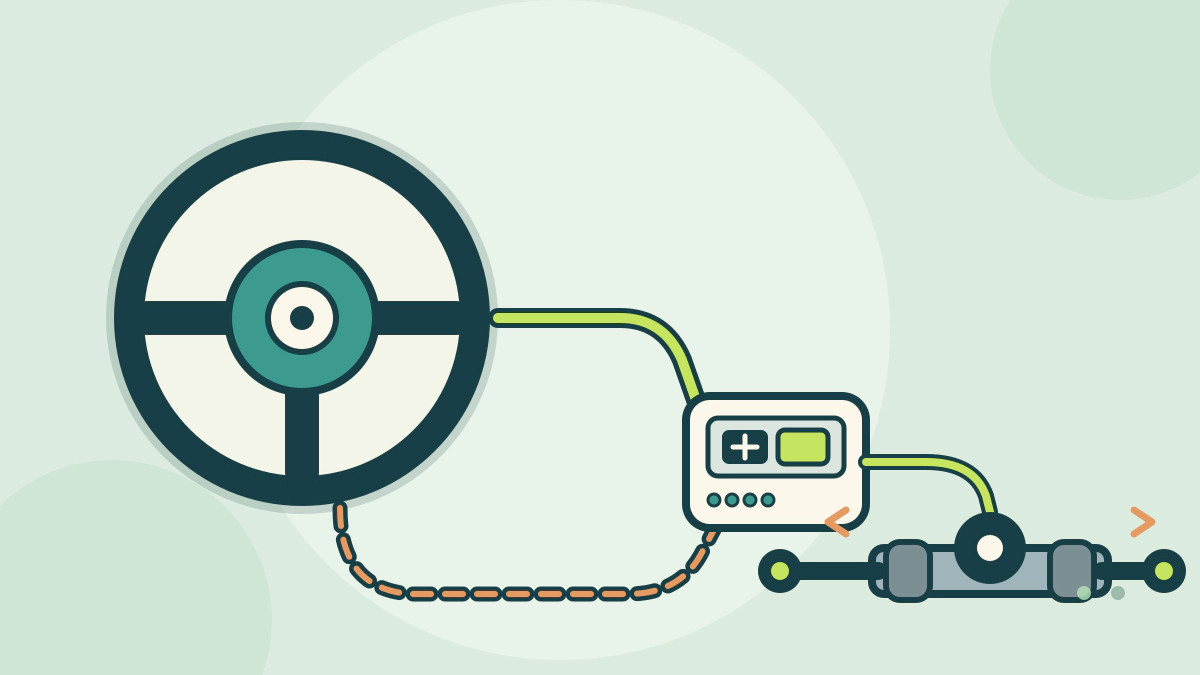
Steer-by-wire removes the steering shaft and uses sensors, motors and software. See how the Lexus RZ system works and why redundancy matters.
What does steer-by-wire actually change?
A steer-by-wire system removes the mechanical shaft between the steering wheel and the front wheels. Sensors read the driver’s input, a computer decides what the wheels should do, and an electric actuator turns the steering rack. A second motor, usually at the wheel, generates the resistance and feedback the driver feels.
Lexus describes its system this way: there is no mechanical connection between the steering wheel and the front wheels. The driver’s inputs travel as electronic signals through a steering torque actuator to a steering control actuator on the front axle (Lexus newsroom). The system debuted in the RZ electric SUV.
That architecture is the defining feature. Electric power steering still has a column and a shaft; it just adds a motor to assist. Steer-by-wire deletes the shaft entirely.
The parts that replace the shaft
| Part | Job |
|---|---|
| Steering control, wheel or yoke | Captures the driver’s intended angle |
| Steering torque actuator | Produces feedback force and self-centering feel |
| Steering control actuator | Moves the steering rack at the front axle |
| Sensors and control units | Convert input to commands and monitor faults |
| Backup path | Keeps steering available if a fault is detected |
The exact layout varies by maker. The table describes the functions, not a universal parts list. A supplier may combine the control unit with the actuator, and the backup path may use a second winding, a second controller or another arrangement.
What the driver notices
The most obvious change is the ratio. Because software sets the relationship between wheel angle and road-wheel angle, it can vary with speed. Lexus says its RZ system runs a lower ratio at low speed for parking and a higher ratio at highway speed for stability. It also sets lock-to-lock travel at plus or minus 200 degrees, so hand-over-hand turning is almost eliminated (Lexus).
Feedback is synthetic. The system can filter vibration from the road while still passing some information to the driver. That is a tuning choice. Some drivers like the calm, direct feel; others miss the texture of a mechanical rack. A test drive is the only way to know which group you are in.
Why redundancy gets so much attention
With no shaft, a failed sensor or actuator cannot be overridden by muscle. The system has to keep working, or bring the car to a controlled stop, without a mechanical fallback.
Lexus says a back-up system intervenes immediately to provide uninterrupted performance if the steering system has an issue. SAE’s account of the RZ program reports that the system is fully redundant, unlike the Infiniti Q50 system that retained a mechanical column (SAE).
NHTSA studied the safety case in a 2018 report. Its assessment of a generic steer-by-wire system, with active steering and four-wheel steering features, followed the ISO 26262 process and identified five vehicle-level safety goals and 81 system functional safety requirements (NHTSA DOT HS 812 576). That is the kind of analysis behind a production system, and it is why fault detection and a backup path are central to the design.
What federal rules require
Federal safety standards do not require a steering shaft. They set performance requirements.
FMVSS 203, at 49 CFR 571.203, limits the force the steering control system can transmit to the driver’s chest in a 24 km/h body-block impact and requires that parts cannot catch clothing or jewelry. It does not apply to vehicles that meet the frontal barrier requirements of FMVSS 208 by means other than seat belts, or to vehicles without a steering control (eCFR).
FMVSS 204 limits rearward displacement of the steering column and shaft in a 48 km/h barrier crash. Its definitions describe a column and a shaft, and the standard excludes vehicles without steering controls and vehicles certified to the frontal requirements of FMVSS 208 (eCFR). A car with no shaft is therefore not tested against a column-displacement limit in the same way. That is not a loophole. Occupant protection still comes from FMVSS 208, and the steering control itself still has to meet the applicable impact requirements.
Living with a steer-by-wire car
Routine items do not disappear. Tires, wheel alignment and suspension condition still set how the car tracks and how the steering feels. A pull or an off-center wheel is still a reason to check the tires and alignment, not automatically a software fault. See why a steering wheel shakes at highway speeds for the ordinary causes.
Diagnosis is different. These systems log faults and may need manufacturer software and calibration procedures. If a warning appears, do not treat it as a DIY repair. Use the owner’s manual for the warning’s meaning and take the car to a dealer or a shop with the maker’s service information. For the older hydraulic system, see power steering fluid maintenance, which does not apply to a steer-by-wire rack.
This is one of several design changes covered in the Future Mobility and Innovation hub.
Frequently asked questions
Is steer-by-wire the same as electric power steering?
No. Electric power steering keeps the mechanical column and shaft and adds an electric motor to assist. Steer-by-wire removes the mechanical connection and uses actuators and software instead.
What happens if a steer-by-wire system fails?
The maker’s design determines the response. Lexus says its system has a back-up that intervenes if a fault occurs. A warning light or reduced steering assist means the car should be checked by a dealer rather than driven normally.
Do all new cars use steer-by-wire?
No. It appears on a small number of production models. Most new cars still use electric power steering with a mechanical column.
Is steer-by-wire legal in the United States?
Yes. Federal standards set performance requirements rather than mandating a shaft. FMVSS 203 and 204 cover steering control impact protection and column displacement, and FMVSS 208 covers occupant protection.