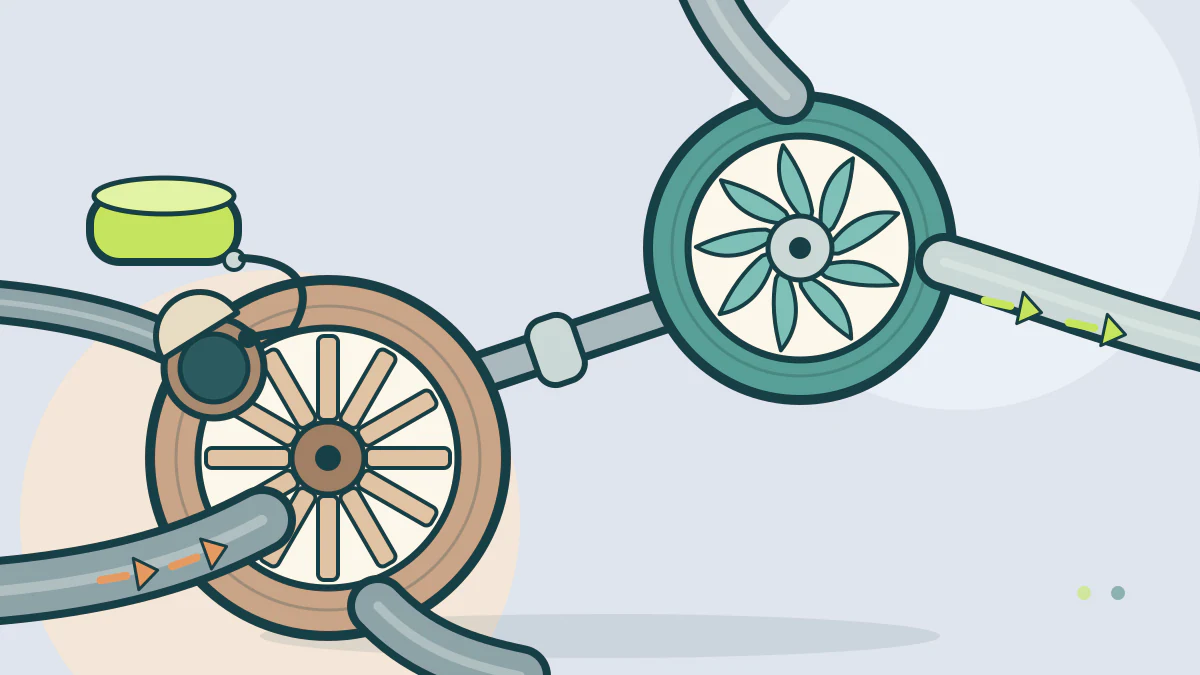
Trace exhaust energy through the turbine and shaft to the compressor, and see why charge air is cooled, how boost is limited and what heat does to the turbo.
What happens inside a turbocharger?
Exhaust gas leaving the engine spins a turbine wheel, and a shaft carries that rotation to a compressor wheel that pushes more air into the intake. Garrett’s basic guide describes the sequence: exhaust enters the turbine, expands, and gives up energy that drives the compressor. More air mass allows more fuel to be burned, so a smaller engine can produce more power.
The turbo is not a separate power source. It recovers energy that would otherwise leave through the exhaust.
Two wheels, one shaft, three housings
Garrett’s parts list names the compressor wheel, compressor housing, turbine wheel, turbine housing, center housing, bearings, backplate, and oil inlet and outlet. The compressor wheel pumps air into the engine. The turbine wheel converts exhaust energy into shaft power. The center housing supports the rotating group.
Bearings matter because the shaft spins fast. Garrett says journal bearings have long been standard, while ball-bearing cartridges reduce friction. Oil feed and drain lines lubricate and cool the bearing area. Garrett notes that its ball-bearing turbos need less oil than journal-bearing units, and that oil and water plumbing is often neglected.
Why the compressed air gets hot
Compressing air raises its temperature as well as its density. Garrett explains that the compressor raises density, and that many turbocharged engines use a charge air cooler, or intercooler, to cool the compressed air before it enters the intake. Cooler air is denser, and it also increases resistance to detonation.
The intercooler does not make extra boost. It removes heat that compression added, so the engine can use a denser charge.
Where the turbine gets its energy
On the exhaust side, Garrett describes a pressure and temperature drop across the turbine as the gas expands. That expansion harnesses energy to drive the compressor. The turbine also creates backpressure, meaning exhaust pressure before the turbine is higher than atmospheric pressure.
That trade-off explains a lot. A turbine housing that responds quickly at low speed can become a restriction at high flow, which is why a wastegate bypasses exhaust around the turbine once the target boost is reached. The wastegate explainer covers the control side.
| Part | Job | Why it matters |
|---|---|---|
| Compressor wheel | Pumps air into the intake | Sets airflow and pressure ratio |
| Turbine wheel | Extracts energy from exhaust | Drives the compressor through the shaft |
| Center housing and bearings | Support the rotating assembly | Oil flow and bearing type affect response and durability |
| Intercooler | Cools compressed air | Denser charge and better knock resistance |
| Wastegate | Bypasses exhaust around the turbine | Limits boost and protects the turbo |
| Blow-off valve | Vents pressure when the throttle closes | Prevents compressor surge |
What surge and lag feel like
Garrett says a blow-off valve is a pressure-relief device on the intake tract that prevents the compressor from going into surge. It should sit between the compressor discharge and the throttle body, ideally after the intercooler.
Lag is different from surge. Garrett defines turbo lag as the delay before enough exhaust gas pressure spins the turbine and forces compressed air into the intake. Inertia, low exhaust flow at low speed, turbo size, wheel matching and wastegate operation all affect it.
How heat affects the turbo and shutdown
The turbine side runs in hot exhaust, so the turbo needs oil and, on some units, coolant to manage heat. Kia’s 2023 owner’s manual tells drivers not to race or accelerate immediately after a cold start. It also recommends idling about one minute after high-speed or heavily loaded driving before shutting off, so the turbocharger can cool.
That is a manufacturer-specific instruction, not a universal interval. Check your own manual. A turbo that smokes, whistles abnormally or loses boost needs diagnosis rather than a parts swap. The turbocharged vs naturally aspirated comparison explains the broader trade-offs, and the Automotive Mechanical Systems hub covers related systems.
Frequently asked questions
Does a turbocharger make free power?
No. It uses exhaust energy that would otherwise be wasted, but it adds backpressure and heat, and the engine must burn more fuel to match the extra air. The gain depends on how the engine is tuned and how it is driven.
Does a turbo engine need premium gasoline?
Not always. The required octane is set by the manufacturer for each engine, so check the owner’s manual or the fuel-door label. Intercooling improves resistance to detonation, but it does not set the octane requirement by itself.
What does the wastegate do inside the turbo?
It lets exhaust gas bypass the turbine to cap boost. Without that bypass, the turbo could keep accelerating and exceed its safe speed. The spring and actuator set the opening point, and some systems add electronic control.
Can I shut the engine off right after a hard climb?
Kia’s manual says to idle about a minute after heavy load before shutting off, and other manufacturers may specify differently. Follow the instruction for your vehicle. If the manual gives no special shutdown step, use its normal guidance.