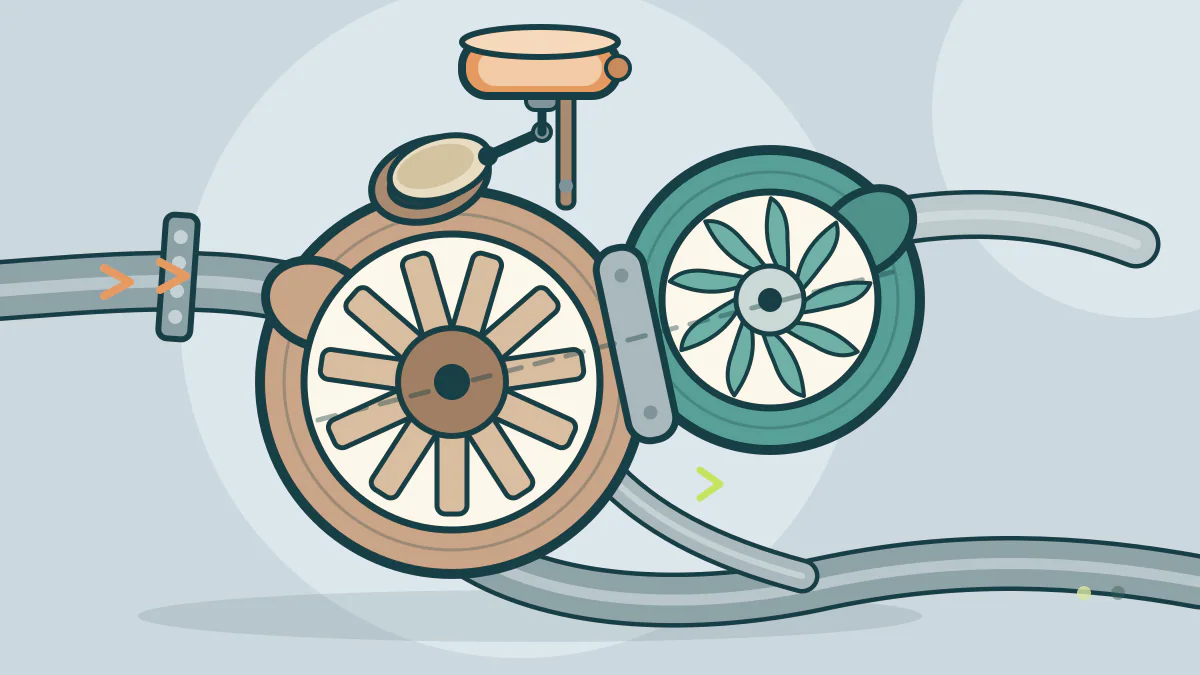
A turbo wastegate is a valve that lets exhaust gas bypass the turbine to limit boost. Learn how internal and external wastegates control turbo speed.
What is a turbo wastegate?
A turbo wastegate is a valve that lets exhaust gas bypass the turbine wheel, limiting how fast the turbocharger can spin and how much boost it can make. Garrett Motion describes it as a spring loaded valve that allows exhaust gases to bypass the turbine. The valve opens when boost pressure reaches a set level, so the turbo stops adding airflow beyond that point.
This is a control device, not a power adder. The turbo still makes boost. The wastegate decides when extra exhaust energy should go around the turbine instead of through it.
How the spring and actuator set the limit
Garrett’s explanation starts with the spring inside the wastegate housing. The spring is rated for a pressure. A boost reference line runs from the compressor side to a port on the lower housing. As the turbo spins faster, pressure in that line rises. When the signal approaches the spring rating, the valve begins to lift.
On Garrett’s GVW external wastegates, the base calibration is 14.5 psi, or 1 bar. Spring choices cover roughly 3 psi to 25 psi, depending on the part and the reference conditions. Those numbers describe the spring’s opening point, not a target that every engine should run.
A rod connects the actuator to the valve. Some systems add electronic control to delay the opening point beyond what the spring alone would allow. On a factory internal wastegate, Garrett lists a flapper valve, crank arm, rod end and pneumatic actuator. The actuator should see boost pressure only. It is not designed for vacuum and should not be plumbed to the intake manifold in a way that exposes it to vacuum.
Internal and external wastegates
The two layouts do the same job in different places.
| Detail | Internal wastegate | External wastegate |
|---|---|---|
| Location | Built into the turbine housing | Mounted on the exhaust manifold or header |
| Valve size | Fixed by the housing | Several sizes available |
| Packaging | Compact, few extra parts | Larger, needs fabrication and plumbing |
| Flow and control | Limited by the small port; can struggle at high flow | Larger valves can give finer boost control |
| Service | Housing-integrated | Replaceable components |
| Typical use | Factory turbo systems and lower boost | High-power and racing builds |
Garrett notes that internal wastegates are compact, simple and cost effective, but their small valve limits flow and can respond slowly. External wastegates allow larger valves, less manifold backpressure and easier service, at the cost of size and extra plumbing. The company says its internal-wastegate turbos stop at the G35 and GTX35 frame sizes; larger frames use externally wastegated turbine housings.
Why a smaller housing can still drive well
A wastegate lets the turbine housing be sized for low-speed response. Garrett explains that a smaller A/R housing accelerates the turbine quickly when the valve is closed. At higher engine speed, the housing approaches its flow limit, so the wastegate opens and lets excess exhaust bypass the turbine.
That combination gives the engine a responsive turbo without forcing all the exhaust through a restrictive housing at full power. The wastegate is the reason the same turbo can behave differently at low engine speed and near redline.
Wastegate versus blow-off valve
These two valves are often confused because both vent air. They work on opposite sides of the turbo.
A wastegate is on the exhaust side. It controls turbine speed by diverting exhaust gas around the turbine. A blow-off valve is on the intake side. It vents boosted air when the throttle closes, which helps prevent compressor surge. Garrett separates the jobs clearly: the wastegate regulates boost by limiting turbo speed, while the blow-off valve protects the compressor when the driver lifts off the throttle.
What a wastegate failure can mean
Garrett warns that a failed wastegate diaphragm can let the turbo overspeed and fail. It also notes that an internal wastegate can have overboost trouble in high-flow configurations, which can damage the engine. Those are reasons to treat unexplained boost changes as a diagnostic issue, not as a tuning opportunity.
A wastegate that does not seal, or one whose actuator does not move through its full stroke, changes the relationship between exhaust flow and boost. The result may be low boost, slow response or a boost spike. Diagnosis needs the manufacturer’s service information and, on a modified car, the build’s own boost-control diagram. Spring changes and actuator adjustments are not routine maintenance.
For the wider picture, see turbocharged versus naturally aspirated engines and ECU tuning explained. More terms are in the Automotive Glossary.
Frequently asked questions
Does a wastegate increase horsepower?
No. A wastegate limits boost by diverting exhaust away from the turbine. It allows the engine to use a suitable turbo without overspeeding it, but the power comes from fuel and airflow, not from the valve itself.
What happens if a wastegate sticks open?
Exhaust bypasses the turbine when it should be driving it, so the turbo may spin too slowly and produce little boost. The car can feel sluggish and may set a fault code. A shop should check the actuator, linkage and control circuit.
Is an external wastegate better than an internal one?
Not automatically. External units offer larger valves, easier service and more control in high-power builds, but they add size, cost and plumbing. Internal units suit compact factory layouts and moderate boost. The right choice depends on the turbo, the manifold and the target boost.
Can I adjust the wastegate spring myself?
Spring changes and actuator adjustments alter boost control and can lead to overboost. They require the correct parts, a boost gauge and knowledge of the engine’s calibration. Have the work done by someone with the manufacturer’s service information, and check warranty and emissions implications first.