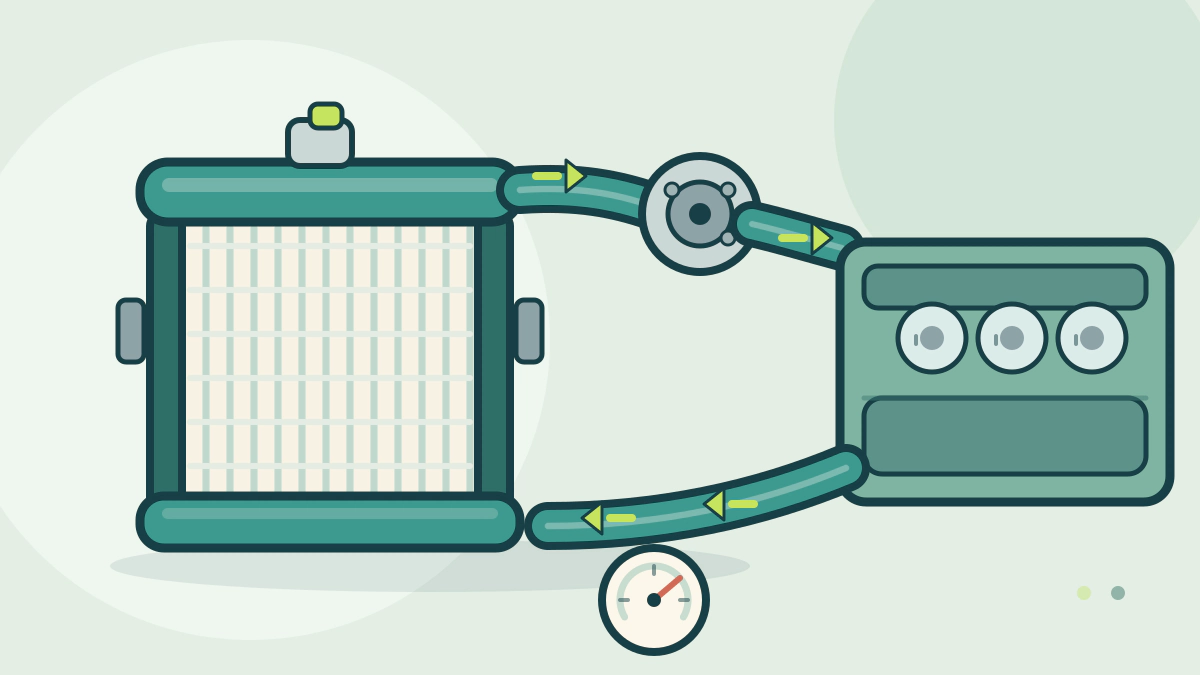
Follow coolant from the pump through the engine, thermostat and radiator, and see how pressure, airflow and the heater core keep engine temperature stable.
How does an engine cooling system work?
An engine cooling system circulates liquid coolant through passages around the engine, then sends the heated coolant to the radiator, where airflow removes the heat. MAHLE’s technical guide lists the main parts as the radiator, thermostat, coolant pump, expansion tank, lines, fan and temperature sensor. The pump moves the coolant, the thermostat decides when it reaches the radiator, and the radiator transfers heat to the air.
This is a closed loop, not a once-through system. The same coolant is reused, so the loop must hold pressure and stay free of leaks.
What the pump, thermostat and radiator each do
The coolant pump drives circulation. Belt-driven pumps are common, and Bosch shows an electric coolant pump circulating coolant as required, with the engine control unit able to control the flow path through a solenoid valve.
The thermostat controls when coolant flows through the radiator. MAHLE says a mechanical thermostat uses a wax element that melts above 80 C (176 F) and opens a valve. While the engine is cold, coolant takes a short route back into the engine. Once operating temperature is reached, the thermostat opens the radiator circuit. Some modern thermostats are mapped by the control unit instead of acting on wax alone.
The radiator is a heat exchanger. Hot coolant passes through tubes joined to fins, and air moving across the fins carries heat away. MAHLE notes that coolant can flow top to bottom or side to side.
| Component | Main job | A fault can show up as |
|---|---|---|
| Radiator | Transfers heat from coolant to air | Overheating at speed or with the air conditioning on |
| Thermostat | Opens the radiator circuit at operating temperature | Slow warm-up, no cabin heat or overheating |
| Coolant pump | Circulates coolant through the loop | Leaks, noise or poor circulation |
| Radiator fan | Pulls air through the core at low speed | Overheating in traffic but not at highway speed |
| Expansion tank and cap | Holds expanding coolant and controls pressure | Coolant loss, a collapsed hose or boiling |
| Heater core | Warms cabin air with engine coolant | A cold heater while engine temperature looks normal |
Why the cooling system runs under pressure
A closed cooling system is pressurized. MAHLE says the circuit runs at 1.0 to 1.5 bar (about 15 to 22 psi), and that pressure raises the boiling point of the coolant. That lets the engine run hotter than an open system could without boiling.
The expansion tank gives coolant room to expand. MAHLE says the tank is only about half filled. A pressure-relief valve in the cap opens when pressure rises too high, and a vacuum valve lets air back in as the system cools.
Pressure is also why the cap is dangerous. Kia’s 2023 owner’s manual warns never to remove the radiator or inverter cap while the engine is running or hot, because scalding coolant or steam can escape. Let the engine cool and follow the manual for your model.
What the coolant itself does
Coolant is not just water. MAHLE says the mixture provides antifreeze, raises the boiling point and protects engine and cooling-system parts from corrosion. Kia’s manual says to use deionized or soft water when mixing, and warns against mixtures above 60 percent or below 35 percent antifreeze.
Do not judge coolant only by color. The required specification is in the owner’s manual. The coolant flush guide explains when replacement is justified.
Where the cabin heat comes from
The heater core is a small heat exchanger inside the dashboard. Bosch describes a heat exchanger that transfers thermal energy for cabin heating, with a blower moving air over it. Hot coolant flows through the core, and the blower sends warmed air into the cabin.
That is why a cold heater can be an early cooling-system clue. A low coolant level, a stuck thermostat or a blocked heater core can leave the engine temperature looking normal while the cabin stays cold. The overheating symptoms guide covers diagnosis, and the roadside response guide explains what to do if the gauge climbs.
Why airflow matters as much as coolant
Coolant can only release heat if air can reach the radiator. MAHLE’s diagnostic list starts with coolant level, contamination, antifreeze and leaks, then asks whether the radiator and the condenser in front of it are blocked. It also checks the fan and the belt that drives a mechanical pump.
Car Care Council calls cooling-system failure a leading cause of breakdowns and recommends checking the coolant level often and changing it according to the owner’s manual. The Automotive Mechanical Systems hub covers the related engine systems.
Frequently asked questions
Does the thermostat control the radiator fan?
Not usually. The thermostat controls coolant flow through the radiator, while the fan is switched by the engine control unit or a separate fan control module. A fan that never runs can cause overheating in traffic even when the thermostat works.
Why does my heater blow cold when the engine is warm?
A low coolant level, a stuck thermostat or a blocked heater core can reduce flow through the heater core. Air trapped in the system after a coolant service can do the same. Check the coolant level only when the engine is cold, then consult the owner’s manual.
Can I drive with the temperature gauge slightly high?
A gauge that reads above normal deserves attention, especially if it is climbing or a warning appears. Stop safely if steam, a warning lamp or a loss of power occurs. Do not open a pressurized cap to investigate at the roadside.
How often should coolant be changed?
The interval is set by the manufacturer and varies with the coolant type and model year. Use the maintenance schedule in the owner’s manual rather than a universal mileage figure.