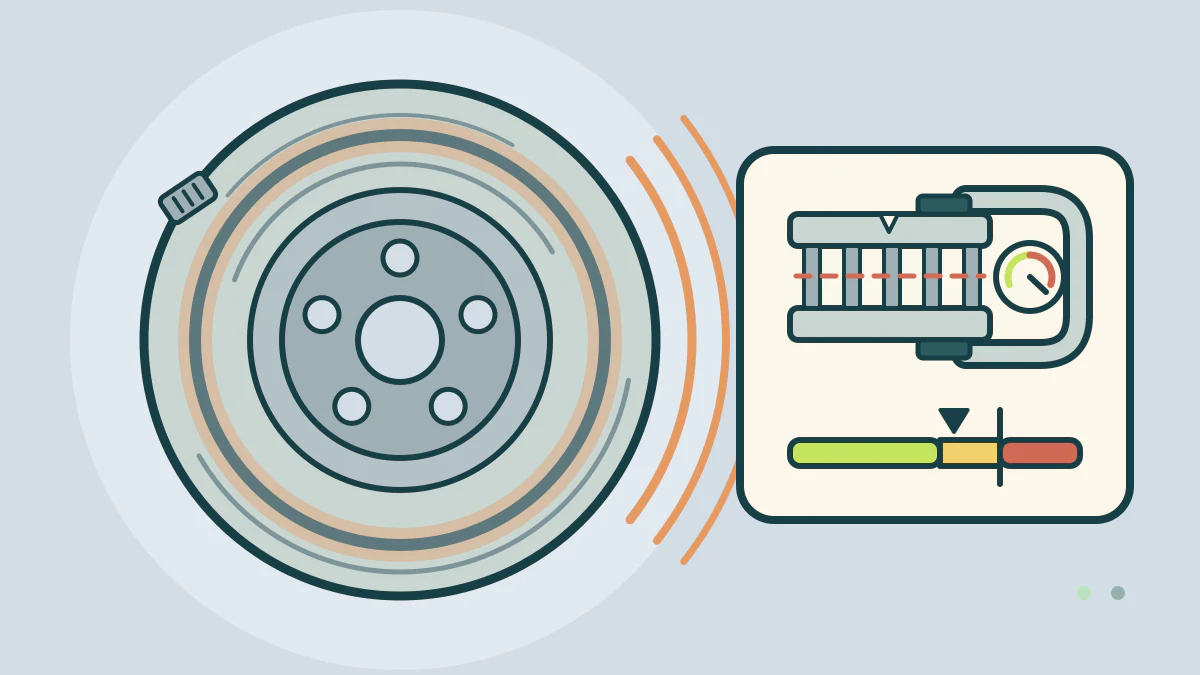
Learn what decides rotor replacement: the minimum thickness set by the maker, scoring, pulsation and rust, using Pennsylvania's inspection rule and manuals.
When do brake rotors need replacement?
Brake rotors need replacement when a measurement shows they are thinner than the maker’s minimum, or when damage cannot be corrected. Noise, vibration and rust are reasons to have them inspected. None of them proves a rotor is finished.
This guide covers the rotor question only. For the split between pads and discs, read our guide to brake pads versus brake rotors. For wider topics, see Tires, Wheels and Brakes.
The minimum thickness that decides replacement
Pennsylvania’s inspection rule gives the clearest official wording. An inspector removes at least one front wheel and the opposite rear wheel. The brake system fails if the disc thickness is less than the minimum stamped on the assembly or less than the manufacturer’s specification.
That tells you two things. The limit is set by the vehicle maker, and it may be marked on the part itself. A rotor can look fine and still be under the limit, because wear is measured, not judged by eye.
This guide gives no thickness figures. They differ by vehicle and by axle. Find yours in the manufacturer’s service information, and ask the shop to show you the measured value beside the limit.
The Car Care Council lists rotor thickness as part of a thorough yearly brake inspection. A 2024 Kia manual says to check discs for run out and wear as a scheduled maintenance item.
Signs that point to a worn or damaged rotor
| Sign | What the sources say | Sensible next step |
|---|---|---|
| Vibration or shudder when braking | The Car Care Council lists vibration as a warning sign. A Kia manual says continuous steering wheel shudder while braking should be checked by a dealer. | Book an inspection |
| Scraping or grinding | The FTC says to schedule diagnosis if you hear or feel scraping or grinding during braking. | Get it checked promptly |
| Pulling to one side when braking | The FTC lists this as a reason to schedule diagnosis. | Inspect brakes, not only tires |
| Visible grooves or scoring | Pennsylvania’s rule rejects rotors scored beyond a set depth. | Have the depth measured |
| Rust in the vent area | A Kia manual says it may not affect braking performance. | Ask a technician to judge it |
Pulsation: what it does and does not prove
Pulsation is the rhythmic shake you feel through the pedal or steering wheel while slowing. The sources describe it as a symptom, not a diagnosis.
A 2026 Kia K5 manual says frequent hard braking can deform components and wear the disc brake, causing vibration when braking. The same page tells owners with continuous vibration or shudder to have the car checked.
The FTC also notes that an unbalanced tire makes a vehicle vibrate. So shaking does not always mean rotors. Our guide to why a car vibrates when braking lays out how to sort the possibilities.
Scoring and rust: which ones matter
Scoring is a groove worn into the rotor face. Pennsylvania’s rule rejects drums or rotors scored deeper than a stated limit. It also rejects mechanical damage other than normal wear. A technician needs a gauge to know where a groove stands against that limit.
Rust is less clear-cut. A 2024 Kia manual says the exposed vent area of an outer-vent disc may become rusty without affecting braking performance. That statement covers that disc design. It does not say all rust is harmless, so rust that comes with vibration or noise still deserves a measurement.
How driving conditions change the check schedule
A Kia severe-use maintenance table asks for brake discs, pads and calipers to be inspected more frequently under several conditions. These include salt or corrosive materials, repeated hills, towing, taxi or patrol use, frequent high speed with rapid acceleration and deceleration, and stop-and-go traffic.
The Council names driving habits, operating conditions and vehicle type as wear factors. The Kia K5 manual page quoted above also says frequent speeding and braking can wear the disc brake and advises avoiding excessive braking.
None of these sources gives a mileage at which rotors must be replaced. Use your owner’s manual schedule, and let the measurement decide.
Why replacement is a professional job
The Council warns against putting off brake service, including letting brakes reach the “metal-to-metal” point. It calls that potentially dangerous and likely to cost more.
Procedures vary by vehicle. Tesla’s Model 3 service manual lists a combined front pads and rotors replacement procedure that ends with burnishing the brakes. It also lists runout measurement as a separate procedure. Other makers will differ, so rely on your model’s service information.
Frequently asked questions
Can I tell that rotors are worn just by looking?
Not reliably. The limit is a thickness, and Pennsylvania’s rule compares the measured disc with the stamped or specified minimum. Visible grooves are a reason to measure, but only the measurement settles the question.
Do rotors need replacing on a set mileage?
The sources read for this guide give no mileage. The Car Care Council recommends an inspection that includes rotor thickness at least once a year. A Kia severe-use table calls for more frequent checks in harsh conditions.
Does surface rust mean the rotors must be replaced?
Not by itself. A Kia manual says rust on the vent area of its outer-vent discs may not affect braking performance. A technician should judge any other rust, together with thickness and scoring.
Is brake pulsation always a warped rotor?
The sources do not say so. A Kia manual links hard braking to worn or deformed discs that cause vibration, and the FTC notes that unbalanced tires also cause vibration. Have a shop find the actual cause before buying parts.