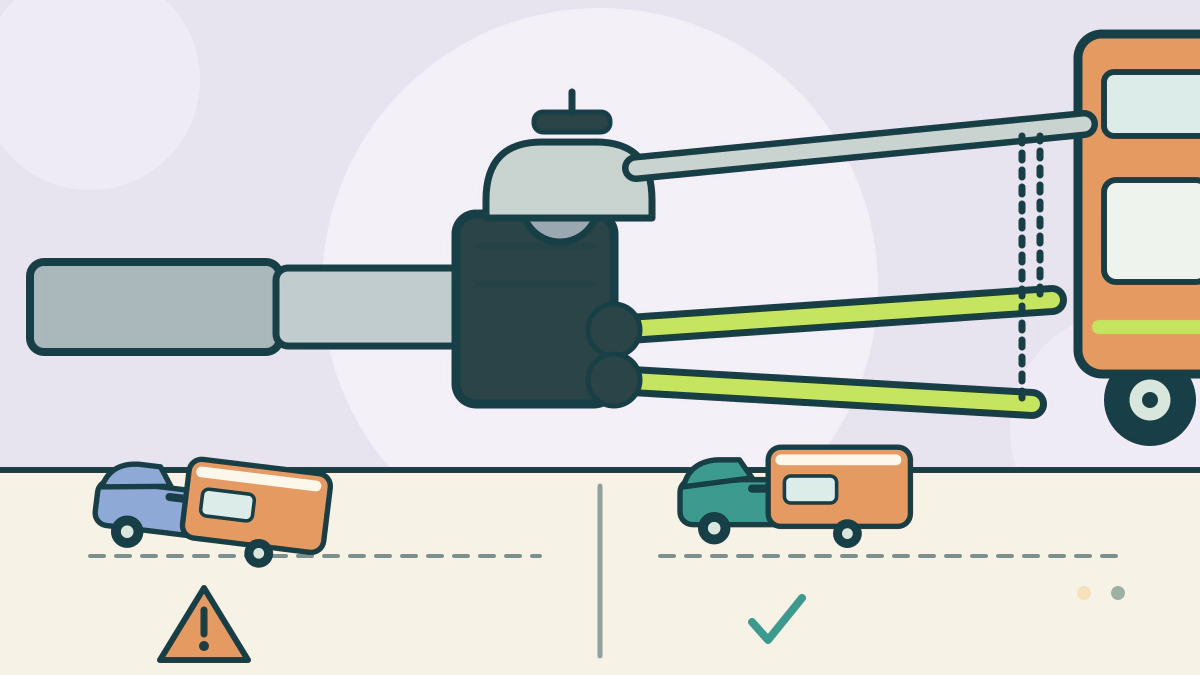
See how spring bars move tongue load across three axles, when GM's 2026 half-ton guide requires it, and how the fender-height setup works.
What does a weight-distribution hitch do?
It uses spring bars to move part of the tongue load from the tow vehicle’s rear axle to its front axle and to the trailer’s axles. It does not raise any weight rating.
Equal-i-zer’s hitch manual describes the problem plainly. Without weight distribution, the tow vehicle “teeter-totters” on its rear axle and unweights the front axle. Moving load back to the front steering axle puts weight back on the tires that steer and brake.
The load does not disappear. It is shared across three axle groups: the truck’s front axle, its rear axle and the trailer axles. More towing basics are in Off Roading and Towing.
When a manufacturer requires one
Not every trailer needs weight distribution. GM’s 2026 Silverado and Sierra 1500 trailer towing supplement sets a threshold for that model. Up to 3,175 kg (7,000 lb) of trailer weight, a weight-distributing hitch is optional. Above 7,000 lb, it is required. The same table gives the distribution as 50%.
That is GM’s rule for one vehicle line. Other vehicles and other model years can set a different threshold, so read the towing section of your own manual.
The supplement adds a warning that matters after setup. If a weight-distributing hitch is used, the rear axle rating must not be exceeded after the spring bars are applied. Moving weight forward does not license a heavier rear axle.
The setup is a measurement, not a guess
GM’s procedure measures the front of the truck before and after hitching, then splits the difference.
| Step | Measurement | Example |
|---|---|---|
| 1 | Height of the front wheel opening with the trailer detached | H1 = 1,000 mm |
| 2 | Same height with the trailer attached and the bars loose | H2 = 1,050 mm |
| 3 | Difference between the two | 50 mm |
| 4 | Half the difference | 25 mm |
| 5 | Target height after tensioning the bars: H2 minus half the difference | 1,025 mm |
The target is halfway between the loaded and unloaded heights. Equal-i-zer’s manual says to follow the hitch maker’s instructions for tension, and warns that no single formula fits every combination.
The same GM section warns that a trailer must be level front to back. Towing nose-up or nose-down loads the trailer axles, springs and tires unevenly.
Why one setting does not fit two rigs
Equal-i-zer’s adjustment appendix lists what changes the result. A longer distance from the rear axle to the hitch ball transfers less weight than a shorter one at the same setting. A soft SUV suspension reacts farther and faster than a stiff heavy-duty pickup. A trailer with a long distance from axle to coupler pushes distributed weight forward, while a short one absorbs more into its own suspension.
Loading matters too. The manual gives an example: shifting 40 gallons of water from the front of a trailer to the back can turn 330 lb of positive tongue weight into 330 lb of negative tongue weight. A rig set up correctly for the outbound trip can be wrong on the return leg.
That is why the hitch needs checking when the load changes, not only when the trailer is new.
Sway control is a separate feature
Weight distribution and sway control solve different problems. Sway control resists the side-to-side movement that crosswinds and passing trucks can start. The Equal-i-zer design combines the two with friction at the hitch head and at the trailer brackets, but not every weight-distribution hitch includes sway control.
Loading still decides most of it. Equal-i-zer says tongue weight should be at least 10% of gross trailer weight for the hitch to work effectively, and that most trailers are designed for 10% to 15%. A trailer loaded tail-heavy can sway no matter which hitch is fitted. What tongue weight means covers the measurement.
The trailer’s own placard also matters. Under 49 CFR 571.110, a trailer must show its cargo capacity, and a recreation vehicle trailer’s axle ratings plus recommended tongue weight must at least equal its GVWR. A hitch cannot correct a trailer that is loaded beyond those figures.
When to have the hitch installed professionally
The setup involves bracket placement, clearance and tension settings that vary by hitch and trailer frame. If the trailer frame is not rated for the brackets, or the receiver is not rated for the load, the combination is wrong before adjustment starts.
Have a qualified shop install and adjust the hitch if you do not have the maker’s instructions for your exact model, or if the trailer frame needs drilling. Then recheck the setup when the tow vehicle, trailer or load changes. Related reading: gross combined weight rating and lifted truck towing.
Frequently asked questions
Does weight distribution increase my towing capacity?
No. It changes how the load is carried across the axles. The vehicle, hitch and trailer ratings stay the same.
Do I need weight distribution for a 5,000 lb trailer?
It depends on the vehicle. GM’s 2026 Silverado and Sierra 1500 supplement makes it optional up to 7,000 lb. Other vehicles set lower thresholds, so check your manual.
Can I set up the hitch once and leave it?
Only while the load stays the same. Trailer loading, water tanks and cargo change tongue weight, and Equal-i-zer says the setup should be checked when the configuration changes.
Does a weight-distribution hitch stop sway?
Not by itself. Sway control is a separate function, and trailer loading, tongue weight, tires and speed still affect stability.