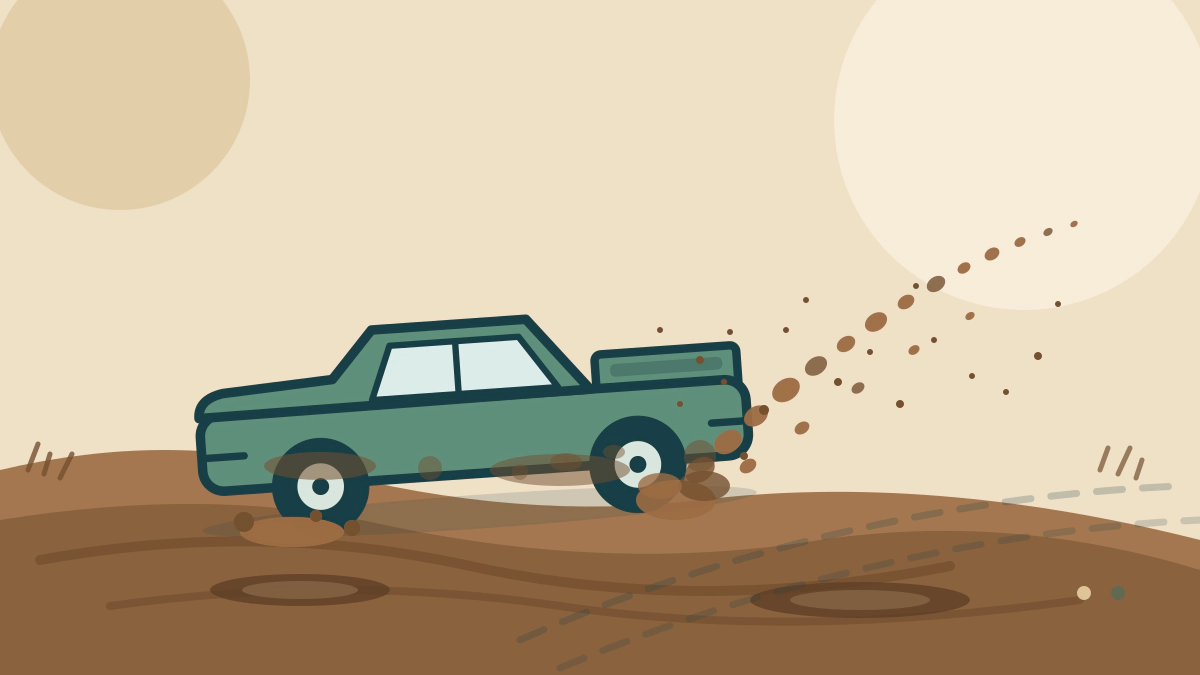
Engage four-wheel drive before the mud, check the depth, keep steady momentum and stop the wheelspin if the truck starts to dig in.
How should you drive a pickup through mud?
Engage four-wheel drive before the tires reach the mud, check the depth if you can, and keep steady momentum without spinning the tires. Mud rewards smooth inputs and punishes wheelspin. A truck that digs in at the entrance can turn a short crossing into a recovery.
Engage 4WD before you need it
Jeep’s off-road guidance says to put the vehicle in four-wheel drive whenever you anticipate needing extra traction, not after traction is already lost. The Ford F-150 owner’s manual lists 4H for off-road conditions that include mud, and 4L for low-traction surfaces with extra torque multiplication. It also says not to use 4H or 4L on dry, hard pavement, because that can increase tire wear and damage driveline parts.
Use the mode your manual specifies. A part-time system can bind on dry pavement; a full-time system may be left engaged. The owner’s manual for the exact truck is the authority.
Check the depth before you commit
Ford’s Raptor supplement says to approach deep mud with caution, test the depth before entering if possible, and remember that obstacles and deep ruts may be hidden under the surface.
Walk the edge if it is safe. Look at where other vehicles entered and exited, and at the color and texture of the mud. If you cannot judge the depth or the exit, turn around.
Momentum, not throttle
Ford’s guidance is to cross deep mud in a steady, controlled way while maintaining momentum. Jeep makes the same point from the other side: over-revving the engine can spin the wheels and lose traction. Apply power smoothly and keep the truck moving.
If traction starts to go, Jeep says to turn the steering wheel back and forth rapidly, which can help the tires bite into fresh ground. The Raptor supplement describes the same sawing motion as about a quarter turn in each direction. If traction is lost, stop. Spinning the tires digs deeper.
When the truck begins to slide
The F-150 manual says to be cautious of sudden speed or direction changes in mud, because even four-wheel-drive vehicles can lose traction. If the truck slides, steer in the direction of the slide until you regain control. Do not add throttle and do not brake sharply.
In shallow mud at higher speed, Ford says directional control is reduced much like on snow or ice. Slow down before the muddy section, not in the middle of it. The same smooth-input rule applies to other loose surfaces, as explained in how to approach steep off-road hills.
If you get stuck
Stop the wheelspin first. The F-150 manual describes rocking the truck by shifting between forward and reverse, stopping between shifts, and pressing lightly on the accelerator. It warns not to rock the vehicle if the engine is not at normal temperature, not to rock for more than a minute, and not to spin the wheels above 34 mph, because the tires can fail.
A recovery strap and rated points are safer than more throttle. The off-road recovery equipment guide explains the gear and the safety rules.
Tires and the mud that packs
The National Park Service warns that mud-terrain tires are not effective in some clay soils, because the clay packs into the tread and turns the tire into a smooth, slick surface. Tread pattern alone does not guarantee traction.
For unpaved roads, the Park Service recommends a high-clearance four-wheel-drive vehicle with all-terrain tires and a proper spare. Check the tire’s load rating and condition before a trip. All-terrain versus highway-terrain tires explains the construction difference.
If you lower tire pressure for off-road use, follow the vehicle manufacturer’s guidance and reinflate before returning to pavement. The Raptor supplement warns that low pressure makes a tire more likely to debead in a corner and that tires must be returned to the recommended pressure for the road.
Clean up after the mud
Ford says mud stuck to tires and rotating driveshafts can cause an imbalance that may damage components. Wash the underside after the trip, and check the brakes, air filter, boots, exhaust and undercarriage fasteners as the Raptor supplement lists.
Mud decisions at a glance
| Situation | Action | Why |
|---|---|---|
| Mud ahead, depth unknown | Stop and probe or walk it | Hidden ruts and obstacles |
| Deep mud with a clear exit | Use the mode the manual specifies; keep momentum | Wheelspin digs in |
| Truck starts to slide | Ease off; steer in the direction of the slide | Sudden inputs upset the truck |
| Momentum is lost | Stop spinning; saw the wheel gently | Fresh ground may give a bite |
| Still stuck | Rock briefly or use a rated recovery | More throttle digs deeper |
| After the crossing | Clean mud from tires and shafts; inspect | Imbalance and damage |
More trail guidance is in Off Roading and Towing.
Frequently asked questions
Do I need 4L to drive through mud?
Not always. Ford lists 4H for mud and 4L for low-traction surfaces that need more torque at low speed. Jeep caps low range at 25 mph. Use the mode the owner’s manual specifies for the depth and speed you expect, and do not use either mode on dry pavement.
Should I spin the tires to get out of mud?
No. Jeep says wheel spinning digs the vehicle in deeper, and Ford warns against spinning wheels above 34 mph because the tires can fail. Stop the spin and try a gentle sawing motion, a brief rocking procedure or a proper recovery.
Are mud-terrain tires the best choice for mud?
Not universally. The Park Service says mud-terrain tread can pack with clay and lose traction in some soils. A good all-terrain tire in good condition may work better, depending on the ground and the load.
What should I check after driving through mud?
Clean mud from the tires, wheels and rotating driveshafts, then check the brakes, air filter, boots, exhaust and undercarriage. Ford recommends a full inspection after off-road driving, including tire pressure and damage.