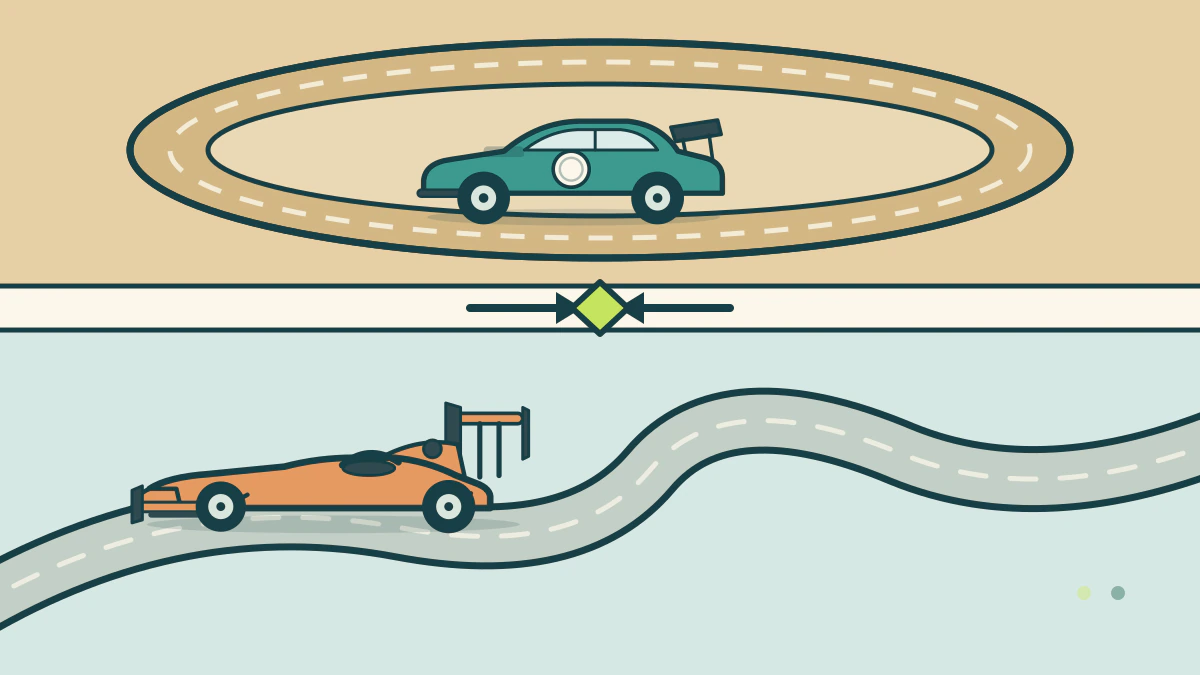
Compare NASCAR and Formula 1 on car rules, circuits, race weekends and points, using the sanctioning bodies' own 2026 regulations and official series pages.
How do NASCAR and Formula 1 differ?
They are two separate rulebooks for two kinds of racing: Formula 1 is a global championship for single-seat cars on permanent and street circuits, while NASCAR is a US stock-car series that races mostly on ovals and settles its title through a Chase. The split begins with the car and then runs through the track, the weekend schedule and the scoring.
The cars are built to different technical rules
Formula 1 cars follow the FIA technical regulations. The 2026 car keeps a 1.6-litre V6 turbo hybrid power unit, but the electric side now provides roughly half the power, and the cars are shorter, narrower and lighter than the previous generation (Formula 1). They run 18-inch Pirelli tyres and active front and rear wings that flatten on designated straights. The hybrid side alone is a large topic, covered in how motorsport hybrid systems work.
NASCAR Cup cars are closed-body stock cars. The Next Gen car uses a composite body, a 110-inch wheelbase, a steel tube chassis and a naturally aspirated 358 cubic-inch V8 (NASCAR spec sheet). NASCAR lists it at about 3,300 pounds with a five-speed sequential transaxle.
NASCAR also adjusts the package to the track. For 2026, Cup cars target 750 horsepower at tracks shorter than 1.5 miles, and every track gets A-post flaps that deploy with the roof flaps to reduce liftoff risk (NASCAR).
| Item | Formula 1 | NASCAR Cup Series |
|---|---|---|
| Body style | Single-seat car with a central cockpit | Closed composite stock-car body |
| Engine | 1.6-litre V6 turbo hybrid | 358 cu in naturally aspirated V8 |
| Wheels and tyres | 18-inch Pirelli | 18-inch Goodyear Eagle |
| Weight | Set by the FIA technical rules | About 3,300 lb |
| Aero | Active front and rear wings | Track-specific spoiler package |
| 2026 field | 22 drivers | Full Cup field |
One series races circuits, the other mostly ovals
Formula 1 races on permanent circuits and street circuits. The sporting regulations define the race as a set number of complete laps, and Monaco is run to a shorter distance than other rounds (FIA Section B).
NASCAR’s calendar is built mainly on ovals of different lengths, with road courses mixed in. The 2026 rules separate a short-track and road-course package from an intermediate package, so the same car type behaves differently from week to week. The two series also come from different traditions, as the history of American road racing shows.
Points decide the title in different ways
Formula 1 awards points to the top ten finishers of a Grand Prix: 25, 18, 15, 12, 10, 8, 6, 4, 2 and 1. Sprint weekends add points for the top eight, from 8 down to 1 (Formula 1). There is no playoff; the driver with the most points at the end of the year is champion.
NASCAR runs a 36-race Cup season split into a 26-race regular season and a 10-race Chase. The top 16 drivers in points qualify, and the Chase has no eliminations. A race win is worth 55 points, second place 35 and third 34, while stage points still pay 10 down to 1. Points are reseeded once, and the regular-season champion starts the Chase with 2,100 points (NASCAR).
| Item | Formula 1 | NASCAR Cup Series |
|---|---|---|
| Season length | Set number of Grands Prix | 36 points races |
| Title format | Most points over the season | 26 regular-season races plus 10 Chase races |
| Race win | 25 points | 55 points |
| Other scoring | Top ten finishers, plus sprint top eight | Stage points for the top ten, then finishing points |
| Postseason | None | 16-driver Chase, no eliminations |
The weekend schedule changes what you watch
An F1 weekend usually runs practice, then qualifying in three parts. Q1 lasts 18 minutes, Q2 lasts 15 and Q3 lasts 13. Six drivers drop out after each of the first two parts, and the final ten fight for pole (Formula 1). Sprint weekends replace part of that schedule with a short race.
A NASCAR weekend is built around the race itself. The race is divided into three or four stages, and the top ten in a stage score points. That gives teams a reason to race hard before the final segment.
Why the two formats produce different races
An F1 race pays points once, at the finish, so a bad qualifying session leaves a driver working through traffic for the whole race. A NASCAR race pays stage points along the way, so a poor first segment can be partly recovered before the final stage. Pit stops matter in both formats, but for different reasons.
For a new viewer, start with F1 qualifying to see one-lap speed, then watch the end of a NASCAR stage and the restart that follows. The two series sit inside the wider Motorsports and Performance Driving section, which also covers rally racing versus circuit racing.
Frequently asked questions
Is Formula 1 faster than NASCAR?
There is no shared event or rulebook that makes a direct comparison possible. F1 cars are built to a weight and aerodynamic formula, and NASCAR Cup cars are heavier closed-body cars.
Do the two series use the same points scale?
No. Formula 1 pays 25 points for a win and does not use stage points. NASCAR pays 55 points for a win in 2026, adds stage points, and reseeds the field for a 16-driver Chase.
Why does NASCAR split a race into stages?
Stages create scoring moments before the finish and give the broadcast natural breaks. The stage results pay points to the top ten, and the final stage sets the race order.
How many races does each season have?
Formula 1 lists 24 races on its 2026 calendar. The NASCAR Cup Series runs 36 points races, split into 26 regular-season races and 10 Chase races.
Bottom line: NASCAR and Formula 1 differ because their rulebooks define different cars, different circuits and different ways of awarding a title.