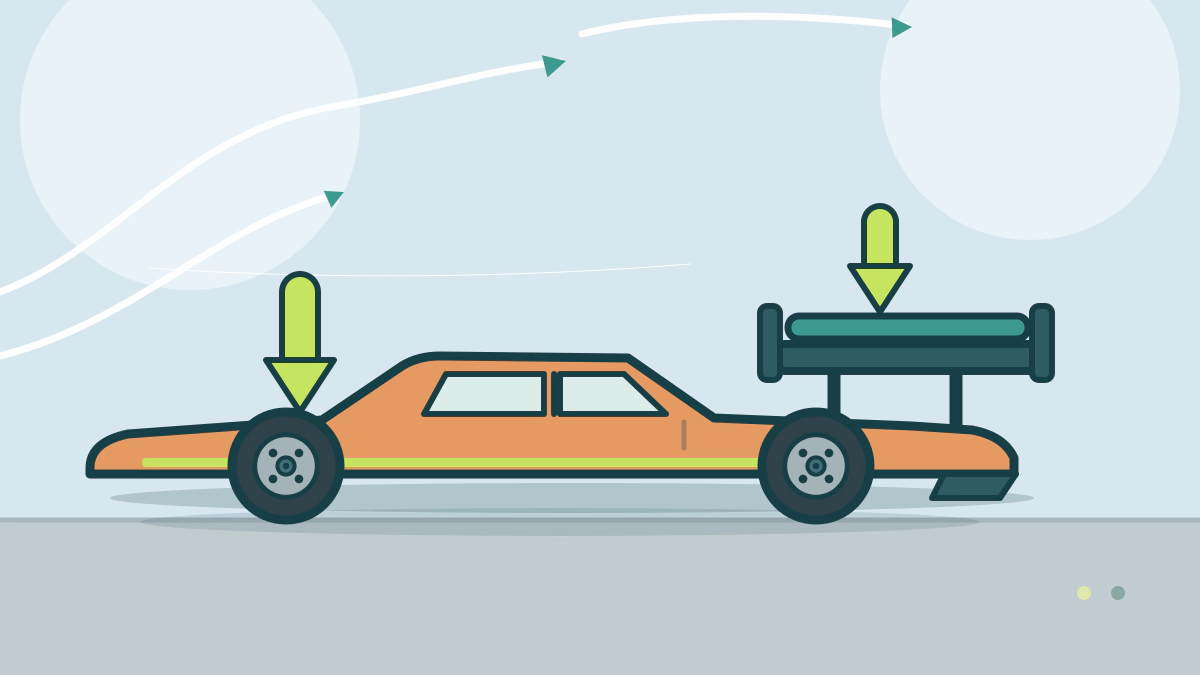
Downforce is lift pointed downward: air pushes a car onto the road as speed rises. See the equation, a worked example and the drag trade-off.
What is downforce?
Downforce is the vertical aerodynamic force that pushes a car toward the road. NASA describes lift as a force acting perpendicular to the airflow, produced when a moving gas is turned by a solid object (NASA Lift). Downforce uses the same force, directed downward. Formula 1 defines it as the vertical component of the aerodynamic forces on the car (F1 Glossary).
Inverted wings and shaped underbodies turn air upward, so the reaction pushes the car down. The force grows quickly with speed, and the Motorsports and Performance Driving hub covers the rest.
The lift equation works with the sign flipped
NASA’s lift equation is L = Cl x one-half x density x velocity squared x area (NASA Lift Equation). The lift coefficient, Cl, bundles shape and angle into one number. Density is air density, velocity is road speed and area is a reference area.
For downforce, keep the equation and treat the result as a downward force. Double the speed and the force quadruples, because velocity is squared.
Cl is normally found by experiment, not from a spec sheet, which is why a wing angle tested on one car does not transfer neatly.
A worked example with labelled assumptions
Assume a reference area of 1.5 square meters, a lift coefficient of 2.5 and air density of 1.23 kilograms per cubic meter. NASA’s standard atmosphere at sea level gives about 1.23 kg/m3 at 101.29 kPa and 15.04 C (NASA Atmosphere). The area and coefficient are illustrative, not measured for a specific car.
At 27 meters per second, about 60 mph, the calculation is 2.5 x 0.5 x 1.23 x 27 squared x 1.5. That equals about 1,681 newtons, or 1.68 kN. Dividing by 9.81 gives a weight equivalent of roughly 171 kilograms.
| Speed | Speed in m/s | Downforce with these assumptions | Weight equivalent |
|---|---|---|---|
| 60 mph | 27 | 1.68 kN | 171 kg |
| 90 mph | 40 | 3.69 kN | 376 kg |
| 120 mph | 54 | 6.73 kN | 685 kg |
| 150 mph | 67 | 10.35 kN | 1,055 kg |
The jump from 60 to 120 mph is 4x, not 2x: the squared term.
Why that force changes grip
Downforce presses the tires onto the road. Within the tire’s limits, more vertical load allows more cornering force, so the car can carry more speed through a corner. Formula 1’s glossary says downforce can improve grip, traction and handling (F1 Glossary).
The relationship is not unlimited. Tires do not gain grip in a straight line forever as load rises, and the front and rear must be balanced. A car with huge rear downforce and little front downforce may feel stable until it refuses to turn.
At 30 mph, the same assumptions give about 414 newtons, or roughly 42 kilograms. Mechanical grip still does most of the work at that speed.
The drag bill arrives at the same time
Drag is the aerodynamic force that opposes motion, and NASA gives it the same structure: D = Cd x one-half x density x velocity squared x area (NASA Drag Equation). Lift and drag rise together because both depend on dynamic pressure.
Use the same area, a drag coefficient of 1.0 and density of 1.23. At 54 m/s, drag is about 2,690 newtons. Power is force times speed, about 145 kilowatts or 195 horsepower. At 27 m/s, the same calculation gives about 18 kilowatts. Doubling speed quadruples drag but multiplies the power needed by eight.
NASA also explains induced drag: generating lift creates a downstream force of its own, so more downforce tends to bring more drag (NASA Drag). That is the central trade-off: a high-downforce setup helps in slow corners and hurts on long straights.
Formula 1’s 2026 cars make the trade-off visible. Their active wing elements stay closed to produce downforce and drag, then open to reduce both for straight-line speed (Formula 1). A flatter floor also reduces ground-effect forces, so teams find downforce in other areas.
Ground effect and the setup balance
A shaped floor and diffuser can accelerate air beneath the car and create a low-pressure region that pulls the car down. Formula 1 notes that its 2026 rules diminish these ground-effect forces, while wings and other surfaces still contribute (Formula 1). Time attack cars often trade straight-line speed for one fast lap, as the time attack guide explains.
Ground-effect downforce is sensitive to ride height. A lower car may make more downforce but risks bottoming out and losing the flow. That is why ride height and spring rates interact with aero.
Downforce does not replace tires, brakes or a balanced chassis. It is one force in a system, and it changes with speed and attitude. The aerodynamics of electric cars shows the same trade-off in a different context, where reducing drag often matters more than adding downforce.
Frequently asked questions
Is downforce the same thing as grip?
No. Downforce is an aerodynamic force pushing the car down. Grip is how the tire responds to that load and the road. It can add grip, but it does not replace the tire.
Does more downforce always mean a faster lap?
Not necessarily. More downforce usually adds drag, which costs straight-line speed. The best setup depends on the track, which is why teams run different wing levels.
Why does downforce rise with the square of speed?
Because the lift equation multiplies density by velocity squared. Going twice as fast puts four times the dynamic pressure on the same surface, so force is four times larger if coefficient and area stay the same.
Do road cars make meaningful downforce?
At legal road speeds, the equation produces small forces from road-car-sized surfaces, and extra wings or spoilers tend to add drag. For a road car, reducing drag usually matters more than chasing race-car downforce.