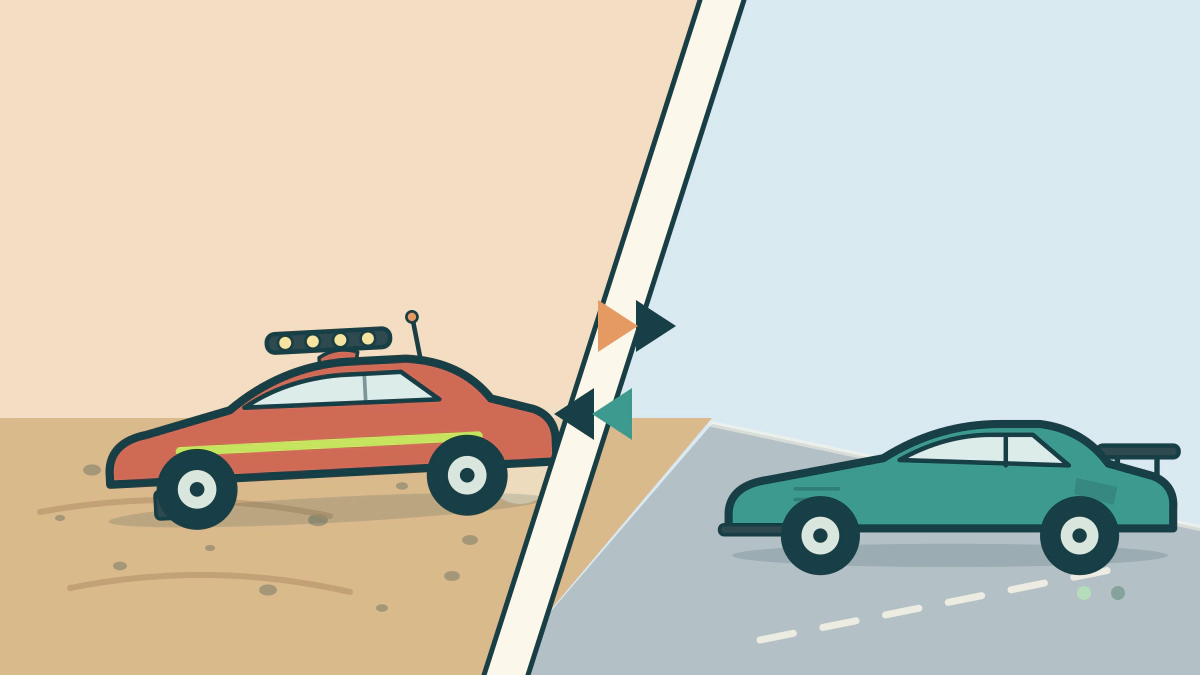
Compare rally and circuit racing on course layout, starts, timing, co-drivers and surfaces, using WRC and Formula 1 rules and event information.
What is the main difference between rally and circuit racing?
Circuit racing is wheel-to-wheel racing on a closed loop where cars share the track and complete laps, while rallying is a sequence of timed point-to-point stages run one car at a time, and the crew with the lowest cumulative stage time wins. In rally, the clock is the direct opponent. In circuit racing, the car beside you is.
Both are sanctioned motorsport with technical rules, safety requirements and licensed competitors. The structure of the event is where they separate. This guide sits in the Motorsports and Performance Driving section, alongside the separate comparison of NASCAR and Formula 1.
| Element | Rally | Circuit racing |
|---|---|---|
| Course | Special stages on closed roads | Closed circuit with repeated laps |
| Start | Cars released individually | Cars start together from a grid |
| Timing | Each stage timed to 1/10 second | Lap times over a set race distance |
| Traffic | No racing alongside another car on stage | Overtaking and traffic are central |
| Winner | Lowest cumulative stage time | First car to complete the race distance |
A rally is a set of stages joined by public roads
The WRC describes each rally as a series of timed sections, usually 15 to 25 special stages, held on closed roads. Drivers tackle the stages one at a time, and timing is taken to 1/10 second. A co-driver reads pace notes that describe the hazards ahead (WRC).
The stages are linked by road sections. Crews drive between them on public roads and must obey normal traffic regulations. Those transfers are part of the event, and arriving late at a time control brings a penalty.
Before the rally starts, crews have two days of reconnaissance. They drive the route at limited speed and write or refine pace notes.
A circuit race is one shared race on a closed loop
A circuit event runs on a closed track. In Formula 1, the weekend normally includes free practice, a three-part qualifying session and the race. Qualifying sets the grid, and the race is run over a set number of laps (Formula 1). Because every car is on the same loop at the same time, a circuit race is shaped by overtaking, traffic and pit timing. The FIA regulations also set the race distance in laps, with Monaco shorter than other rounds (FIA Section B).
The co-driver is a rally-only role
A rally car carries two people. The co-driver holds the pace notes, calls the corners and warns about hazards, and manages the time card and schedule. The WRC notes that the co-driver reads detailed notes while the driver concentrates on the road.
A circuit car carries one driver. The team communicates by radio, but nobody sits alongside.
Surface and weather play different roles
The 2026 WRC calendar blends snow, gravel and asphalt events (WRC). Rally Sweden runs on snow and ice, and crews use studded tyres for grip. A gravel rally punishes the car with stones and dust, while an asphalt rally rewards precise lines.
Circuit racing usually runs on paved asphalt. The surface is consistent from lap to lap, so the work shifts to tyre temperature, braking stability and aerodynamic balance. Rain changes grip, but the track does not become a different material between stages.
How the two formats reward different skills
Rally rewards precision and trust. A driver commits to a corner based on a note, not on what is visible. Mechanical sympathy matters too, because crews carry their own tools and can only rely on themselves outside the service park.
Circuit racing rewards racecraft. A driver has to manage tyres, judge a pass, defend a position and read traffic. The best lap is useful, but the finishing position is what pays.
| Skill | Rally | Circuit racing |
|---|---|---|
| Reading the road | From pace notes and recce | From vision and repetition |
| Overtaking | Rare on stage, decided by time | Constant tactical decision |
| Teamwork | Driver and co-driver as a unit | Driver plus engineers on radio |
| Endurance | Long days and changing surfaces | Sustained concentration in traffic |
How to watch each format
Watch a rally stage from one corner and you will see a single car at a time, often sideways on gravel or cutting through snow. The leaderboard changes when stage times are published, not when a pass happens.
Watch a circuit race and you follow the order live. A pit stop or a pass changes the standings immediately. Neither format is a better test of speed; they test different things.
American circuit racing developed through club events and permanent tracks before it became the professional ladder it is today, a story covered in the evolution of American road racing. Rally-style timed competition for club drivers is a separate path, explained in what time attack racing is.
Frequently asked questions
Do rally cars race side by side?
No. Cars are released individually and the stage is timed. A super-special stage can use two parallel tracks so two cars run at once, but the result is still decided by time (WRC).
Why does a rally need a co-driver?
The co-driver reads pace notes that describe corners, crests and hazards, and keeps the crew on schedule. Without those notes, a driver could not safely commit to a road at racing speed on the first pass.
Are rally stages closed to traffic?
Yes. Special stages are closed roads used for the timed sections. The road sections between stages are open public roads, and crews must follow traffic law while driving them.
How is a rally winner decided?
The winner is the crew with the lowest total time across all special stages, after penalties. A single fast stage does not win a rally unless the crew can repeat that pace.
Bottom line: Rally and circuit racing both reward speed, but rally turns the event into a timed puzzle shared with a co-driver, while circuit racing turns it into a direct fight on a shared loop.