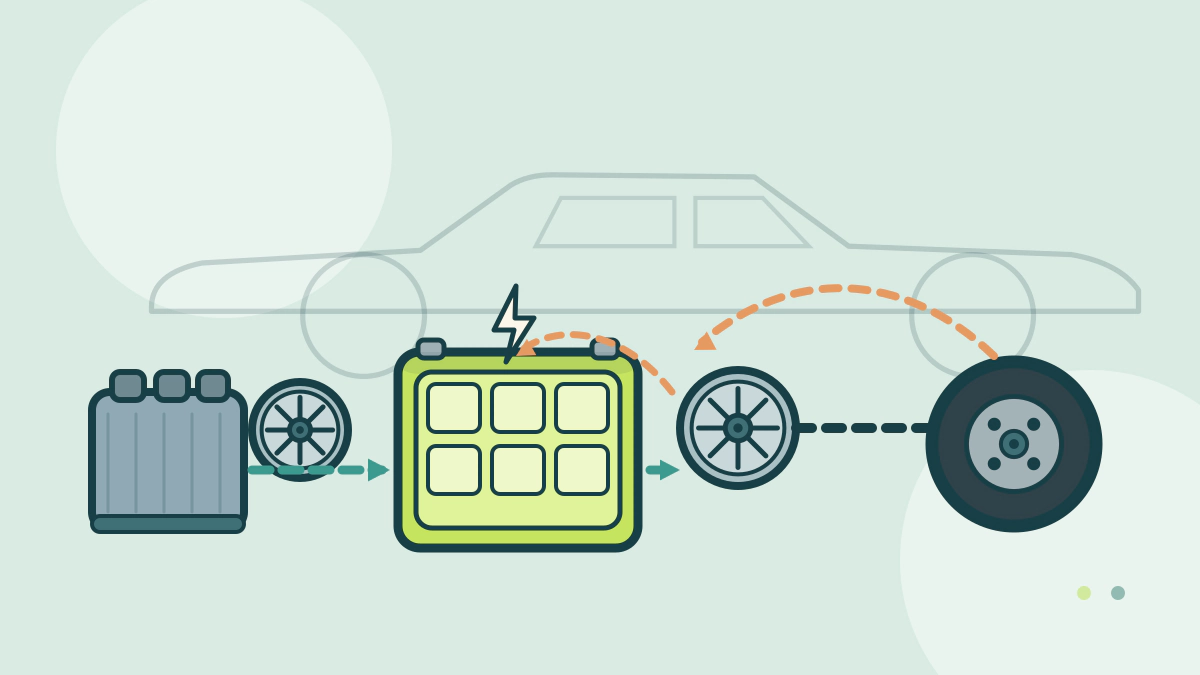
See how Formula 1 and Le Mans Hypercar hybrids recover, store and deploy energy, and why the rules limit when the electric motor can help.
What does a motorsport hybrid actually do?
It captures energy that would otherwise be lost, stores it, and sends it back to the wheels as a short burst of power. Formula 1 and the Le Mans Hypercar class both use this idea, but their rulebooks control it in different ways. The hardware is only half the story: the regulations decide when the electrical machine may add torque. This sits under Motorsports and Performance Driving.
The main parts of a racing hybrid
The central part is the motor generator unit, usually called the MGU-K. The letter K stands for kinetic. It is an electrical machine that can act as a motor or a generator. Under braking it converts kinetic energy into electricity; under acceleration it turns stored electricity back into torque at the wheels.
An energy store, normally a battery, holds that electricity. Control electronics manage the flow between the motor, the store and the rest of the power unit. In Formula 1 the rules also define the energy store, the MGU-K control unit and the safety systems around them.
Formula 1 cars also used an MGU-H until the end of the previous rules cycle. The H stood for heat, and the unit sat in the exhaust flow. It recovered energy that would otherwise go out of the tailpipe. Formula 1 removed it for 2026, explaining that the technology had not been adopted by road car makers.
Two series, two sets of limits
Both championships use electrical assistance, but not at the same scale.
| Item | Formula 1 from 2026 | Le Mans Hypercar |
|---|---|---|
| Electrical machine | MGU-K rated at 350 kW to the rear wheels | Front MGU-K limited to 200 kW of DC power |
| Second machine | None, because the MGU-H was removed | None required |
| Energy storage | Battery energy store | Battery energy store |
| Low-speed use | Managed by energy flow rules and driver modes | Positive front torque only above 120 km/h on slicks |
| Supply route | Developed by each power unit maker | Bosch supplies the MGU, inverter and control unit |
The Formula 1 MGU-K is nearly three times as powerful as the old one, which delivered 120 kW. Formula 1 says the goal is for about half of the power unit output to come from the electrical side.
Le Mans Hypercar takes a different path. The front MGU-K may not exceed 200 kW of DC power. Outside the pit lane, it may only apply positive torque above 120 km/h on dry slicks. With wet tires the threshold is 140 to 160 km/h, so the front motor cannot help in the slowest part of a corner.
How the energy goes in and out
Recovery happens in more places than hard braking. Formula 1 lists braking, coasting, part throttle and lifting off. It also describes super clipping, where the car keeps harvesting at the end of a straight even at full throttle.
The recovered energy goes into the store, and the control system decides when to release it. The store has a capacity, the motor has a power limit, and the rules set how much energy may move.
That makes hybrid racing partly an energy management contest. A driver may save deployment for a straight where passing is possible. Formula 1’s boost button exists for that choice.
What the driver controls
Formula 1 cars run most energy management through prepared engine maps. The driver can override them. One driver-selected mode is lift-off regeneration, but using it also disables the active aero devices.
The boost button returns the power unit to maximum output or to a team-defined profile. The driver can use the saved energy in one burst or spread it over several corners.
Le Mans Hypercar rules treat the front motor as part of the powertrain. The regulations define a front power train from the MGU-K through its transmission to the drive shafts. Torque meters let the organizers monitor what the car delivers.
Why racing hybrids are not road hybrids
A racing hybrid is built for a short, intense life. It must survive high temperatures, full-power use and weight limits. A road hybrid must last for years and work in traffic.
The two systems share principles, not parts. Regenerative braking in a road car recovers energy in much the same way as a racing MGU-K, but the road car also has to be smooth, quiet and durable. The guide to regenerative braking explains that version, and BEV, HEV and PHEV differences cover the road-car categories.
The 2026 Formula 1 rules keep the 1.6-liter turbocharged V6 and concentrate on the MGU-K instead.
Frequently asked questions
Do motorsport hybrids plug in to recharge?
No. The cars recover energy while they run and store it on board. The energy comes from braking, coasting and, in some rules, the exhaust flow.
Why did Formula 1 remove the MGU-H?
Formula 1 says the MGU-H was effective but complicated, and road car makers did not adopt it. Removing it made the power unit simpler and more relevant to production cars.
How much power does the 2026 Formula 1 MGU-K produce?
The MGU-K is rated at 350 kW at the rear wheels. That is up from 120 kW in the previous generation. Formula 1 aims for roughly half of the power unit output to come from the electrical system.
Can a Le Mans Hypercar use its front motor in a slow corner?
No. The front MGU-K may only apply positive torque above 120 km/h on dry slick tires. The threshold rises to between 140 and 160 km/h on wet tires. That keeps electrical torque out of the slowest corner phases.