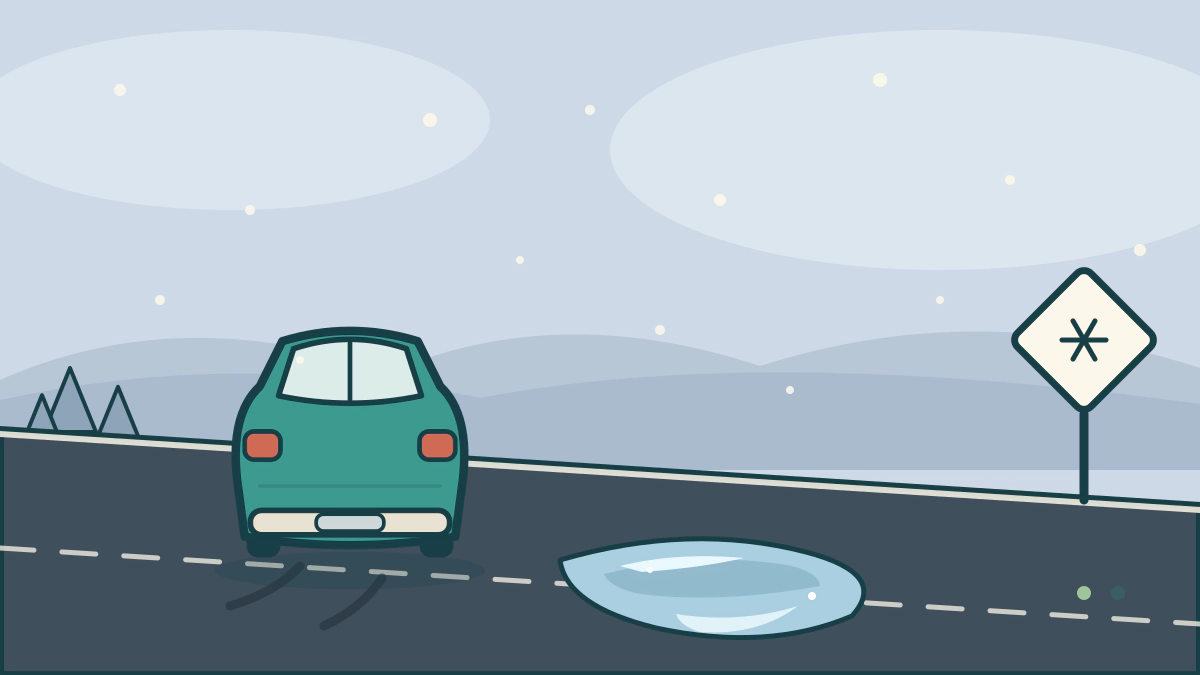
Learn where black ice forms, why it is hard to see, and how to slow down, brake and steer without losing grip on a cold road.
Where black ice forms, and why it is hard to see
Black ice is a thin layer of ice that is difficult to see, and it is most likely when the road surface is at or below freezing. The National Weather Service says freezing fog can cause it to form on roadways. It adds that the ice is hard to see and particularly dangerous, and advises driving more slowly when you suspect icy conditions. If a patch looks wet while the temperature is near freezing, treat it as ice.
When surface temperatures are at or below freezing, tiny liquid droplets in fog can freeze instantly on roads and vehicles. That leaves a glaze that can look like wet pavement.
Some stretches freeze first. The Iowa Department of Transportation explains that shaded areas are the first to freeze and the last to melt because their pavement stays colder. Caltrans names bridge decks and shady spots as places that can be icy when other areas are not.
Where to expect ice first
| Place or condition | What official guidance says | What to do |
|---|---|---|
| Bridge decks and overpasses | Caltrans says they can be icy when other areas are not | Ease off before the joint |
| Shaded road and bridge shadow | Iowa DOT says these freeze first and melt last | Expect ice when open pavement looks clear |
| Wheel tracks after blowing snow | Iowa DOT says warm tires can trap snow and glaze the tracks | Do not assume the tracks have more grip |
| Freezing fog | NWS says droplets freeze on roads and can form black ice | Treat the surface as icy |
| Slush and packed snow after treatment | Iowa DOT expects patches of packed snow and ice | Slow down and skip cruise control |
The wheel-track case is easy to miss. The Iowa DOT describes how warm tires trap ground-level blowing snow. As more vehicles cross the same tracks, a glaze of ice forms. That glaze can be very slippery even when the rest of the road looks snowy.
Make one input at a time
Sudden corrections are the problem, not the ice alone. Caltrans tells drivers to avoid sudden stops and quick direction changes on snow and ice. The Colorado Department of Transportation turns that into a rule: when you accelerate, turn or brake, do only one at a time. Trying two at once can cause a slide or a spin.
The Kia 2026 K5 owner’s manual describes the same risk. It lists speeding, rapid acceleration, sudden brake applications and sharp turns as potentially very hazardous on snowy or icy roads.
Brake the way your car is built to brake
NHTSA says a driver with antilock brakes should apply firm, continuous pressure to the pedal. A driver without antilock brakes should pump the brakes if the wheels start to lock up.
If your car has ABS, hold steady pressure and let the system work. Our guide to ABS versus electronic stability control explains what each system can and cannot do on a low-grip surface.
Cut speed before you reach the ice
Caltrans puts the speed problem plainly. A highway speed of 65 mph may be safe in dry weather, but it is an invitation for trouble on snow and ice. Snow and ice make stopping distances much longer, so the agency says to leave more distance ahead.
Colorado DOT makes a broader point: driving too fast for conditions causes most crashes. Leave a gap that gives you time to react without a hard stop.
Prepare the car, then decide whether to go
Cold changes the car as well as the road. NHTSA notes that tire pressure falls as the outside temperature drops. Check each tire when it is cold, meaning it has not been driven for at least three hours, and use the pressure on the door-frame label rather than the sidewall maximum.
NHTSA also recommends checking tread depth, replacing tires with uneven wear, and considering snow tires. Tread should be at least 2/32 of an inch. Our guide to checking tire tread depth shows how to measure it.
Caltrans adds brakes, wipers, the defroster, the heater and the exhaust system to the pre-winter check. It also advises carrying chains in mountain areas and knowing whether the vehicle is front or rear wheel drive. NHTSA also lists items such as a scraper, shovel, sand or kitty litter, jumper cables, a flashlight, blankets, water and food.
Then check the forecast. NHTSA says to consider postponing non-essential travel if roads are not in good shape, and to tell someone your route and arrival time. The winter car maintenance checklist covers the service side, and the Driving Guides hub has more weather topics.
Frequently asked questions
Why is black ice so hard to see?
The National Weather Service says black ice is difficult to see, which is what makes it particularly dangerous. It forms as a thin glaze, so it can blend in with dark pavement or look like a wet patch.
What should I do if my car starts to slide on ice?
Avoid sudden braking and quick steering changes, as Caltrans advises. If your car has antilock brakes, hold firm, continuous pedal pressure; without ABS, pump the brakes if the wheels lock.
Where does black ice form first?
Shaded areas are usually first, according to the Iowa DOT, because their pavement stays colder and they are the last to melt. Caltrans names bridge decks and shady spots as places that can be icy when other areas are clear. Wheel tracks packed with blown snow can also glaze over.
Do winter tires help on black ice?
The Colorado DOT says winter tires are the safest choice for snowy and icy conditions. Its published comparison shows a much shorter stopping distance on snow with winter tires than with all-season or summer tires. NHTSA also suggests considering snow tires before winter, and our winter versus all-season tire guide explains the markings.