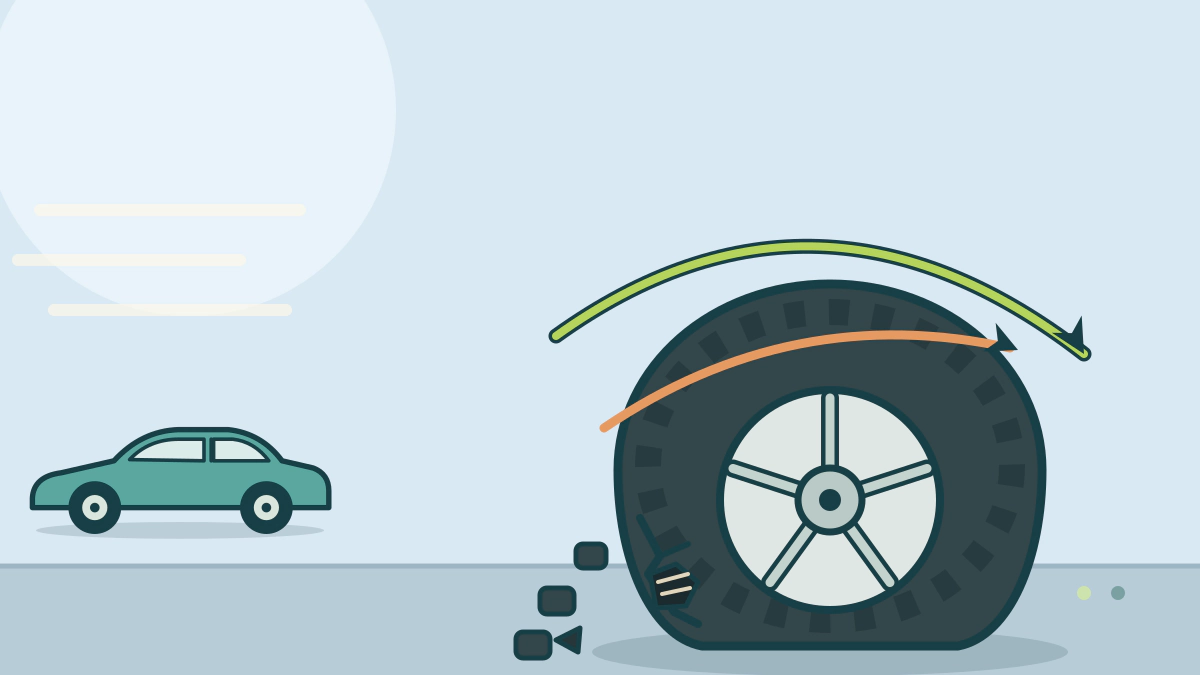
Hold the wheel, ease off the accelerator and steer to a safe stop after a blowout, then protect yourself from traffic before checking the damage.
Hold the wheel and keep the car balanced
If a tire blows out, grip the steering wheel with both hands, keep your speed if it is safe, ease off the accelerator and steer where you want the car to go. That sequence comes from NHTSA’s blowout guidance, which treats balance and control as the goal (NHTSA). NHTSA warns that an overreaction, including slamming the brakes or abruptly lifting off the accelerator, can cause a loss of control. The noise and the pull are alarming, but the first response should be small and deliberate. If the car is still in a travel lane, the highway breakdown guide covers getting it clear.
The five steps NHTSA lists
- Hold the steering wheel with both hands.
- Maintain your speed if possible and if it is safe to do so.
- Release the accelerator gradually.
- Correct the steering as needed, looking where you want the car to go.
- Once the car is stable, slow down and pull off the road where and when you judge it safe.
NHTSA does not ask the driver to identify the failed tire, inspect the damage or stop in the first second. Control comes first.
A front and rear blowout feel different, but the steps do not change
| What you notice | Which tire it suggests | What to do |
|---|---|---|
| The steering wheel pulls or feels forced | Front tire | Hold both hands, correct gently, keep speed steady |
| The seat or body of the car feels unsettled | Rear tire | Keep the wheel steady and ease off the accelerator |
| A pop followed by flapping rubber | A blowout, per AAA’s description | Follow the same control steps before stopping |
| A tire pressure warning before the event | A significantly underinflated tire, per NHTSA | Inspect and set pressure when safely stopped |
NHTSA says the steps are the same no matter which tire fails; only the feel changes, with a front blowout showing up in the steering and a rear one in the seat or body (NHTSA). AAA describes the sound cue: a sudden pop followed by the sound of flapping rubber (AAA).
Do not brake hard, jerk the wheel or stop in a lane
NHTSA’s warning is specific: slamming on the brakes or abruptly removing your foot from the accelerator can cause a loss of control (NHTSA). The aim is a controlled speed reduction, not the shortest possible stop. Keep steering inputs smooth and let the car settle before you move toward the shoulder.
Choose the stop before you leave the road
Once the car is stable, NHTSA says to continue slowing and pull off where and when you judge it safe (NHTSA). AAA’s breakdown guide adds the practical order: coast toward the side, use the turn signal, and on a multi-lane highway take the next exit or the right shoulder. If neither is available, AAA says the left shoulder may be considered, again pulled as far from traffic as possible (AAA). A narrow shoulder beside fast traffic may offer less room than an exit that is a short distance ahead. NHTSA leaves that choice to the driver’s judgement, which is why the decision should be made while the car is still rolling and controllable.
After you stop, protect people before the tire
Turn on the hazard lights, exit from the passenger side when it is safe, and keep everyone away from the traffic lane (Texas DPS). AAA advises staying inside a car that is clear of traffic with seatbelts on, and getting out if the car may be rear-ended or shows fire or smoke (AAA). Drivers approaching a stopped vehicle with hazards on may be required to move over or slow down; NHTSA says all 50 states have move-over laws and 19 states plus DC include vehicles with hazard lights (NHTSA). A legal duty is not a physical shield. Call for assistance with the location, vehicle details and problem ready (AAA).
Check the tire only from the safe side
A blown tire is usually obvious, but the cause may not be. NHTSA says poor maintenance, including underinflation and skipped rotation, can lead to a flat, a blowout or tread separation (NHTSA). It also says a tire worn to 2/32 inch is not safe, and that a bulge, cut or crack is a reason to stop using it. Inspect from the side away from traffic, never from the lane. Check tire tread depth before the next long drive, not after a failure. A full-size spare is not a replacement for worn tires except in an emergency, and spares age because they are seldom used (NHTSA). Check the owner’s manual and the tire information for any speed or distance limit on the spare before driving on it. If the car uses run-flat tires, the manual’s instructions still govern how far and how fast you can go. The Driving Guides section covers other emergency scenarios.
Frequently asked questions
Should I brake hard to stop quickly?
No. NHTSA warns that slamming the brakes can cause a loss of control. Grip the wheel, ease off the accelerator and slow progressively.
Do front and rear blowouts need different handling?
No. NHTSA says the steps are the same; a front failure is felt through the steering and a rear one through the seat or body.
Can I drive on the flat tire to the next exit?
NHTSA’s guidance is to pull off the road once the car is stable, rather than continue to a destination. Stop as soon as you can do so safely.
What causes a blowout?
NHTSA links poor tire maintenance, including underinflation and missed rotation, to blowouts and tread separation. Heat, damage and age can also matter, and NHTSA notes that some makers recommend replacing tires at six to ten years.