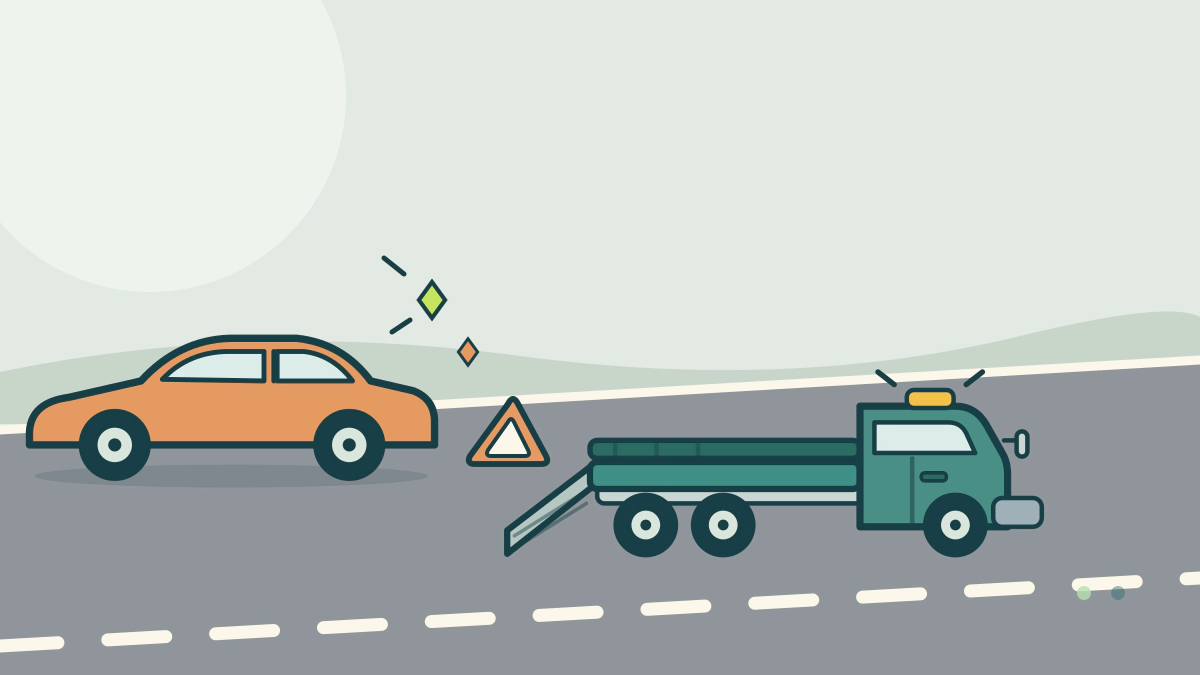
Move out of the travel lane, choose the safest shoulder or exit, keep people on the protected side and give responders a location they can find.
Get out of the travel lane before you diagnose
Signal, keep control and coast to the right shoulder or the next exit; once stopped, turn on the hazard lights and call 911 if you are stranded in a live lane. AAA’s breakdown guide says to coast to the side and to use the turn signal as you normally would, without unnecessary risks (AAA). On an interstate or multi-lane highway, AAA says to take the next exit or the right shoulder when possible. If neither is an option, the left shoulder may be considered, again pulled as far from traffic as possible (AAA). The cause of the problem can wait. The lane position cannot.
Choose the stopping place by the space it gives you
| Situation | What AAA recommends | Why it helps |
|---|---|---|
| A multi-lane highway with an exit close by | Take the next exit | Moves the car off the high-speed road |
| No exit, right shoulder available | Right shoulder, as far from traffic as possible | Puts space between the car and moving vehicles |
| Right shoulder blocked or unsafe | Consider the left shoulder, far from traffic | AAA lists it as an alternative, not a first choice |
| Car cannot leave a live lane | Do not stay inside; get people away and call 911 | AAA warns the car may be rear-ended |
The shoulder is not automatically safe. Stop as far from the traffic lane as the car allows, and take the next exit when the shoulder is narrow or blocked.
Move people to the protected side
Texas DPS says to exit from the passenger side, away from traffic (Texas DPS). AAA’s rule is to stay with the vehicle, belted, when it is clear of traffic, and to get out when it might be rear-ended or is on fire (AAA). Once outside, AAA says to get well away from oncoming traffic and from the vehicle, and to never wait for help directly behind or in front of the car.
Make the vehicle visible from a distance
Hazard lights are the first signal (AAA). If it is safe to leave the car, raise the hood; AAA says to check whether the hood is too hot to touch first, because flames or hot steam may be underneath (AAA). Texas DPS suggests a light-colored cloth on the antenna or door handle and a “Send Help” sign in the window (Texas DPS). Reflective triangles or flares help at night, but AAA says to set them out only if exiting is safe. Keep the warning devices in the car before the trip; NHTSA lists flares or emergency markers, a flashlight and a first aid kit among the supplies to carry (NHTSA).
Call for help with the details ready
AAA lists the information to give: name and membership number, exact location and cross streets, make, model, year, color and plate, and the nature of the problem (AAA). Add whether anyone is in danger. AAA says to call 911 for a car fire, a car stranded in fast-moving traffic, or an unsafe area. In Texas, the Department of Public Safety lists a Motorists Helpline at 1-800-525-5555 for a disabled or stranded motorist (Texas DPS); check your state DOT or highway patrol for an equivalent number.
Do not walk the shoulder to the next exit
AAA’s guidance is to stay with the car when it is clear of traffic and to get well away from oncoming traffic when it is not (AAA). If you must leave, tell the dispatcher where you are going and which direction you are taking. Texas DPS says that if you decide to accept a ride, write down your name, the date, the time you left, your direction, and the plate and description of the vehicle, then notify law enforcement (Texas DPS).
Why the move-over law matters to you
Every state has a move-over law covering emergency vehicles with flashing lights (NHTSA). NHTSA says 19 states and Washington, DC include any vehicle with flashing or hazard lights. Colorado’s rule gives the shape of the slow-down duty: move over a lane, or slow to 25 mph or less in a 40 mph zone and at least 20 mph below the limit at 45 mph or higher, with a $150 fine and 3 points for a violation (Colorado State Patrol). A driver who ignores the rule can still hit the car. Stand on the side away from the lane, not at either end of the vehicle.
While you wait
The waiting period has its own rules: where to sit, what to tell a passerby and when to move. Our guide to staying safe while waiting for roadside assistance covers that stage. If the breakdown involved steam, a warning light or smoke, the cause needs diagnosis rather than a guess; engine overheating is one common reason a car stops on the highway. See what a roadside emergency kit should contain. More scenarios are covered in the Driving Guides section.
Frequently asked questions
Should I stay in the car on the shoulder?
Stay inside, belted, when the car is clear of traffic, per AAA. Get out if the car may be rear-ended or shows fire or smoke.
What if the car stops in a live lane?
AAA says not to stay in a vehicle that may be rear-ended. Get people out on the side away from traffic and call 911.
Should I open the hood?
AAA says an open hood signals a breakdown, but check the hood’s heat first; if it is too hot to touch, flames or hot steam may be underneath.
Can I keep driving to the next exit?
If the car can still move safely and an exit is close, AAA suggests taking it. If it cannot, use the shoulder and stop as soon as it is safe.