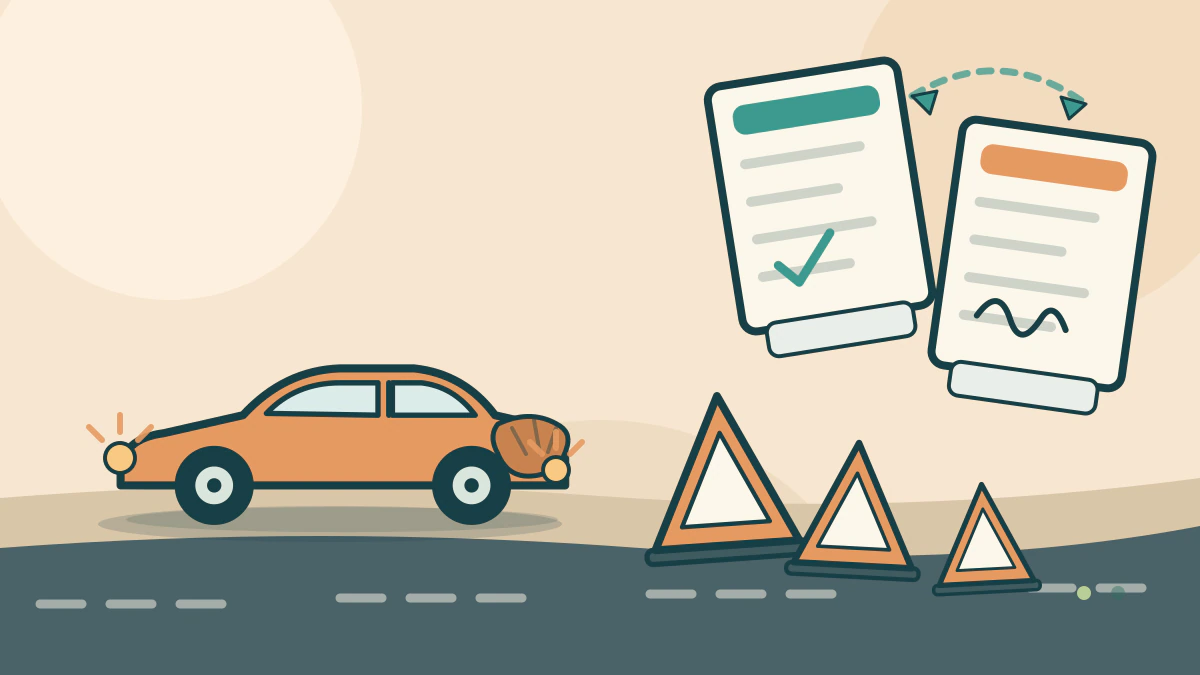
A step-by-step sequence for the first minutes after a low-speed crash: clearing the lane, calling the right number, exchanging details and filing reports.
What should you do first after a minor crash?
Stop, switch on the hazard lights and move the vehicles out of the travel lane if they still drive. Then check every person in both cars before you look at the damage. A low-speed collision still leaves you standing in live traffic.
Stopping is a legal duty, not a courtesy. The New York DMV says you must stop after a crash no matter how small the damage, and that leaving a property-damage scene is a traffic violation. The Kansas DOT puts the same instruction first on its crash page.
Clear the lane before you compare bumper damage
If nobody is hurt and both vehicles can move, move them. TxDOT tells drivers not to wait for police before moving a drivable car out of the flow of traffic. MoDOT notes that Missouri law requires a reasonable effort to move the vehicle to the shoulder when there are no serious injuries.
Pull as far onto the shoulder, a side street or a nearby lot as the scene allows. If a car will not move, or you cannot get out safely, stay belted inside and call for help. Kansas DOT gives that exact instruction when a vehicle cannot be driven.
Decide who to call from what you can see
An injury, a deployed airbag or an undrivable car changes the call. Kansas DOT says to dial 911 in those cases. TxDOT adds a driver who appears impaired, a driver with no insurance, or a driver who leaves the scene to its list of reasons to call police.
For a plain fender bender with no injuries, MoDOT directs drivers to the local non-emergency number. Give the dispatcher the exact location and follow the instructions you get.
| What you see | Who to call | Published guidance |
|---|---|---|
| Anyone hurt, an airbag deployed, or a vehicle cannot be driven | 911 | Kansas DOT |
| No injuries and both vehicles drive | Local non-emergency line, then follow the dispatcher | Missouri DOT |
| A driver seems impaired, has no insurance, or starts to leave | Law enforcement, as soon as it is safe | Kansas DOT and TxDOT |
| You hit a parked car and the owner is not there | Try to find the owner, or leave a note with your details and notify police | Kansas DOT and New York DMV |
Exchange the details a claim will need
Kansas DOT lists the full set for a non-injury crash: the other driver’s name, license number and state, address, phone, vehicle identification number, plate, insurer and policy number, plus the crash location and any witness contacts. New York DMV also expects the insurance policy number and its effective date.
Write down the other vehicle’s year, make, model and color while they are in front of you. Then photograph in a fixed order, as DC DDOT suggests: plates first, then damage on both cars, then street signs or landmarks that fix the location, then debris or damaged property. Stay out of the lane while you do it.
Keep the conversation to what you saw; fault and injuries get sorted out later.
Check the airbag before you drive away
NHTSA states that air bags deploy only once and must be replaced at an authorized repair center before the vehicle is driven again. NHTSA also notes that bags can deploy in what looks like a minor crash, so a bag hanging from the steering wheel means the event was not minor by its definition.
A red airbag light that stays on after the crash deserves a scan, which our guide to airbag warning lights covers. If the car pulls to one side, leaks fluid or smells of fuel, leave it and call a tow. The signs that mean a car should not be driven are collected in when not to drive after a collision.
File the state report and call your insurer
Reporting rules belong to your state, and the thresholds differ. New York DMV requires form MV-104 within 10 days when someone is injured or killed, or when damage to one person’s property reaches $1,000. Kansas DOT says no crash report is needed when there are no deaths or injuries and total damage is under $1,000, but you still must stop and exchange information.
Ask the responding officer for the report number and how to obtain the report. If no officer came, check your DMV’s site for the form and deadline. This guide describes what state agencies publish; it is not legal advice.
Then notify your insurer with the same facts you wrote at the scene. Our insurance-focused walkthrough explains what to do after a car accident for insurance, and whether a minor claim is worth filing depends on your deductible. The Car Safety and Recalls hub has the wider post-crash checklist.
Frequently asked questions
Do I have to call the police after a fender bender?
It depends on the state and circumstances. Kansas does not require a report for a no-injury crash under $1,000 in total damage. Texas DOT advises calling when a driver is impaired, uninsured or leaving, so check your state DMV page first.
Should I move the cars before the police arrive?
Yes, when nobody is hurt and both vehicles drive. TxDOT says not to wait for police before clearing a drivable car from traffic, and Missouri law requires a reasonable effort to move it to the shoulder.
What should I photograph first?
Start with the plates, then the damage on each vehicle, then the wider scene. DC DDOT suggests street signs, landmarks, debris and damaged property after that. Take every photo from a safe spot, never a live lane.
What if the other driver will not share insurance details?
Kansas DOT tells drivers to notify law enforcement when another driver has no insurance or leaves the scene. Note the plate and vehicle description, and ask the responding officer to record the refusal. Do not block the other car or follow it.