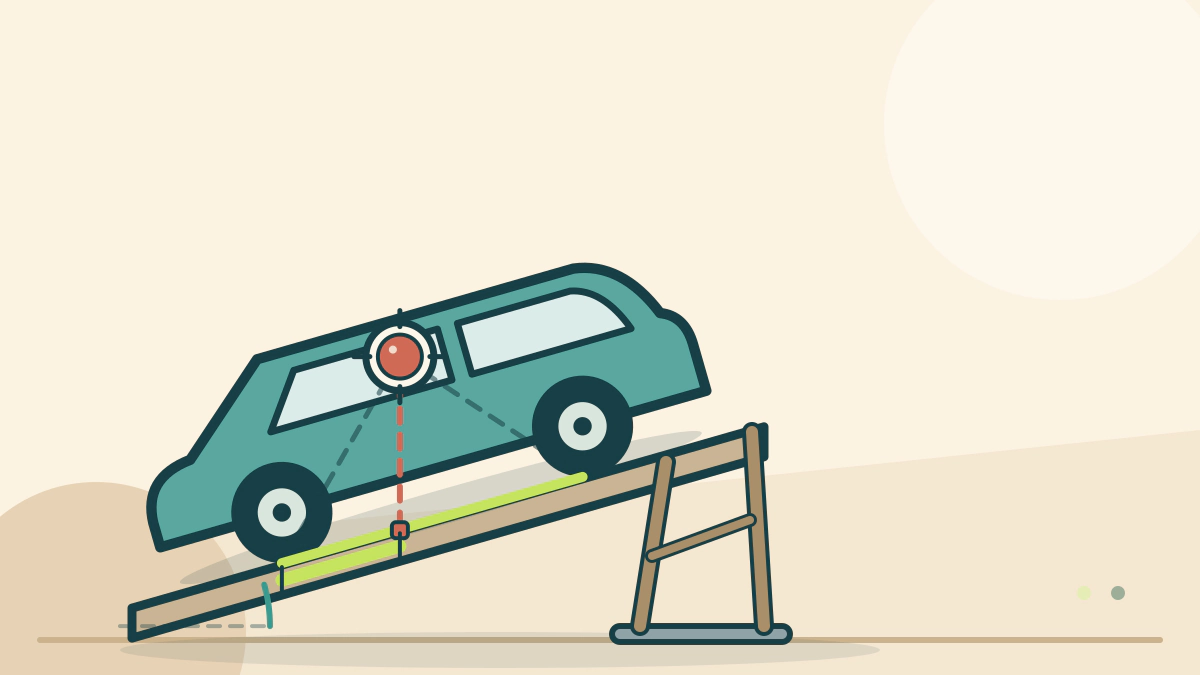
Rollover resistance starts with a low center of gravity and a wide track, then depends on stability control, roof strength, tires and how the vehicle is loaded.
What makes a vehicle resist rollover?
A vehicle resists rollover best when its center of gravity is low and its track is wide, because those dimensions set the static stability factor; stability control, tire condition, roof strength and loading then shape what happens in a real event.
A rollover is not a single failure. The vehicle first has to lose control or leave the road, and then a tire, curb, soft shoulder or guardrail can trip it. NHTSA says most rollovers are tripped events rather than on-road tip-ups caused by cornering alone.
What does static stability factor measure?
NHTSA’s 2001 rollover rating rule defines static stability factor as one-half the track width divided by the height of the center of gravity. A wide track and a low center of gravity raise the number. A tall, narrow vehicle lowers it.
NHTSA’s current 5-Star Safety Ratings page says the rollover rating now combines the SSF measurement with a driving maneuver that tests whether a vehicle is vulnerable to tipping up.
The measure is static. It does not include tires, suspension, steering or driver input.
Why do tall, narrow vehicles roll more often?
In the 2001 rule, NHTSA reported the share of police-reported single-vehicle crashes that involved rollover: 13 percent for cars, 14 percent for vans, 24 percent for pickup trucks and 32 percent for SUVs. Those figures reflect the fleet of that period, not every current model.
| Vehicle type | Share of single-vehicle crashes that rolled over |
|---|---|
| Passenger cars | 13 percent |
| Vans | 14 percent |
| Pickup trucks | 24 percent |
| SUVs | 32 percent |
The pattern fits the geometry. A pickup or SUV carries its mass higher and often has a narrower track relative to its height than a sedan.
Vehicle type is not destiny. A crossover can have a better SSF than a truck-based SUV, and a loaded van can behave worse than its empty rating suggests.
How does electronic stability control change the risk?
ESC uses sensors to detect a mismatch between steering input and the vehicle’s path, then brakes individual wheels to help keep the vehicle pointed where the driver intends. NHTSA describes ESC as a technology that may reduce the risk of a vehicle entering an incipient rollover.
NHTSA’s 15-passenger van page says that thanks to electronic stability control, rollover is no longer a danger for newer 15-passenger vans. That statement is specific to newer vans with ESC, not a promise for every tall vehicle.
ESC cannot overcome physics. A vehicle can still leave the road, strike a curb and trip into a rollover, especially if the driver is travelling too fast for a curve.
What does roof strength add?
Roof strength matters after the vehicle is already rolling. FMVSS 216a requires the roof to withstand 3.0 times the unloaded vehicle weight for vehicles up to 6,000 pounds GVWR, with the test plate moving no more than 127 mm and no more than 50 pounds applied to a head form.
IIHS used a related measure in its roof strength test: the peak force before the roof crushed 5 inches, divided by vehicle weight. A good rating required at least 4.0, acceptable 3.25, marginal 2.5. IIHS discontinued the test because most vehicles earned good and the federal rule caught up.
A stronger roof keeps the occupant compartment from collapsing and helps keep occupants inside. It does not prevent the rollover.
How do loading and tires change a stable design?
Loading can raise the center of gravity or move it rearward. NHTSA’s van guidance says to place cargo forward of the rear axle, avoid overloading, and put no loads on the roof. It also says to fill seats from front to back when the van is not full.
Tire condition matters for the same reason. NHTSA says worn or improperly inflated tires can lead to a loss of control and possibly a rollover, and recommends weekly pressure checks on a 15-passenger van. The pressure on the door pillar or in the owner’s manual is the starting point, not the maximum on the tire sidewall.
Aftermarket lifts and oversized tires raise the center of gravity, but the effect depends on the kit. The owner’s manual and the installer’s documentation are the place to check.
What should a buyer compare?
Look at the rollover stars for the exact model year, check whether ESC was standard, and look at the roof rating if an IIHS score exists.
The NHTSA five-star guide explains how the overall score combines frontal, side and rollover results. The IIHS Top Safety Pick guide explains how roof strength feeds award criteria.
For a used vehicle, a lift, a roof rack loaded beyond the manual’s limit or a repaired rollover should change the decision. The Car Safety and Recalls hub covers recall checks and other pre-purchase steps.
Frequently asked questions
Does a higher static stability factor always mean a safer vehicle?
No. SSF describes resistance to rollover in a single-vehicle crash, not braking, crash protection or how well the driver avoids a crash, so NHTSA pairs it with a dynamic maneuver.
Do SUVs roll over more than cars?
NHTSA’s 2001 analysis found rollover in 32 percent of police-reported single-vehicle crashes for SUVs and 13 percent for cars. Modern stability control and changed designs affect those numbers, so compare current ratings for the exact model.
Does a stronger roof prevent rollover?
No. Roof strength protects the occupant compartment once a rollover begins, while preventing the rollover depends on geometry, stability control, tires and driving.
Can I make my own vehicle more resistant to rollover?
You cannot change the track width or center of gravity easily, but you can keep tires properly inflated, avoid roof loads, keep cargo low and forward, and slow down for curves and bad weather.