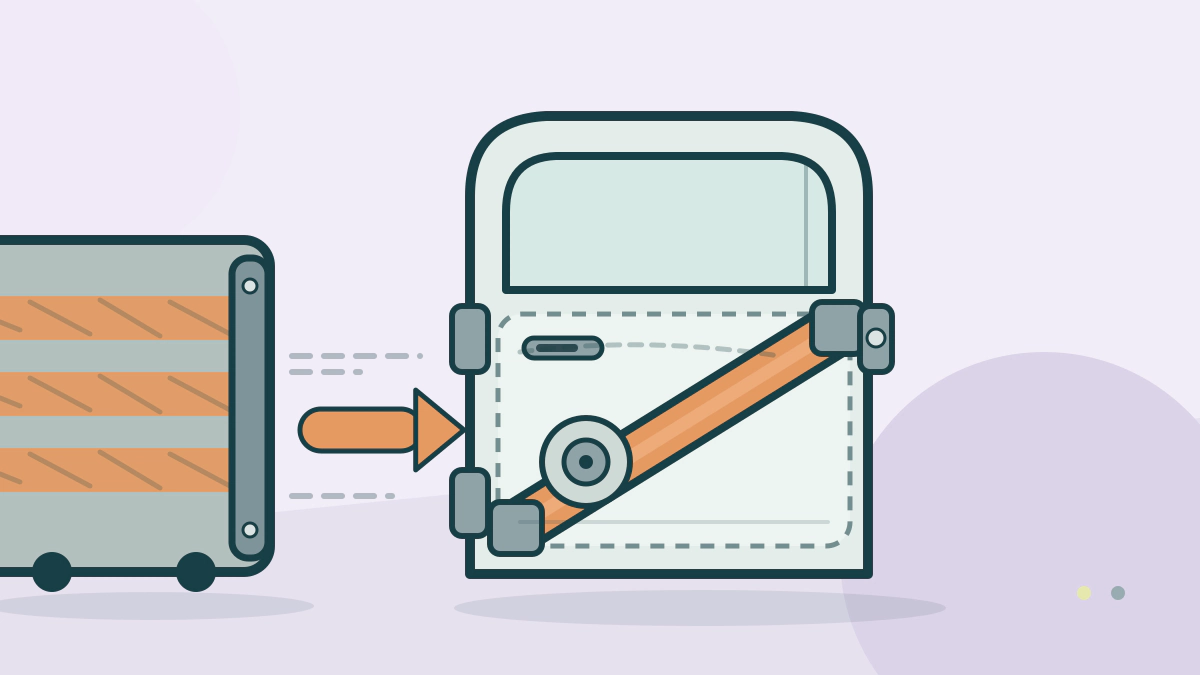
Side crashes leave little crush space, so door structure, side airbags, curtain airbags and belt fit do most of the work. Here is what each part does.
Why are side impacts harder to protect against?
A side impact leaves only the door, its trim and the gap to the occupant to absorb energy, so protection depends on door and pillar strength, side airbags, a curtain airbag and a belt that holds the person in place.
A frontal crash has the hood and front structure ahead of the occupant. A side crash begins at the door skin. NHTSA notes that side airbags inflate even faster than frontal bags because there is less space between the occupant and the striking object.
The Car Safety and Recalls hub covers the wider system.
What does Federal Motor Vehicle Safety Standard 214 require?
FMVSS 214 sets side-impact requirements for passenger cars and light trucks up to 10,000 pounds gross vehicle weight rating. It has three parts: door crush resistance, a moving barrier test and a pole test.
The door crush test pushes a 12-inch loading device into a side door; initial resistance must be at least 10,000 N (2,250 lb). In the moving barrier test, a deformable barrier strikes the side at 53 km/h (33.5 mph). The pole test hits a 10-inch rigid pole at up to 32 km/h (20 mph). Both use instrumented dummies, with limits on head injury and rib deflection.
Those numbers describe a minimum, not a promise.
How do side airbags and curtains share the load?
Kia’s 2024 Telluride owner’s manual says the vehicle has a side airbag in each front seat and in the second-row outboard seats. The bag is supplemental to the belt, deploys in certain side impacts depending on severity, and may deploy on both sides.
The same manual says the side and curtain airbags on both sides deploy if a rollover or possible rollover is detected. It also warns that the side airbags are not designed to deploy in every side impact or rollover.
A curtain airbag runs along the roof rail and covers the window area. It is aimed at the head; a seat-mounted side airbag is aimed at the torso. The two work as layers, and neither replaces the belt.
What does the IIHS side test add?
The IIHS side test represents a T-bone crash. A 4,200-pound moving deformable barrier with an SUV-like front end hits the driver side at 37 mph. A small female dummy sits in the driver seat and another sits in the second row behind the driver.
IIHS measures intrusion into the occupant compartment and records injury data from the dummies. IIHS says the 2021 update used a heavier, more realistic barrier and a faster test.
NHTSA’s test supports the government star rating and IIHS’s test supports its own rating and award criteria, so a car can do well in one and less well in the other.
| Test | Striking object | Speed | Dummies | Main output |
|---|---|---|---|---|
| FMVSS 214 moving barrier | Deformable barrier | 53 km/h (33.5 mph) | Front and rear on struck side | Compliance with injury limits |
| NHTSA side barrier rating | 3,015 lb moving barrier | 38.5 mph | Male front, female rear | 1-5 stars |
| NHTSA side pole rating | 25 cm pole | 20 mph | Small female driver | 1-5 stars |
| IIHS updated side | 4,200 lb barrier | 37 mph | Two small female dummies | Good to Poor rating |
The NHTSA rows use the test descriptions on its 5-Star Safety Ratings page. NHTSA says side ratings can be compared across vehicle classes because every vehicle is hit with the same barrier or pole.
What should a buyer check on a specific car?
Start with the separate side barrier and side pole scores, not the overall score alone. Then check the IIHS side rating for the same generation. A body style can change structure and airbags between model years, as why crash test ratings vary by model year explains.
Look for an “SRS AIRBAG” label on the outboard side of each front seat. It marks the bag’s location. If a seat cover hides it or wraps the bolster, the cover may sit in the deployment path, a point covered in seat cover compatibility with side airbags.
On a used car, inspect the door gaps, paint blend on the B-pillar and the condition of the sill. A side repair that straightened the structure without replacing a deployed airbag leaves the next occupant with less protection. NHTSA says deployed airbags must be replaced at an authorized repair center.
A door that opens adds an ejection risk, and IIHS says a door opening during its side test lowers the rating. Belts still set the baseline: NHTSA’s seat belt guidance says the lap belt belongs across the hips, the shoulder belt across the middle of the chest, and never behind the back or under an arm.
Frequently asked questions
Do side airbags deploy in every side impact?
No. Kia’s manual says they deploy only in certain side-impact collisions depending on severity, and NHTSA says airbags are not intended to deploy in every crash.
Is a car with side airbags safer than one without them?
Not automatically. Door and pillar strength, the curtain airbag, belt fit and the specific crash rating also matter, so compare the side barrier and side pole scores for the exact model year.
What is the difference between a side airbag and a curtain airbag?
A side airbag is usually mounted in the seat or the outboard bolster and protects the torso, while a curtain airbag runs along the roof rail and protects the head. Kia’s manual describes both as supplemental to the seat belt.
Can a repaired side-impact car still protect me?
It can, but only if the structure and restraint systems were restored correctly. Have a qualified technician inspect the repair, including any replaced airbags and pretensioners, before you rely on its side protection.