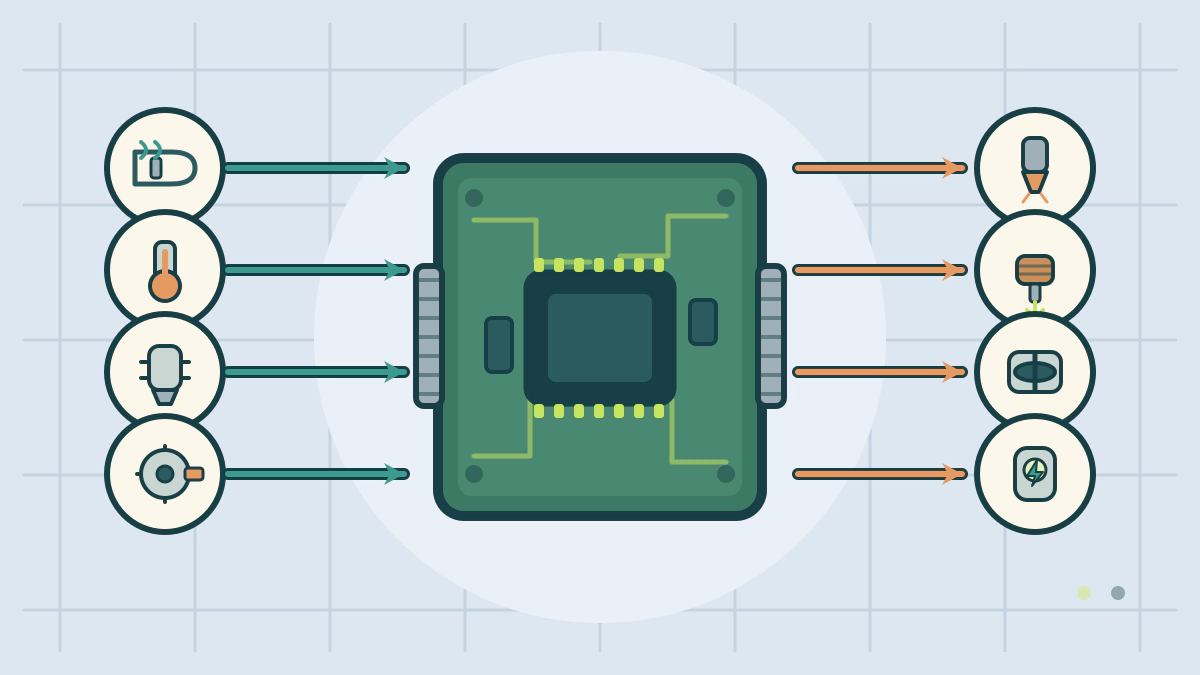
A car ECU is the computer that runs the engine: it reads sensors, times fuel and spark, commands actuators and watches emissions hardware for faults.
What does a car ECU do?
The ECU, or engine control unit, is the computer that runs the engine. It reads sensors, decides how much fuel and spark the engine needs, commands the actuators, and watches emission-related systems for faults. The same unit is often called the engine control module (ECM) or powertrain control module (PCM), depending on the manufacturer and what else it controls.
It follows a calibration written for that engine, then adjusts it using feedback.
What the computer measures
An engine controller needs to know how much air is entering, how fast the engine is turning, how warm it is and what the driver is asking for. Typical inputs include airflow or manifold pressure, throttle position, crankshaft and camshaft position, coolant temperature and oxygen sensor feedback.
The oxygen sensor is the feedback path. It reports how much oxygen remains in the exhaust, which tells the computer whether the mixture is lean or rich. The computer uses that signal to correct fuel delivery as conditions change.
What the computer commands
The outputs are electrical. The ECU pulses the fuel injectors, triggers the ignition coils and may drive the electronic throttle, the evaporative purge valve, variable valve timing and a turbocharger wastegate. On many vehicles it also shares torque requests with the transmission controller over a network.
Kia’s owner’s manual gives one concrete example. The purge control solenoid valve is controlled by the ECM. When coolant is cold at idle, the ECM keeps the valve closed so fuel vapor is not drawn into the engine. After warm-up, it opens the valve (Kia owner’s manual).
That valve shows the pattern. The computer coordinates many small actions so the engine starts, warms up, stays smooth and meets emissions limits.
The control loop as a diagram
Picture three columns. On the left are the sensors. In the middle is the ECU. On the right are the actuators. A line runs from each sensor into the ECU, and a line runs from the ECU to each actuator. A second arrow runs from the oxygen sensor back to the ECU, closing the loop.
Above the ECU, draw a memory block holding the calibration tables, the learned trims and the fault memory. Below it, draw the diagnostic link connector, where a scan tool reads codes and live data.
| Layer | Examples | What it means during diagnosis |
|---|---|---|
| Sensors | Airflow, throttle, crank, oxygen | A bad signal can look like a bad computer |
| ECU | Calibration, trims, fault memory | Codes are clues, not a parts list |
| Actuators | Injectors, coils, purge valve, throttle | A stuck part can mimic a control fault |
| Diagnostic link | Scan tool, readiness monitors | Shows what the computer has tested |
A sensor can be wrong, a wire can drop a signal, an actuator can stick, or the calibration can be unsuitable for the fuel in the tank.
How the ECU checks its own systems
Since 1996, light-duty vehicles sold in the US have used on-board diagnostics, or OBD. The computer runs tests on emission-related components and stores trouble codes when something fails. Federal rules say OBD systems must detect malfunctions in the emission control system, store trouble codes and alert the operator (40 CFR 86.1806-17).
EPA’s OBD guide explains the driver-facing side. The system monitors emission controls and engine components, and it lights the check engine light, also called the malfunction indicator lamp, when it finds a fault (EPA OBD guide).
California’s OBD II fact sheet describes the scope. The on-board computer monitors virtually every component that can affect emission performance, and it stores information that a technician can read to locate the fault (CARB).
That warning light has a narrow job. It reports that a self-test found a problem. It does not say which part to replace.
What the ECU cannot decide
The computer cannot fix a mechanical fault. A vacuum leak, low fuel pressure, a worn spark plug or a stretched timing chain will still produce a bad mixture or a misfire, and the controller can only react within its authority.
It also cannot lawfully ignore emissions hardware. EPA’s tampering policy treats software changes that defeat emission controls as prohibited, and it lists fueling strategies and ignition timing among the design elements manufacturers use to control emissions (EPA tampering policy).
When a code points to a circuit, the next step is testing that circuit: power, ground, connector condition and signal. Replacing the computer is usually the last step, not the first. For the diagnostic sequence, see why clearing a check engine light does not fix the problem.
Where the ECU sits in the wider car
The engine computer is one module among many. Body, transmission, braking and infotainment modules share data over networks. The CAN bus guide explains how those messages travel. ECU tuning is a different subject: it changes the calibration rather than explaining the control loop.
For the surrounding hardware, start with the Automotive Mechanical Systems hub.
Frequently asked questions
Does a car have only one ECU?
No. A modern car has several control modules. The engine computer is one of them, and the number and names vary by model and equipment.
Can a bad ECU cause a no-start?
Yes, but it is not the most likely cause. A no-start can come from the battery, starter, fuel supply, ignition or a security system. Testing is needed before condemning the computer.
Does disconnecting the battery reset the ECU?
It can clear learned trims and readiness monitors, but it does not repair a fault. The monitors need driving time to run again, and an underlying problem will return.
How much does an ECU cost to replace?
Prices vary widely by vehicle, and this guide does not quote them. Ask a dealer or qualified shop for the part, programming and diagnostic charges in writing.