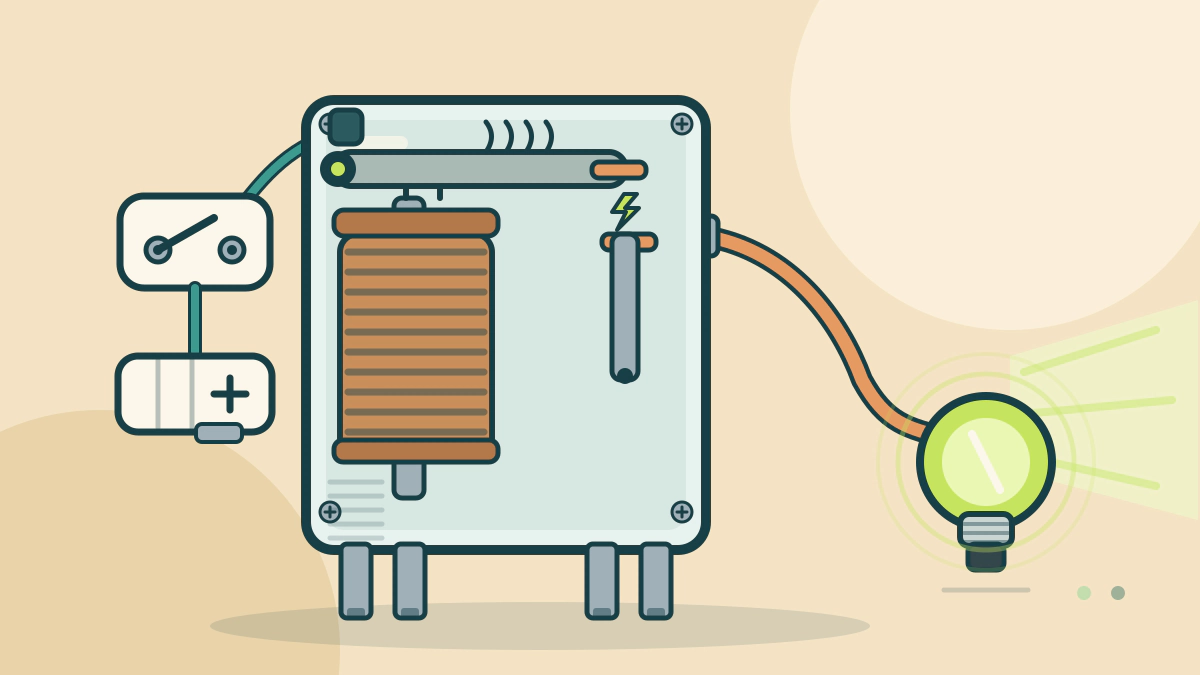
See how an automotive relay uses a small coil current to switch a larger load, what normally open and changeover contacts do and where relays sit in a car.
What does an automotive relay do?
A relay is an electrically operated switch: a small current through a coil creates a magnetic force that opens or closes a separate set of contacts. The coil circuit and the contact circuit are electrically separate. That lets a low-power switch or control module turn a high-current load on and off without routing the full load current through the dashboard.
Omron’s relay primer describes the same basic structure: a coil that converts an electrical signal into mechanical action, and contacts that open or close the circuit. A relay is not a resistor or a fuse.
The parts inside a mechanical relay
A mechanical relay has a coil, a movable armature and one or more contact sets. Current in the coil produces a magnetic field. The field pulls the armature, and the armature moves the contacts. A spring or the contact assembly returns the parts when the coil current stops.
The contact set can be normally open, normally closed or changeover. Omron calls these Form A, Form B and Form C. The coil does not carry the load current; it only moves the contacts.
What the contact forms mean
| Contact form | With the coil off | With the coil on | What it does |
|---|---|---|---|
| Form A (make) | Open | Closed | Switches a circuit on |
| Form B (break) | Closed | Open | Switches a circuit off |
| Form C (changeover) | One path closed, the other open | The paths swap | Selects between two circuits |
Omron also separates single-side stable relays from latching relays. A single-side stable relay returns to its rest position when coil power is removed. A latching relay keeps its last contact position after the coil signal stops.
Why cars use relays
A dashboard switch is not built to carry the current of a fuel pump, a blower motor or a starter. A relay lets the switch control a small coil current while the contacts carry the load. The heavy wiring can then run from the power distribution box to the load instead of through the cabin. The CAN bus guide explains how a control module sends the command that energizes the coil.
The 2019 Ford F-53 Motorhome Chassis owner’s manual shows this arrangement in its fuse specification chart. The power distribution box lists a fuel pump relay, an A/C clutch relay, a horn relay, a starter relay, a blower motor relay and a powertrain control module relay. Several fuse descriptions also mention a relay coil, which shows that the control side and the load side are treated as different circuits.
Each relay position controls a named circuit, and the rating and pin arrangement must match the vehicle.
Where relays are found in a car
Relays usually sit in the power distribution box under the hood, in a relay block near the battery, or in a fuse panel inside the cabin. The owner’s manual identifies the box, the relay positions and the circuits they serve. Some vehicles label relays on the box lid; others use a chart in the manual. The Automotive Mechanical Systems hub covers the systems these relays support.
The 2024 Mazda CX-5 owner’s manual explains the fuse side of the same panel: the electrical system is protected by fuses, and a blown fuse has a melted element inside. A fuse opens the circuit when current is too high. A relay switches the circuit on command. They work together, but they are not substitutes.
What a relay does not tell you
A click from the relay box only shows that the coil received power and the armature moved. It does not prove that the contacts are passing current, that the load is grounded or that the control module sent the right command. A relay can click and still have burned or dirty contacts.
A silent relay may still be good; its coil may have no power or ground because of a blown fuse, a bad module output, a broken wire or a corroded connector. A clicking noise with no start is a separate clue that still needs circuit testing.
How to approach a suspected relay problem
Start with the owner’s manual chart and the exact circuit. Confirm the fuse, then check whether the relay coil gets power and ground when the circuit is commanded. A test lamp or meter can show whether the control side is working, but the test points come from the wiring diagram for that vehicle.
Do not bridge relay terminals with a wire to “test” a load. That bypasses the protection the circuit was designed with and can damage wiring or the module. If a relay is swapped, use an identical relay from a noncritical position only if the manual or diagram allows it.
High-current and safety-system circuits are not places for improvised testing. Send those to a qualified technician with the manufacturer’s service information.
Frequently asked questions
What is the difference between a relay and a fuse?
A fuse protects a circuit by melting open when current is too high. A relay is a switch that turns a circuit on or off from a control signal. A car may use both in the same circuit.
Why does a relay click?
The click is the armature and contacts moving when the coil is energized. It confirms coil operation, not that the contacts carry current.
Can a relay be replaced with one that has a higher current rating?
Use the relay specified for the vehicle and circuit. A different rating or pin arrangement can overload the wiring or fail to fit.
Do all cars use the same relay layout?
No. Relay positions, ratings and control strategies vary by manufacturer and model. Use the chart for the exact year and model, not a generic diagram.