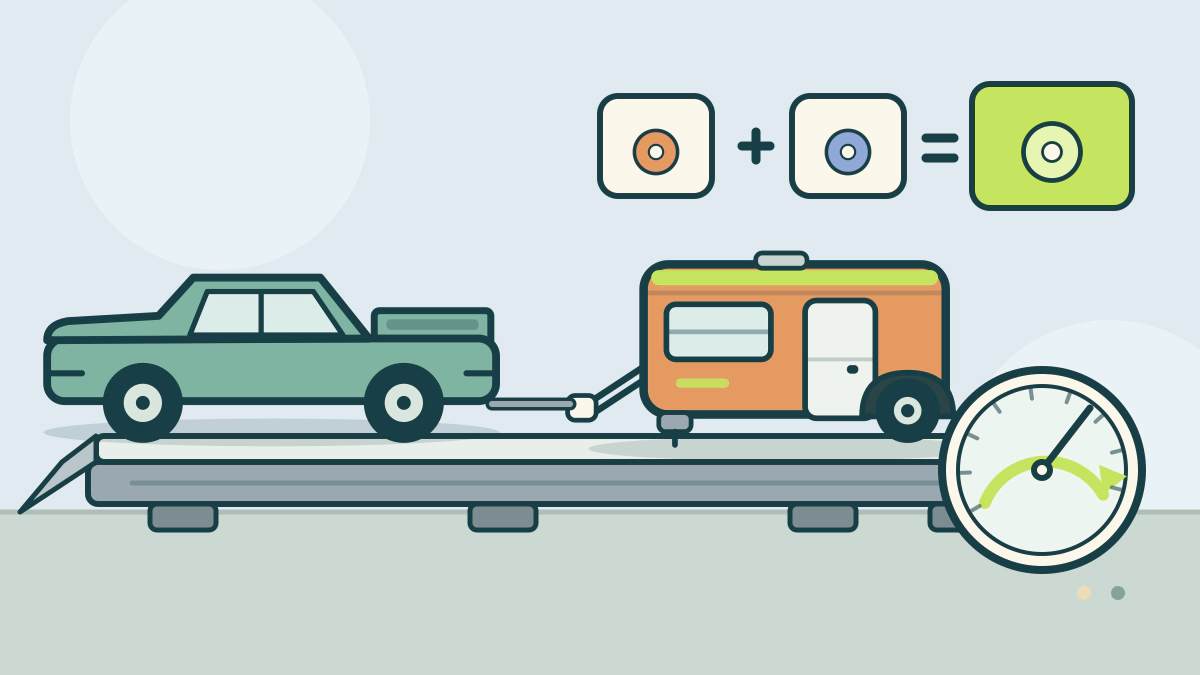
Work out a safe trailer weight from GCWR, GVWR, axle ratings and tongue weight, with a step-by-step example and the scale checks that confirm it.
What is the safest way to calculate towing weight?
Work out every limit separately, then use the smallest answer. The brochure tow rating is only one of them. A rig can be under its trailer rating and still overload the truck’s rear axle, its payload or its hitch.
The numbers come from four places: the tow vehicle’s certification label, its towing guide or owner’s manual, the hitch hardware labels, and the trailer’s own placard. More towing basics are in Off Roading and Towing.
Read the ratings before you do any arithmetic
Manufacturers define the terms in slightly different words but the same way. Toyota’s 2026 RAV4 Hybrid owner’s manual calls GCWR the maximum allowable gross combination weight. That is the loaded tow vehicle plus the loaded trailer. It calls GVWR the maximum for the vehicle alone, and when a trailer is attached the tongue weight counts as part of the vehicle.
The manual also says the trailer weight rating assumes a base vehicle with a driver, a front passenger, hitch and hitch systems. Extra people, cargo and accessories reduce the usable trailer weight. That is why a truck with a full cab and a loaded bed cannot always pull its advertised maximum.
GM’s 2026 Silverado and Sierra 1500 trailer towing supplement adds a useful detail. The maximum trailer weight rating assumes a driver, a front seat passenger and all required trailering equipment. It also says the rating may have to be reduced to stay within GCWR, GVWR, maximum tongue weight or the rear axle rating.
Work through the limits in a fixed order
Each row below answers a different question, and the smallest answer controls.
| Limit | What it caps | The arithmetic | Where the number is printed |
|---|---|---|---|
| GCWR | Truck and trailer together | GCWR minus the loaded truck weight | Towing guide or manual |
| GVWR | The truck alone, tongue included | GVWR minus the scaled truck weight | Certification label on the driver’s door jamb |
| Rear GAWR | Weight on the rear axle | Compare with the scale’s rear axle reading | Certification label |
| Trailer weight rating | The loaded trailer | Compare with the trailer’s scale weight | Towing guide for the exact configuration |
| Hitch or receiver rating | Tongue weight and trailer weight | Compare with the hitch labels | Receiver and hitch hardware |
| Trailer GVWR | The trailer alone | Compare with the trailer’s scale weight | Trailer certification label or placard |
A single high number does not cancel a low one. The combination has to satisfy every row. Towing capacity and payload capacity are separate limits for the same reason.
A worked example with published ratings
Take a 2026 RAV4 Hybrid built to the 3,500 lb trailer rating. Its owner’s manual lists a GCWR of 8,420 lb and a trailer weight rating of 3,500 lb.
Suppose a scale ticket shows the truck with driver, passenger and gear but no trailer at 3,750 lb. The GCWR sum leaves 8,420 minus 3,750, or 4,670 lb for a loaded trailer. The trailer rating is 3,500 lb, so 3,500 lb is the ceiling.
Now add tongue weight. Toyota says the tongue weight should be 9% to 11% of gross trailer weight. At 3,500 lb that is 315 to 385 lb. That load sits on the hitch and counts toward the truck’s GVWR and rear axle rating. With the trailer attached, the truck’s own weight rises by that amount, so compare the new figure with GVWR on the label rather than the brochure.
What tongue weight means explains the measurement. GM’s guide gives a wider range than Toyota’s, 10% to 15% for a conventional trailer, and says the maximum is 10% when towing the maximum trailer weight. Use the figure in your own vehicle’s manual.
Check the trailer’s own label too
The trailer is not exempt from arithmetic. Under 49 CFR 571.110, a trailer’s placard must state the cargo capacity as “The weight of cargo should never exceed” a stated figure. For a recreation vehicle trailer, the rule also says the sum of the axle ratings plus the recommended tongue weight must be at least the trailer’s GVWR.
So the loaded trailer must stay under its own GVWR, and the cargo inside it must stay under the cargo figure on the placard. A trailer can be within the truck’s rating and still be overloaded on its own axle.
What the scale ticket proves
GM’s supplement gives a six-step check for GCWR. Start with curb weight, add the loaded trailer, all passengers, all cargo in the vehicle, hitch hardware such as the draw bar and ball, and any accessories. The total must not exceed GCWR. It also says the only way to be sure is to weigh the loaded combination.
A public scale gives axle weights as well as a total. That lets you check the rear axle against its rating, which a total weight cannot do. Weigh the truck alone, then the truck with the trailer, then the trailer alone if the scale allows it. The payload sticker guide shows how the label’s cargo figure is meant to be used.
Frequently asked questions
Does the trailer’s dry weight count?
No. Use the trailer loaded for the trip, with water, propane, gear and cargo aboard. A dry weight from a brochure leaves out everything that makes the trailer heavy.
Can I tow at the GCWR limit with an empty truck?
Only if the axle and hitch ratings also pass. GCWR does not protect the rear axle or the receiver, so check each limit separately.
Why do two makers give different tongue weight percentages?
They set their own limits for their own vehicles. Toyota’s 2026 RAV4 Hybrid manual says 9% to 11%, while GM’s 2026 trailering guide gives 10% to 15% for conventional trailers. Follow your vehicle’s manual.
Is a weight-distribution hitch part of the calculation?
It changes how load is carried, not the ratings. The combined weight rating still applies. See gross combined weight rating.