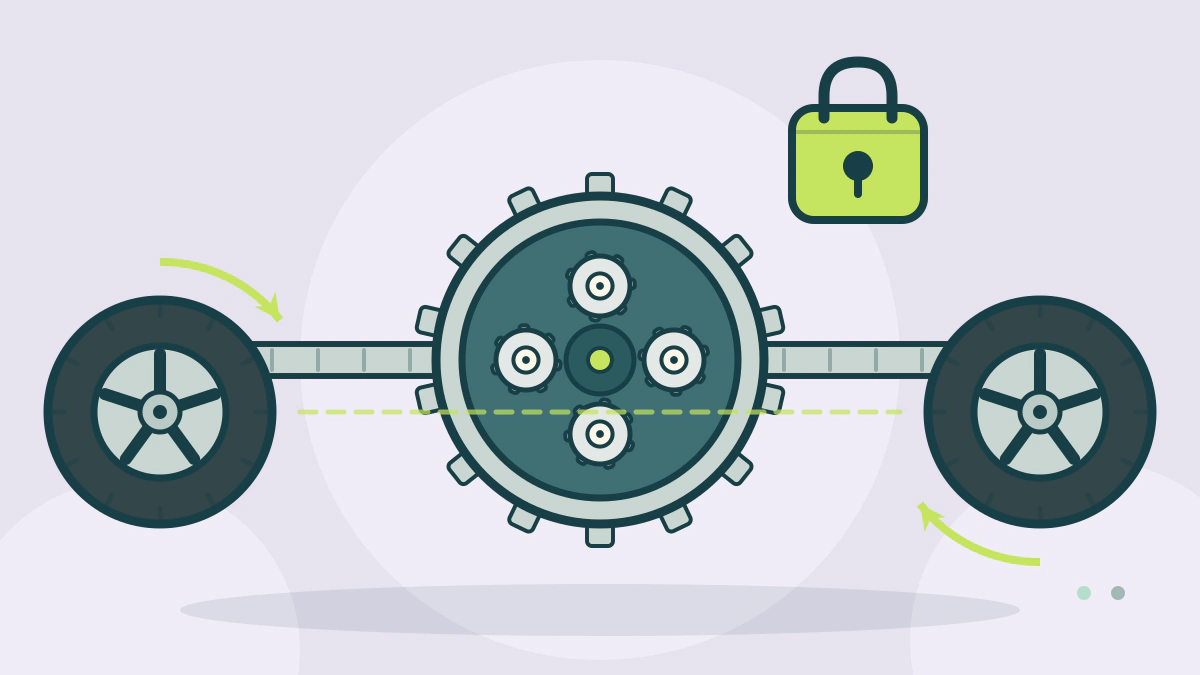
A locking differential forces both wheels on an axle to turn together so the tire with grip gets torque; selectable and automatic lockers differ in engagement.
What does a locking differential do?
A locking differential forces both wheels on one axle to turn at the same speed, so torque can reach the wheel with grip instead of being wasted on a spinning wheel. Eaton describes a locker as locking the axles together and providing 100 percent of available torque to the wheel with traction (Eaton).
That matters when one wheel is in the air or on ice, mud or loose rock. An open differential lets the two wheels turn at different speeds, which is what a vehicle needs in a turn. The same freedom becomes a problem when one tire has little or no grip.
Why an open differential loses drive
When a vehicle turns, the outside wheel travels a longer arc than the inside wheel (NDSU report). A differential sits between the two wheels and lets them rotate at different rates. In the common open design, a carrier holds spider gears connected to the two axle shafts, and those shafts can rotate independently.
The catch is torque. With an open differential, one wheel can spin while the other stays still, and the vehicle does not move. If one wheel is on ice or in the air, that is exactly what happens.
A differential also reduces stress in normal driving by allowing the wheels to follow their own paths. Locking it removes that freedom on purpose.
The main types compared
| Type | Normal behavior | When it locks | Trade-off |
|---|---|---|---|
| Open | Wheels turn independently | Never | One spinning wheel can stop progress |
| Automatic locker | Open or locked by mechanism | Loss of traction or torque | Can ratchet or chirp in turns |
| Selectable locker | Open until switched | Driver presses a button | Driver must use it correctly |
Eaton describes its automatic MLocker as normally operating like an open differential, locking when it detects loss of traction below 20 mph and unlocking when conditions allow. The Detroit Locker is normally locked and unlocks during turns. A selectable ELocker stays open until the driver presses a switch, then locks the axles (Eaton types).
What a locked axle does to torque
With the axle locked, the two wheels must turn together. If one is off the ground, it receives no torque because it has no traction, while the wheel on the ground receives the torque the engine and gearing can supply (Eaton).
That is why a locker helps on a rocky ledge or a cross-axle rut. It is also why a locker can surprise a driver. On a high-grip surface, the inner wheel must travel a shorter path in a turn, but the locked axle forces it to match the outer wheel. Something has to slip: a tire, the driveline or the steering.
Manufacturers restrict the mode for that reason. Ford says its electronic locking differential is for mud, rocks, sand and other off-road conditions where maximum traction is needed, and is not for dry pavement, where it increases tire wear, noise and vibration (F-150 ELD).
How a selectable locker behaves in a Ford F-150
The 2025 F-150 manual describes the electronic locking differential as a device in the rear axle that provides additional traction when needed (what it is). The driver can activate it electronically and shift it on the fly within the operating speed range. It disengages above a set speed and reengages below that speed.
The system can also engage or disengage automatically based on speed, four-wheel-drive mode and drive mode. Ford advises against operating it while cruise control or trail control is active, because the system may not engage as expected.
Ford also warns that a significantly different spare tire on the rear axle can limit the locker’s function. With a spare mounted there, engage and disengage it at a stop (precautions).
When a locker helps, and when it does not
A locker is a traction aid for low-speed obstacles. It does not replace ground clearance, tire tread, a sensible line or a spotter. It also does not help a vehicle that is already high-centered, because both wheels can spin freely with no load. The Off Roading and Towing hub covers the rest of the traction system, including how to approach steep off-road hills.
It also only works with the axle it is fitted to; it does not change how torque moves between axles, the subject of AWD versus 4WD. For the general drivetrain term, see what AWD means.
On loose climbs, a locked rear axle can push the vehicle straighter and reduce wheelspin. On a tight, high-grip turn, it can make steering heavier and load the driveline.
Installation is not a casual job. Eaton’s installation instructions describe replacing a differential as a demanding task that requires close attention to tolerances and preloads, and state that each vehicle is different (Eaton instructions). A shop with the correct tools and the manufacturer’s procedure is the safer choice.
Frequently asked questions
Is a locking differential the same as limited slip?
No. A limited-slip unit resists speed differences between the wheels but does not fully lock them. A locking differential can force both wheels to turn at the same speed.
Can I leave a rear locker on all the time?
No for a selectable off-road locker. Ford restricts its electronic locker to off-road use and warns against dry pavement, where tire wear, noise and vibration increase.
Does a locker work in mud and sand?
It can help by keeping both wheels driving, but it cannot create grip. Tire choice, pressure, momentum and the line still decide whether the vehicle gets through.
Can I install a locker myself?
It is a precision job that involves tolerances and preloads. Eaton’s instructions treat it as demanding work, and the vehicle manufacturer’s procedure should be followed, so a qualified driveline shop is the safer route.