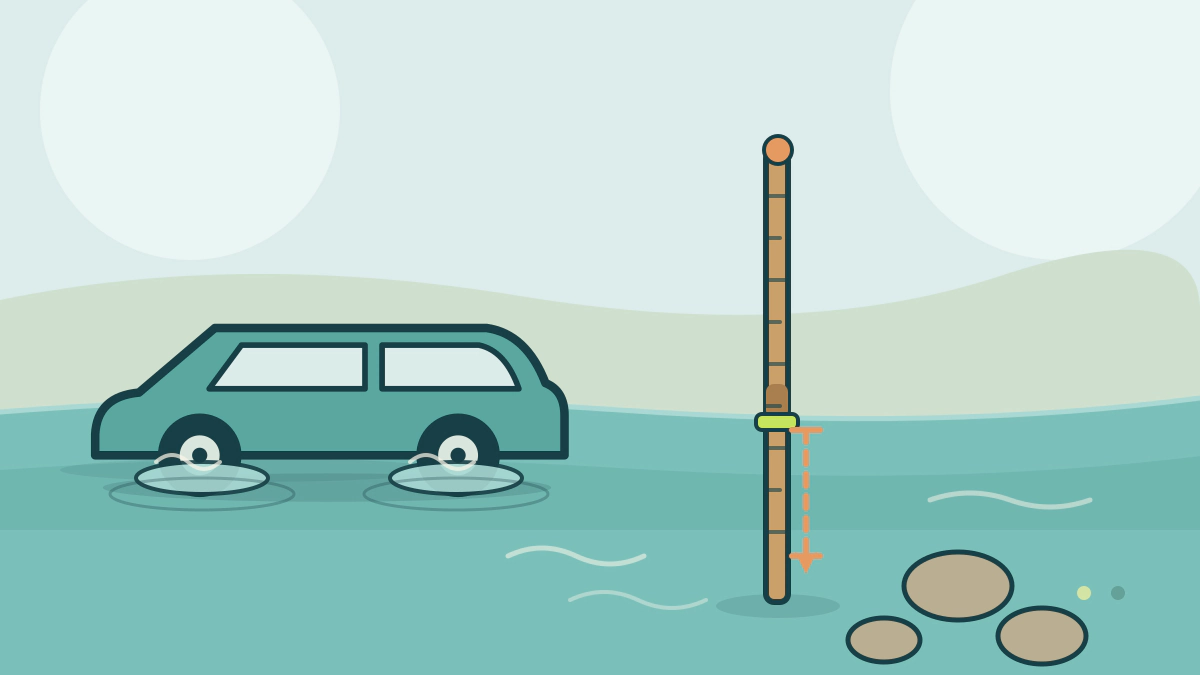
Check depth, current, bottom and exit before driving into water, then use the vehicle's own fording limit and a slow, steady crossing.
What should you check before a water crossing?
Check the depth, the speed of the current and the exit before any wheel enters the water. If depth or current is uncertain, turn around. A stalled engine in deep water can turn a delay into a rescue.
A flooded public road is not a trail ford. Moving floodwater should always be avoided.
Why moving water and legal crossings come first
The National Weather Service reports that more than half of all flood-related drownings occur when a vehicle is driven into hazardous flood water. It states that 6 inches of fast-moving water can knock over an adult, 12 inches of rushing water can carry away most cars, and 2 feet can carry away SUVs and trucks.
The agency says never drive around barriers blocking a flooded road, because the road may have collapsed underneath. It also says it is never safe to drive or walk into flood water.
A trail ford is different only when it is a designated crossing, the water is shallow and slow, and the land manager allows it.
Tread Lightly’s four-wheel-drive guidance says to cross streams only at designated fording points, where the road crosses the stream. It also says to avoid sensitive areas such as wetlands, lakeshores and streams.
Check the land manager’s rules. Some areas close crossings seasonally to protect fish habitat, and some prohibit driving in the streambed entirely. A GPS track is not permission.
Compare the depth with the vehicle’s rating
Ford’s off-road guidance says to consult the owner’s manual for the vehicle’s water-fording capability, to check the depth before entering and never to attempt a deep, fast-flowing crossing.
Jeep’s Wrangler capability page says do not attempt water fording unless the depth is known and matches the rating in the Owner’s Manual. Water damage may not be covered by the new vehicle warranty.
Kia’s 2023 Telluride owner’s manual sets a lower bar for flooded roads: avoid water higher than the bottom of the wheel hub, drive slowly, and allow extra stopping distance because brakes may be affected.
The wheel-hub line is a road-flooding caution, not a trail target. The manufacturer’s fording rating is the ceiling, and it assumes the stated conditions.
| Check | Why it matters | Do not proceed if |
|---|---|---|
| Depth against the manual | Above the rating, water can reach the intake, breathers or electronics | Water is above the stated fording depth |
| Current | Moving water can push or sweep the vehicle | Flow is fast or rising |
| Bottom | Holes, silt, rocks and debris can stop a wheel | You cannot see or probe the line |
| Entry and exit | Steep lips and undercut banks trap vehicles | The exit is blocked, steep or eroded |
| Upstream weather | Water can rise after rain far away | Storms or releases are possible |
| Recovery plan | A stalled vehicle in water is hard to reach | No safe recovery or communication |
Look at the bottom and the exit
Depth at the edge is not depth in the middle. A crossing can hide a deep hole, a ledge or soft silt that will stop a tire.
Check from the bank, not by wading. The National Weather Service warns that walking into flood water is dangerous.
Look at the exit as carefully as the entrance. A steep, eroded bank or a submerged ledge can stop a vehicle that crossed the water successfully. If the exit is unclear, the crossing is not ready.
Turn around when depth is unknown, current is moving, the bottom cannot be seen, the exit is blocked, or upstream weather is uncertain. Do not cross alone without a recovery plan.
A high-clearance vehicle and a fording rating raise the limit, but they do not make moving water safe. The hill approach guide applies the same principle to steep ground: inspect first and keep a retreat. The Off Roading and Towing hub covers recovery gear and towing.
Drive slowly and steadily
Ford’s guidance is first gear or Drive, very slowly at a constant speed, light throttle and no high engine rpm. Build momentum gradually; do not accelerate through the crossing.
Keep the doors closed. Wait until any vehicle ahead has left the water, because unsettled water makes the line harder to read. Ease off the accelerator as you reach the far side to reduce the bow wave, then apply light throttle to climb out.
Ford also says never to stop or shut off the vehicle in deep water unless water has entered the engine air intake. If the engine stalls, do not restart it.
After the crossing
Brakes lose effectiveness when wet. Kia’s manual says to dry them by applying them gently several times while the vehicle is moving slowly, and Ford says to check braking after the crossing.
Check the fluids, the air filter and the radiator for signs of water or debris. Muddy water can reduce cooling performance by depositing debris in the radiator. If water entered the engine or the interior, stop driving and have the vehicle inspected. The floodwater maintenance guide explains what water can damage and why a stalled engine should not be restarted.
Frequently asked questions
Can I cross a flooded road if it looks shallow?
No. The National Weather Service says never to drive into flood water, and 12 inches of rushing water can carry away most cars. Depth is hard to judge and the road beneath may be gone.
How deep can my vehicle ford?
That depends on the exact model and year. Jeep directs owners to the water fording rating in the Owner’s Manual, and Ford does the same. Do not use another vehicle’s number.
What gear should I use in a crossing?
Ford advises first gear or Drive, a very slow constant speed and light throttle. Avoid high rpm and do not stop in deep water.
What should I do if the engine stalls in water?
Do not restart it. Ford says not to restart a stalled engine in deep water, and the vehicle should be inspected before further driving.