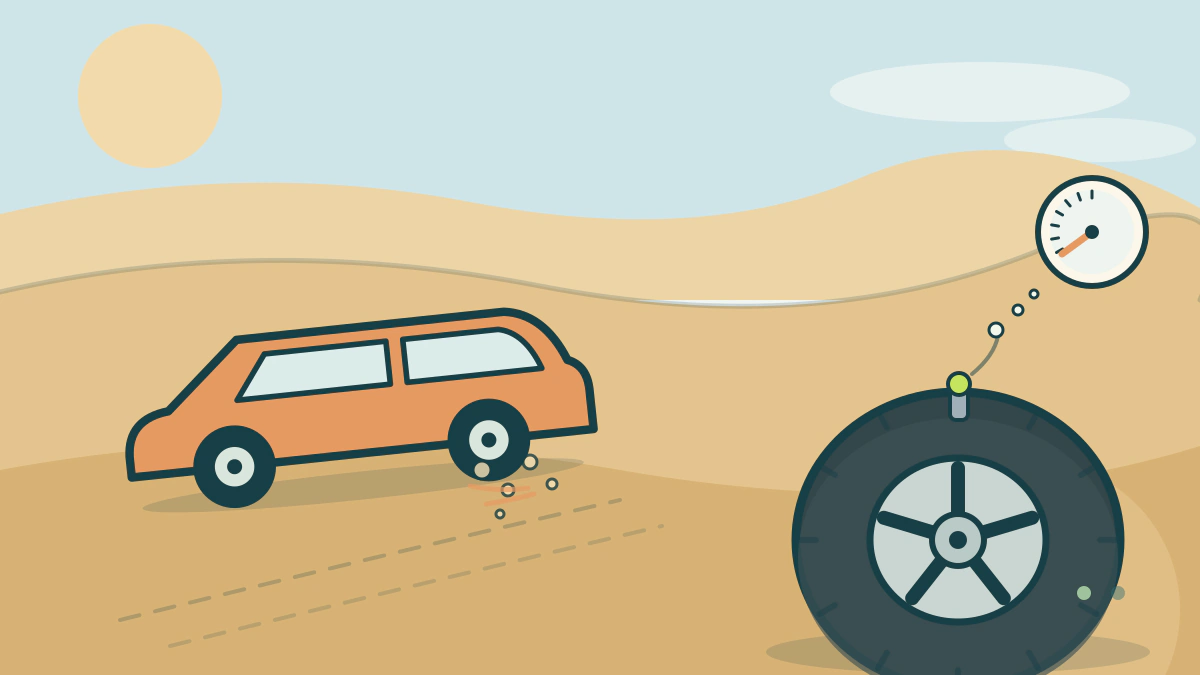
Prepare tires, gearing and momentum before the sand gets soft, then use smooth throttle and steering so the vehicle keeps moving instead of digging in.
What keeps a vehicle from getting stuck in sand?
Lower tire pressure, a suitable gear and steady momentum keep the tires floating on the surface instead of digging in. The most common mistakes are entering with highway pressure, spinning a wheel and stopping on a soft grade.
The National Park Service’s Mojave guidance says most rescues there involve vehicles stuck in sand. The same page says lower pressure greatly increases traction by flattening the tire.
Set tire pressure for the surface, not the highway
Tire pressure comes first. The NPS Mojave page notes that many off-road drivers lower pressure to about 20 psi for soft sand, then reinflate before returning to pavement. Cape Hatteras National Seashore recommends less than 20 psi for most vehicles and says the softer the sand, the lower the pressure needed.
Tread Lightly describes the target by shape rather than by a single number. Its four-wheel-drive guidance says to lower pressure until the tire shows a visible bulge, typically not less than 20 pounds.
Treat those figures as reported practices, not a setting for every vehicle. Load matters, and a fully loaded vehicle needs more pressure than a light one. Use a gauge, respect the tire maker’s limits, and reinflate before highway speeds. The placard versus sidewall guide explains which pressure number to start from.
The table summarizes the adjustments that keep a vehicle moving.
| Adjustment | Why it helps | What happens if you skip it |
|---|---|---|
| Tire pressure | Flattens the tread and enlarges the contact patch | Tires dig in and spin |
| Gear and mode | Delivers torque smoothly and predictably | Sudden torque breaks traction |
| Momentum | Carries the vehicle across soft patches | Stopping and restarting buries the tires |
| Steering input | Keeps the front tires from plowing | Sharp turns push a tire into the sand |
| Route choice | Packed tracks and firm sand carry weight | A soft shoulder traps one wheel |
Choose the mode and gear before the sand
Ford’s Bronco guidance says to keep all four wheels on the most solid part of the trail, drive steadily without varying speed, accelerate slowly and avoid excessive wheel slip. In deep sand at low speed and high outside temperature, it recommends a low gear where possible.
Four-wheel drive or a sand mode can help, but system design differs. The NPS Mojave page separates a true four-wheel-drive transfer case from all-wheel drive, which it says is not designed to fully power the front tires on rugged ground. Read the owner’s manual for the correct mode and any speed limit attached to it. The AWD versus 4WD guide explains the hardware difference.
Keep momentum without spinning
Momentum helps only while the tires are still turning without slipping. Ford’s advice is to use momentum to maintain forward motion and to avoid stopping on steep sand grades, because the vehicle may not be able to start again from a standstill.
Smooth inputs work better than violent ones. Apply throttle gradually, steer with small corrections and look for the firmest line. A spinning tire digs a hole that takes far longer to recover from than a slow climb.
Follow existing tracks when they are legal and firm. Do not create a new line through vegetation, dune grass or a closed area.
Read the surface before you commit
Sand changes with weather, tide and traffic. Tread Lightly’s dune guidance warns that dunes are constantly changing and advises watching for ravines, depressions and steep drop-offs, scouting ahead and reducing speed in blowing sand.
On a beach, check the tide and the permit rules before entering. Cape Hatteras requires a permit and sets a 15 mph limit unless otherwise posted, with 5 mph within 100 feet of pedestrians. It also requires a low-pressure tire gauge, shovel, jack and jack support board.
If the vehicle starts to bog down
Ease off the throttle instead of adding more. A spinning wheel digs deeper.
Stop in a straight line if you can, then reverse along your own tracks. Dig out the sand ahead of the tires, lower pressure further within the tire’s limits, and use a shovel and a jack with a firm base. The NPS Mojave equipment list includes both.
If the vehicle cannot be freed safely, call a commercial towing service. Cape Hatteras notes that park rangers are not allowed to pull or tow private vehicles. In remote areas, stay with the vehicle and use a satellite messenger. The NPS warns that people have died trying to walk back to pavement.
Prepare the vehicle and the trip
Start with clearance and tires. The NPS Mojave page calls a high-clearance four-wheel-drive vehicle with off-pavement tires the most important safety item, and warns that street tires are far more likely to rupture off pavement.
Carry a full-size spare, water, food, sun protection and a way to communicate. Travel with a second vehicle where possible. Tread Lightly recommends at least two vehicles so help is nearby after a breakdown. Check the land manager’s route map and closures before leaving, and compare the terrain with the hill approach guide when the route climbs. The Off Roading and Towing hub covers recovery gear and towing.
Frequently asked questions
Should I air down for a short stretch of sand?
Yes, if the sand is soft enough to trap a tire. Traction loss usually starts at the entrance, before momentum builds.
What pressure should I use?
There is no universal number. NPS guidance cites about 20 psi as a common soft-sand practice, while Tread Lightly describes a visible tire bulge and typically not less than 20 pounds. Check the tire and vehicle limits.
Is four-wheel drive required on a beach?
Cape Hatteras recommends four-wheel drive but allows two-wheel-drive vehicles if the driver judges them capable in deep, soft sand. Clearance, tires and momentum matter as much as the badge.
How do I get unstuck without damaging the vehicle?
Stop spinning, clear sand around the tires, lower pressure within limits and reverse along your own tracks. Call professional recovery if it will not move safely.