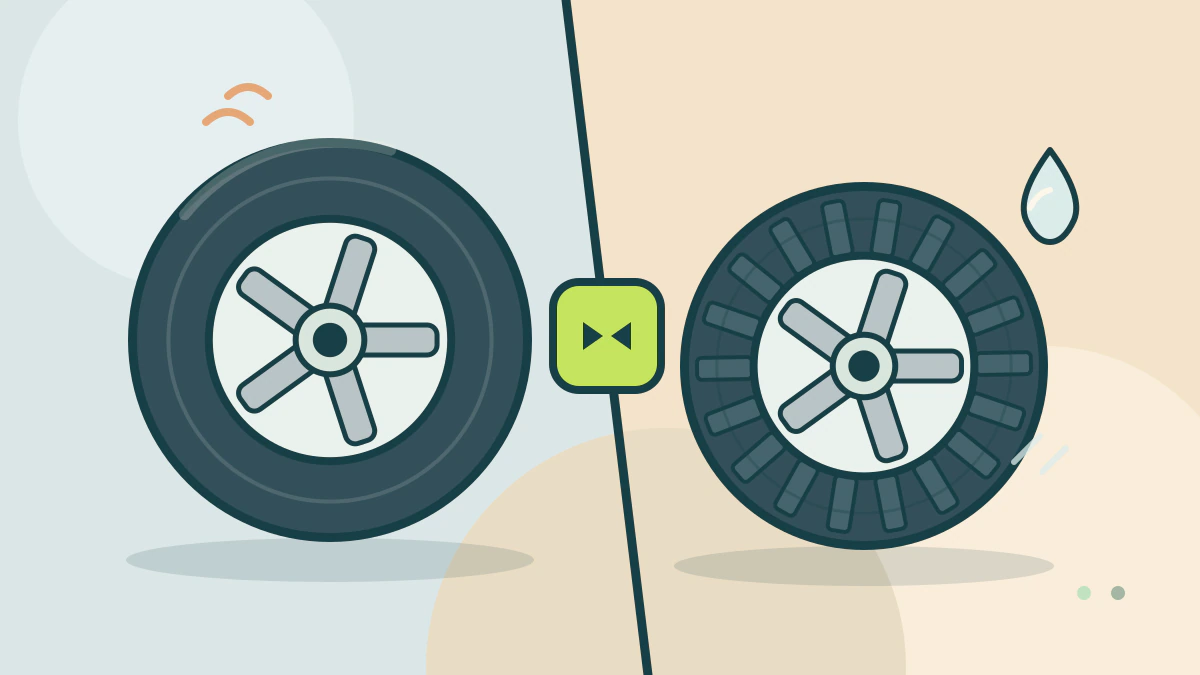
Compare slick and road tires on tread, compound, heat and wet grip, and see why a race tire only works in the conditions it was built for.
What is the main difference between a slick and a road tire?
A slick has no tread pattern, so it puts more rubber on dry asphalt; a road tire has grooves and sipes to clear water. That one difference shapes the compound, the working temperature and the wet behavior. A slick is a dry-track part; a road tire works in rain, cold and traffic. This comparison sits within Motorsports and Performance Driving.
IMSA puts it plainly: a racing tire used in the dry has no tread grooves or siping. The aim is maximum contact between rubber and ground. A road tire faces wet, dry and snow, so it needs grooves to break the surface tension of water and funnel it away.
Tread: contact area versus water clearance
Removing the tread increases the rubber touching the track. It also removes the channels that drain water. On a damp surface a film builds between the tire and the road.
Pirelli describes the result in Formula 1 terms. A slick can squash water closer to the surface, but it cannot make the water disappear. With enough water, the slick behaves like a water ski and aquaplaning begins.
Road tires accept a smaller dry contact patch in exchange for water clearance. NHTSA says tread provides grip and traction, especially on wet or icy roads, and that tires are unsafe at 2/32 of an inch. The tread depth guide shows how to check that limit.
Compound and heat
The tread pattern is only the visible difference. The rubber underneath is also built for a different job.
| Feature | Racing slick | Road tire |
|---|---|---|
| Tread | No grooves or sipes | Grooves and sipes for water |
| Compound | Soft, medium or hard, chosen for the track | Formulated for wear, weather and life |
| Typical hot pressure | About 26 to 27 psi | About 32 to 45 psi |
| Typical tread temperature | About 220 to 240 F when hot | About 80 to 90 F |
| Wet use | Dry track only | Designed for wet and dry |
| Expected life | One stint or race | Tens of thousands of miles |
The pressure and temperature figures come from IMSA’s Michelin technical explainer. A racing tire’s pressure rises by about 8 to 12 psi from cold to hot, against 3 to 4 psi for a street tire. Race tires also run much higher camber.
Tire makers sell slicks in several compounds. Michelin’s Hypercar range uses soft for track temperatures from 0 to 15 C, medium from 15 to 25 C and hard above 25 C. The compound is matched to track temperature.
Why temperature windows matter
Racing rubber works best in a narrow temperature range. Pirelli says Formula 1 tires become hotter and stickier as temperatures rise, which is why teams use tire blankets. Pirelli lists maximum blanket temperatures of 70 C for slicks, 60 C for intermediates and 40 C for full wets.
A tire that is too cold may not provide its intended grip. One that is too hot can lose performance as the rubber degrades. IMSA describes degradation as a mix of temperature, surface, compound, conditions and driving style.
Road tires also warm up, but their compound works across a wide temperature range and must last for years. That is a different compromise from a slick built for a short run.
Wet use and aquaplaning
The wet-weather difference is large. Pirelli says a Formula 1 intermediate can disperse around 35 to 40 liters of water per second at 300 km/h, and a full wet can double that. The grooves and blocks give the water somewhere to go.
A slick has no such path. Pirelli warns that running a slick when a wet tire is needed can cost far more than lap time, with a risk of aquaplaning into an accident. That is why a series switches to intermediates or full wets in rain.
The same principle applies on the road at lower speed. NHTSA links worn tread to lost wet traction. A tire at the 2/32 limit has little capacity left to clear water.
What this means for a track-day driver
A road tire is not a failed racing slick. It is built for all-weather use, long life and road standards. The comparison of touring and performance tires shows how that compromise shifts within the road category.
A competition slick is equally specialised. It expects a dry surface, a suitable wheel and a car set up for it. Tire choice also became part of race strategy in the evolution of American road racing.
Frequently asked questions
Can you use racing slicks on a wet track?
No. A slick has no tread to clear water, and Pirelli says it can aquaplane once a film builds. A wet session needs a tire with grooves, such as an intermediate or full wet.
Why do racing slicks have no tread?
The missing tread puts more rubber in contact with dry asphalt. IMSA says the goal is maximum contact between the tire and the ground. A road tire cannot do that because it must also clear water and work in several weather conditions.
Do road tires and race tires use the same rubber?
They share basic materials. IMSA says both use natural and synthetic rubbers, elastomers, carbon black and materials such as steel, polyester, aramid or nylon. The compounds and constructions differ because the tires work at different temperatures and loads.
How hot does a racing tire get?
IMSA’s Michelin explainer puts a fully warmed racing tire at about 220 to 240 F, against 80 to 90 F for a street tire in normal use. The race tire also gains about 8 to 12 psi from cold to hot.