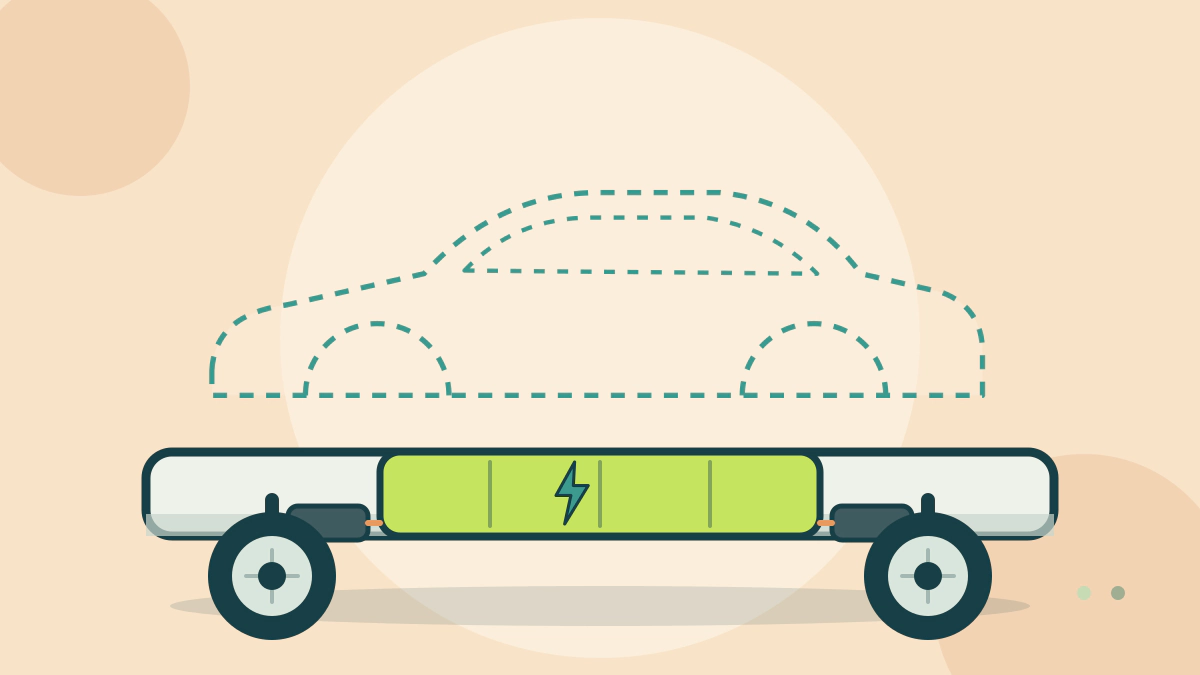
A skateboard platform puts the battery, motor and suspension in a flat lower structure. See how makers describe it, what it gains and where the limits are.
What is an electric skateboard platform?
It is a flat lower structure that carries the battery, electric drive, suspension and wheels, with the body mounted on top. The name comes from the shape: a long, low deck with wheels at the corners. Hyundai Motor Group describes the skateboard concept as a flat platform with the motor, battery and drivetrain placed at the bottom of the body, allowing different upper bodies to be fitted (Hyundai Motor Group).
The term is a design description, not a regulated category or a single engineering standard. Makers use their own names for the architecture.
What sits in the platform
An all-electric car needs a traction battery, a motor, power electronics, a charger, a thermal system and a transmission. DOE’s How Do All-Electric Cars Work? lists those components and explains that the traction battery powers the motor, which drives the wheels.
A skateboard layout groups the heavy hardware low and between the axles.
| Layer | Main parts | What it does |
|---|---|---|
| Floor structure | Battery enclosure, cross members | Carries and protects the pack |
| Drive units | Motor, reduction gear, inverter | Turns electricity into wheel torque |
| Corners | Suspension, brakes, wheels | Connects the platform to the road |
| Body interface | Mounting points, crash structure | Separates the platform from the cabin |
Why makers use the layout
Hyundai’s E-GMP release gives a clear list. Mounting the battery beneath the floor creates a flat cabin floor, which frees legroom and seat arrangements. The pack sits between the axles, which helps weight distribution and lowers the center of gravity. A long wheelbase and short overhangs add interior space (Hyundai).
The architecture also supports modularity. Hyundai says E-GMP reduces complexity through modularization and standardization, so one platform can underpin sedans, SUVs and crossovers. Its later E-GMP.S version extends the idea to purpose-built vehicles, with a full-flat floor from the first row to the third and a body that can be assembled in modules (Hyundai Motor Group).
GM makes a similar case for its Ultium platform. It describes a flexible global platform that can support trucks, SUVs, crossovers, cars and commercial vehicles, with battery options from 50 to 200 kWh and front, rear or all-wheel drive (GM).
The advantages, stated plainly
The cabin gains space because there is no engine tunnel or floor hump. The center of gravity falls because the heaviest part sits low. Crash loads can be routed around the battery with dedicated structure. And because the upper body is separate from the rolling chassis, a maker can vary the body without redesigning the whole understructure.
For an EV, the layout also makes the drive unit easy to duplicate. Hyundai says an all-wheel-drive E-GMP model adds a second motor rather than a driveshaft. That is a packaging advantage, not a free one.
What the layout does not guarantee
A skateboard platform does not make a car light. The battery is still heavy, and the structure around it adds mass. DOE notes that lithium-ion packs remain costly and that material recovery is a challenge (DOE batteries). A low floor does not change those economics.
It does not guarantee good ride or handling either. Those depend on suspension tuning, tires and weight distribution. A low center of gravity helps, but it is not a complete chassis.
It can raise the floor. Hyundai’s E-GMP.S notes that the step floor was lowered for easy entry, which implies the opposite risk when packaging is not managed. A tall pack or a tall ride height can erase the cabin-space gain.
It is also not universal. Hyundai says E-GMP was designed exclusively for BEVs, in contrast with the group’s older platforms engineered mainly for combustion engines. The layout is a choice, not a definition of an electric car.
How to tell what a car uses
Look at the specifications, not the badge. A flat rear floor, a battery listed under the floor, a front storage compartment and a wheelbase that looks long relative to the body are clues. The owner’s manual and the maker’s technical pages are better than a marketing slogan.
For the parts that make the platform work, see how an electric car motor works. For the effect of wheel and tire changes on range, see aftermarket wheels and EV range. The Future Mobility and Innovation hub covers related design topics.
Frequently asked questions
Is every electric car built on a skateboard platform?
No. The layout is common among dedicated EVs, but it is a design choice rather than a requirement. The maker’s specifications are the reliable way to tell.
Does a skateboard platform make an EV lighter?
Not necessarily. It places the battery low, but the pack and its protective structure still add mass. Any weight advantage comes from the whole design, not from the layout alone.
Why do skateboard-platform cars have flat floors?
The battery sits under the floor instead of under a center tunnel, so the cabin floor can be continuous. That frees foot space and lets makers move seats or cargo without working around a hump.
Can one skateboard platform underpin different vehicle sizes?
Yes. Hyundai says E-GMP can underpin sedans, SUVs and crossovers, and GM says Ultium can support vehicles from cars to commercial trucks. The shared understructure is the point of the design.