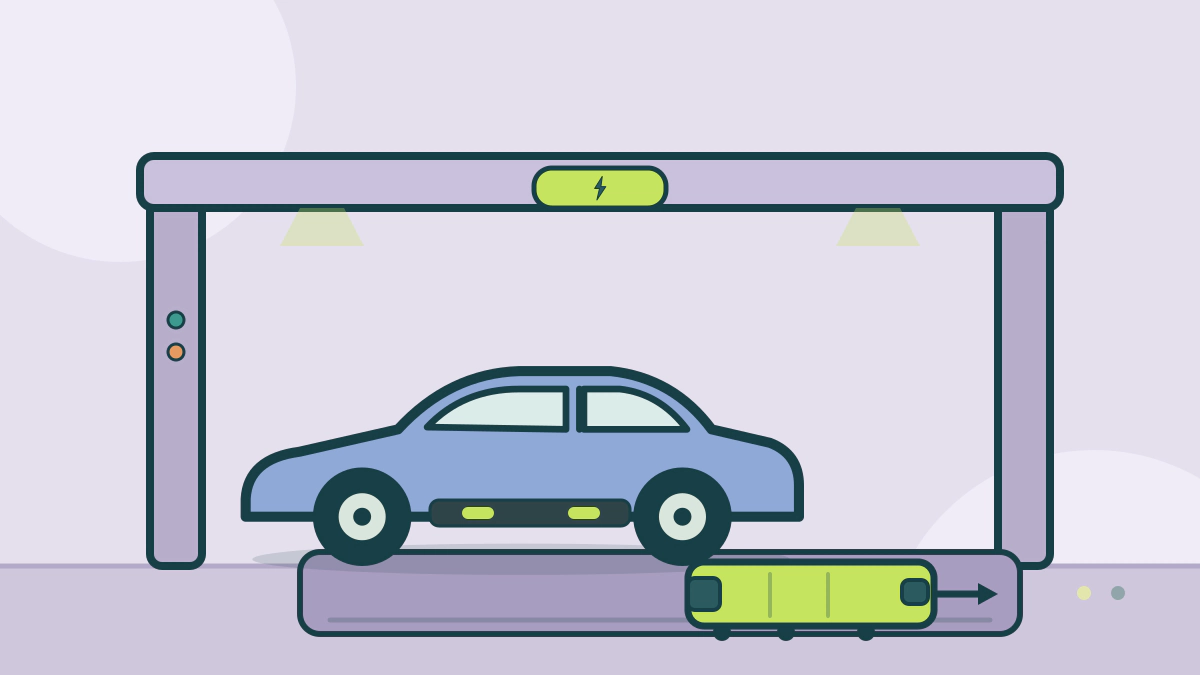
Learn how a swap station exchanges a depleted EV battery for a charged one, which operators use the model, and what limits it in the US.
What is EV battery swapping?
EV battery swapping replaces a depleted battery pack with a charged one at a station, so the vehicle leaves in minutes instead of waiting for a charge. It is a service model: one operator usually owns the batteries, runs the stations and controls which vehicles can use them.
The station does the physical work. A DOE transit guidebook describes automated removal of low-charge batteries and replacement with charged packs. It can recharge depleted packs when electricity is cheapest. DOE AFDC and NREL
For a car, the driver usually stays inside while the vehicle parks over a bay. NIO says its station completes a fully automatic swap in three minutes and checks the battery and drive system during each exchange. NIO
Why operators choose the swap model
The obvious gain is time: a swap takes minutes, a DC fast charge tens of minutes, and Level 2 charging hours. The DOE data center lists DC fast charging as adding roughly 100 to 200 or more miles in 30 minutes, depending on the vehicle and charger. AFDC
The second gain is financial separation. NIO’s Battery as a Service plan sells the car without the battery. The buyer subscribes to a pack and can change capacity later. At launch, NIO described a lower car price and a monthly battery subscription. NIO
Ample takes a modular approach. It says its stations exchange battery modules rather than one large pack, can deliver a full charge in under five minutes, and need no construction. It also says the system works with multiple vehicle models. Ample
Those are operator claims, not independent tests.
Where swapping is actually used
The DOE guidebook calls battery swapping the least common on-route charging method for electric buses, with examples in Asia at publication. It describes a South Korean demonstration where robots swapped roof-mounted packs in under a minute, using packs of about 48.6 kWh. DOE AFDC and NREL
NIO operates Power Swap stations for its own cars and sells battery subscription plans around them. NIO
In a filing with the California Energy Commission, Ample says its first demonstration used swap-enabled Nissan Leaf and Kia Niro EVs in the San Francisco Bay Area. It says its main customers are rideshare and last-mile delivery fleets. California Energy Commission
| Model | Who owns the battery | What the driver does | Example |
|---|---|---|---|
| Home or public charging | Driver, or the lessor | Parks and plugs in | Most US EVs |
| Car battery swap | Operator or battery asset company | Stops at a station; the station exchanges the pack | NIO, Ample |
| Transit battery swap | Transit agency or operator | Bus returns to a route station; robots exchange the pack | Pohang demonstration |
The battery becomes a shared asset, and the driver’s contract changes with it.
The limits start with the battery
The first limit is the battery. A station needs extra packs, and those packs cost money. The DOE guidebook lists the cost of additional batteries as a drawback, along with the risk of damaging packs during a swap. DOE AFDC and NREL
The second limit is compatibility. A vehicle needs a removable pack and the mounting, cooling and communication interfaces the station expects. A typical EV with a sealed pack cannot use a swap bay. NIO’s system works with NIO cars; Ample’s is offered through partner vehicle programs.
The third limit is density. A swap is fast only if a station is nearby. One city station does not replace home charging, and a fleet needs stations on its routes. The DOE guidebook describes swapping as an on-route transit option, where vehicles run fixed routes.
What the contract changes
When the battery is leased, the buyer and the battery owner have separate interests. The subscription sets the monthly price, the capacity you can use, and what happens if the pack degrades. NIO lets users subscribe to different pack sizes, which changes range and cost. NIO
Ask who is responsible for insurance, damage and warranty claims. A swapped pack may not be the one installed at delivery, so the operator holds the battery record. That can affect resale and used-EV value. The battery warranty guide explains how coverage is usually written, and the used EV value guide covers why the pack’s history matters at resale.
Check the exit terms too: can you keep or buy the pack if you move or the operator exits?
Is battery swapping coming to US drivers?
Not as a nationwide retail service. US light-duty examples are fleet-oriented, and the DOE transit example described here was a demonstration. Treat swapping as a brand-specific service, not a standard feature.
If a swap-capable vehicle is offered, check station coverage on your routes, the subscription price, pack sizes and exit terms. Compare the total cost with home and public charging. The charging-time guide shows how to compare refueling stops, and the Future Mobility and Innovation hub collects related battery guides, including battery recycling.
Frequently asked questions
Is swapping faster than charging?
At the station, yes. NIO says three minutes and Ample says under five. A DC fast charge adds 100 to 200 or more miles in about 30 minutes, and total trip time still depends on station distance.
Do I own the battery if I use a swap service?
It depends. In a battery-as-a-service plan, the operator or battery asset company owns the pack and the driver subscribes. In a conventional purchase, the driver owns the battery in the car.
Can any electric car use a battery swap station?
No. The car needs a removable pack and the interfaces the station uses. NIO’s stations serve NIO vehicles, and Ample’s system is installed through partner vehicle programs.
Is battery swapping available in the US?
Only in limited form. Ample has focused on fleet customers in the San Francisco Bay Area, and the DOE transit example described here was a demonstration. Most EV owners do most of their charging at home.