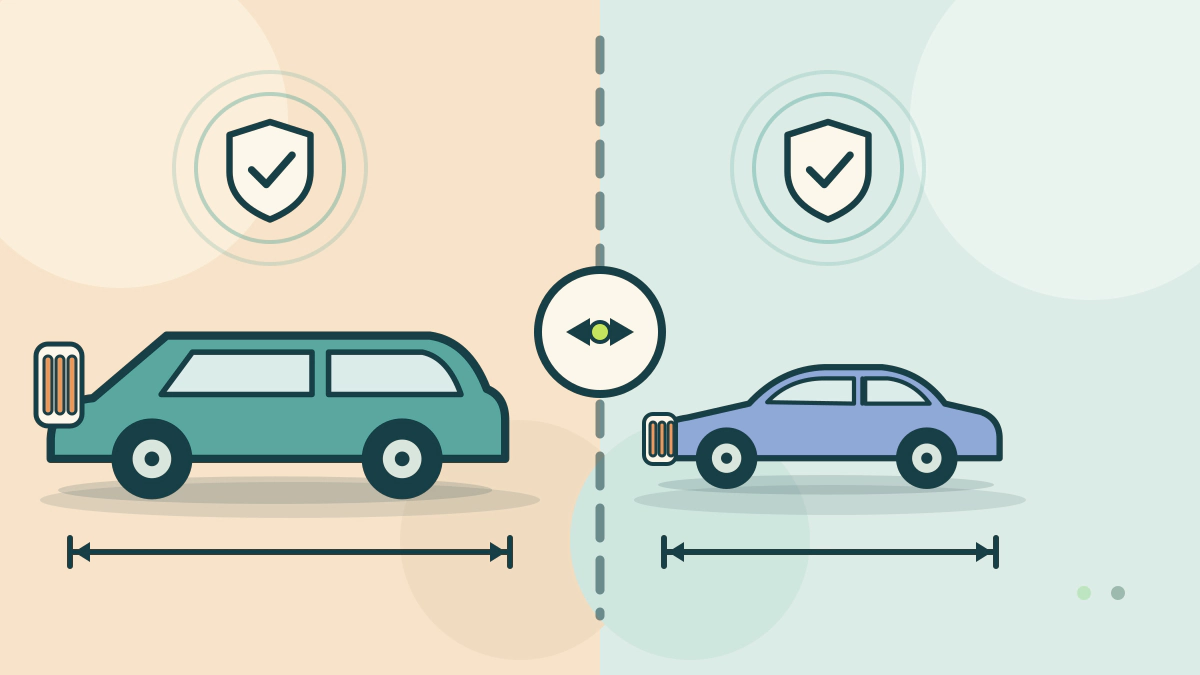
Vehicle size and weight change crash forces, but structure, restraints, safety technology and driver behavior decide much of the real-world risk.
Does a bigger vehicle always mean a safer one?
No. A larger, heavier vehicle usually protects its own occupants better in a crash, but size alone does not settle the outcome. The Insurance Institute for Highway Safety states it plainly: a bigger, heavier vehicle provides better crash protection than a smaller, lighter one, assuming no other differences between them.
Structure, restraints, stability technology, headlights and the driver all change the result. So do the other vehicle and the person on foot or on a bicycle.
What size and weight actually change
IIHS explains the physics in two parts. Length gives the front end more room to crumple before the occupant compartment is crushed. That longer front end helps mainly in frontal crashes, which account for more than half of passenger vehicle occupant deaths.
Weight matters most when two vehicles collide. The heavier vehicle pushes the lighter one backward, so its own occupants feel less force and the people in the lighter vehicle feel more.
IIHS crash-tested pairs in 2019 to show the effect. A 2018 Kia Forte and a 2018 Toyota Yaris iA both earned good ratings in the five IIHS tests relevant to driver protection, yet both did poorly when struck by larger vehicles.
Weight is not free: heavier vehicles can be more dangerous to people in lighter vehicles and to pedestrians.
The trade-offs that size brings
| Factor | Effect on safety | What it does not tell you |
|---|---|---|
| Front-end length | More crumple space in a frontal crash | Protection in side or rear impacts |
| Curb weight | An advantage against a lighter vehicle | How well the structure manages force |
| Height and center of gravity | A higher seating position and view | Rollover resistance at speed |
| Vehicle mass | Protection for its own occupants | The danger it imposes on others |
| Seating capacity | Room for passengers and cargo | Whether every seat has equal protection |
A taller vehicle has a higher center of gravity, so rollover resistance matters. NHTSA tests it separately from frontal and side scores.
Size can create a false sense of protection: a heavy vehicle does not stop shorter, and four-wheel drive does not improve stopping on ice or wet pavement.
Why a five-star rating is not a size rating
NHTSA’s 5-Star Safety Ratings summarize frontal, side and rollover performance for a given model year and configuration. They describe how a vehicle performed in those tests, not how much mass it carries. A five-star small car still faces the size and weight disadvantage IIHS describes when it meets a much larger vehicle.
IIHS takes a similar layered approach in its teen vehicle guidance. Its recommended used list starts with a curb weight above 2,750 pounds, then adds a good driver-side small overlap rating, automatic emergency braking and headlight performance. Weight is an entry condition, not the whole test.
The NHTSA ratings explainer and the IIHS Top Safety Pick guide cover how each program scores a vehicle.
What matters beyond the size badge
Crash structure decides how well the occupant compartment survives. Structure and restraints determine how much of that size advantage reaches the occupants.
NHTSA notes that seat belts prevent ejection from the vehicle, which is why buckling up matters in every seat.
Stability control helps a driver keep control when the vehicle starts to slide. NHTSA requires ESC on light vehicles manufactured on or after September 1, 2011. Automatic emergency braking is widely standard, though availability varies by trim.
Headlights matter at night: how far and how wide they light the road changes how soon a driver can react.
The driver matters too. NHTSA reports that teen drivers have higher fatal-crash rates mainly because of immaturity, lack of skill and lack of experience. Speeding was a factor in 33% of passenger vehicle teen drivers aged 15 to 18 involved in fatal crashes in 2024. One teenage passenger raises the likelihood of risky behavior, and graduated licensing can cut crash risk substantially.
A large vehicle does not compensate for those behaviors. In some cases it makes them worse: more mass, more momentum and a higher center of gravity.
How to weigh size with everything else
Start with the exact vehicle, not the model name. Ratings apply to a model year, a body style and sometimes a build date. A mid-year change can alter standard equipment, which is why the IIHS teen list has build-date exceptions.
Then check the safety features on that specific car. Look for stability control, working belts, airbags that have not been deployed, adequate tires and headlights that are not clouded.
Finally, match the vehicle to the driver. A first car that is too large, too powerful or too tall for a new driver’s judgment adds risk. The Family Teen and Accessible Vehicles section starts with how to choose a safe first car, and used-car safety features for teens covers what to verify on a used example.
Size is a real advantage. It is not a substitute for a sound structure, working restraints, modern safety systems and a driver who is paying attention.
Frequently asked questions
Is a heavier vehicle always safer for its occupants?
Not always. IIHS finds a general advantage for heavier vehicles in crashes with lighter ones, but structure, restraints and crash type can outweigh a weight difference.
Are five-star cars equally safe regardless of size?
No. The stars describe test performance, not mass. A small five-star car still faces the weight disadvantage IIHS describes against a much larger vehicle.
Do larger vehicles make the road safer for everyone?
Not automatically. IIHS reports that SUVs and pickups are more dangerous to pedestrians and bicyclists, and that pickups were still nearly twice as likely as cars to kill the driver of a car they struck in 2017-22.
What should a parent check first?
The exact model year’s crash ratings, standard automatic emergency braking, headlight rating, tire condition and the build date. Size is one filter, not the decision.