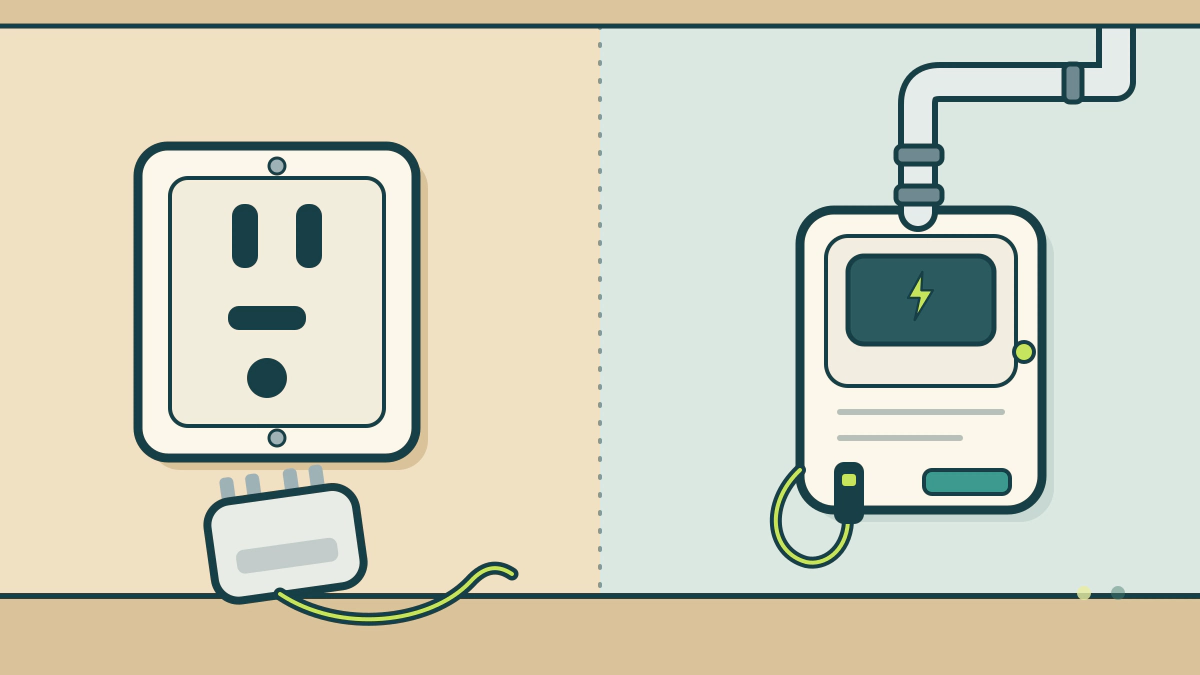
Compare a NEMA 14-50 outlet with a hardwired Level 2 charger: amperage limits, outdoor rules, flexibility and what an electrician must verify.
Which setup fits your charging needs?
Choose hardwiring when you want the highest home charging rate, an outdoor installation or compliance with local GFCI rules. Choose a NEMA 14-50 outlet when a 40-amp charger covers your driving and you value being able to swap equipment without an electrician.
Both are Level 2 charging at 240 volts; the wall connection sets the current limit. The EV Charging hub explains the wider picture, including Level 1 versus Level 2 versus DC fast charging.
Neither option is a do-it-yourself project. The US Department of Energy says installations must comply with local and state codes, and permits may be required. It also notes that EV charging is treated as a continuous load under the National Electrical Code, with Article 625 covering most charging equipment rules.
What a NEMA 14-50 outlet actually provides
The AFDC glossary describes the NEMA 14-50 as an outlet rated at 50 amps and 240 volts. It is used for RVs and dryers, and some EVs come with a cordset made for it.
A 50-amp outlet does not mean a charger can draw 50 amps continuously. The EPA explains that a circuit breaker must be sized at least 125 percent of the charger’s rating, so a 40-amp charger needs a dedicated 50-amp circuit.
Tesla publishes the same relationship in its Gen 3 Wall Connector manual. The manual pairs a 50-amp breaker with a 40-amp maximum output and 9.6 kW at 240 volts. The arithmetic is simple: 240 volts multiplied by 40 amps equals 9,600 watts.
The EPA calls NEMA 14-50 outlets a common choice for Level 2 chargers. It also says an outlet gives you flexibility to swap chargers without hiring an electrician. ChargePoint’s Home Flex guidance says its plug-in version requires a circuit rated 40 or 50 amps, and every other circuit rating must use the hardwired version. Check your charger’s manual first.
What hardwiring changes
Hardwiring removes the receptacle and the plug. The charger is connected directly to a dedicated branch circuit, so the circuit rating, not a plug standard, becomes the main limit.
For Tesla’s Gen 3 unit, the manual lists a 60-amp breaker with a 48-amp maximum output and 11.5 kW at 240 volts. It also tells installers to hardwire branch circuits and not to install cord-and-plug connections.
ChargePoint says hardwiring works with breakers from 20 to 80 amps and can deliver up to 50 amps of charging. It says local GFCI rules may require hardwiring. For outdoor installation, it requires either hardwiring or a weatherproof NEMA receptacle.
| Circuit breaker | Maximum charging current | Power at 240 volts | What it typically means |
|---|---|---|---|
| 50 A | 40 A | 9.6 kW | The usual ceiling for a 14-50 plug-in setup |
| 60 A | 48 A | 11.5 kW | A common hardwired maximum |
| 40 A | 32 A | 7.6 kW | A smaller hardwired or plug-in circuit |
| 30 A | 24 A | 5.7 kW | A lower-power hardwired unit |
| 20 A | 16 A | 3.8 kW | The smallest common Level 2 circuit |
Tesla lists these pairings for its Gen 3 Wall Connector. Other manufacturers publish their own tables, and the vehicle’s onboard charger can lower the actual rate.
The outlet is only one part of the installation
A 14-50 receptacle is a component, not a complete charging plan. The circuit still needs the right conductor size, breaker, grounding and location. The AFDC says an electrician can assess whether the home’s electrical capacity is adequate.
ChargePoint’s installation notes recommend a receptacle that captures all the copper strands and the largest available junction box. A plug adds contact points, and the EPA says hardwiring provides better safety. The home charger installation cost comparison covers the wider budget question.
When the 14-50 makes sense
A 40-amp setup delivers 9.6 kW at 240 volts. The EPA estimates Level 2 charging adds roughly 25 to 40 miles of range per hour, depending on the vehicle.
The outlet also helps if you expect to change chargers, move the unit, or already have a 14-50 installed for another purpose. The EPA says you may not need to hire an electrician if you already have a NEMA 14-50 outlet you are confident was properly installed. An existing dryer or RV outlet is not automatically suitable for EV charging.
When hardwiring is the better answer
Hardwiring is the practical choice when the charger is rated at 48 amps or higher. The EPA says units in that class are usually required to be hardwired rather than plugged in.
It is also the safer default outdoors, where ChargePoint requires hardwiring or a weatherproof receptacle. If local rules require a GFCI breaker, hardwiring may be the only compliant option for the chosen unit.
Hardwiring also reduces the number of field connections. A hardwired 40-amp charger still delivers 40 amps.
Frequently asked questions
Is a NEMA 14-50 outlet enough for overnight charging?
A 50-amp circuit generally supports 40-amp charging, or 9.6 kW at 240 volts. The EPA estimates Level 2 adds about 25 to 40 miles of range per hour, so many drivers replace a day of driving overnight.
Can I plug any Level 2 charger into a 14-50 outlet?
No. The charger must be sold with a matching plug and rated for a 40- or 50-amp circuit. Some models are hardwire-only. Check the installation manual and the label on the unit before buying.
Does hardwiring always charge faster?
No. Hardwiring removes the plug-in circuit limit, but the charger setting and the vehicle’s onboard charger still cap the rate. A hardwired 40-amp unit delivers the same current as a plug-in 40-amp unit.
Can I install a 14-50 outlet for an EV myself?
The EPA says a new EV circuit involves work best left to a professional, and permits and inspections are common. A licensed electrician should perform the load calculation and confirm the final installation.