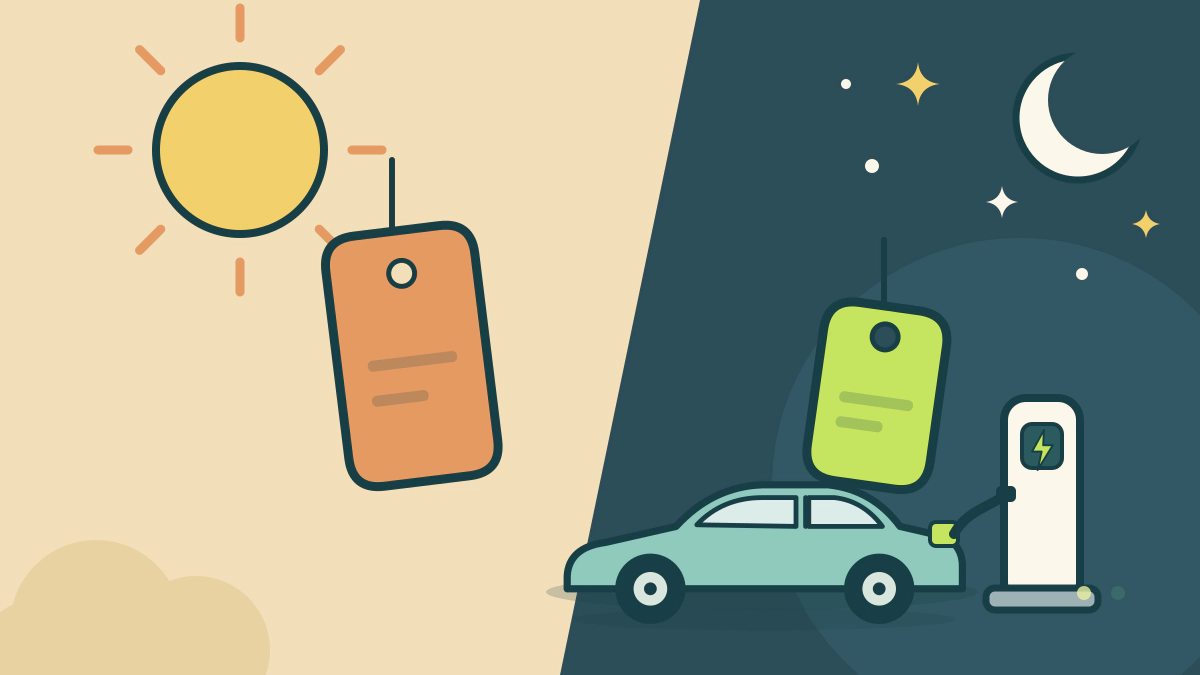
Learn how time-of-use electricity rates price overnight charging, what EIA data can and cannot tell you, and how to schedule a session in a real EV.
Is off-peak EV charging actually cheaper?
Off-peak charging is cheaper only when your electricity tariff charges less during those hours and the car is plugged in long enough to use them. A flat rate does not reward overnight charging at all; a time-of-use rate can cut the price per kilowatt-hour but may raise it during the evening hours when many people arrive home.
Check three things before assuming savings: the tariff’s actual periods and prices, the hours your car is available, and whether the off-peak window can deliver the energy you need.
What a time-of-use rate is
EIA’s glossary defines time-of-day pricing as a special electric rate feature under which the price per kilowatthour depends on the time of day. Its explanation of electricity prices gives the reason: demand is usually highest in the afternoon and early evening, so supply costs more then. Most consumers pay seasonal average rates, but some utilities offer time-of-day pricing to encourage conservation and reduce peak demand.
That phrase matters: time-of-use pricing is an option, not a national default, and each utility’s approved tariff sets the periods.
What EIA publishes, and what it does not
EIA states in its rate data FAQ that it does not publish retail prices for peak or off-peak periods.
| Customer type | 2025 U.S. average retail price |
|---|---|
| All sectors | 13.63 cents per kWh |
| Residential | 17.30 cents per kWh |
| Commercial | 13.41 cents per kWh |
| Industrial | 8.62 cents per kWh |
| Transportation | 13.83 cents per kWh |
Those figures come from the EIA electricity prices page, citing Electric Power Monthly Table 5.3, February 2026, preliminary data. The same page reports a 2025 state range from 35.72 cents per kWh in Hawaii to 8.20 cents per kWh in North Dakota, using Table 5.6.B.
These 2025 annual averages are a reference point, not a prediction of any off-peak price. For the real structure, the EIA FAQ points to the DOE Utility Rate Database and to individual utilities’ tariff schedules.
Where EV-specific off-peak rates come from
Regulators, not federal price statistics, create these rates. The California Public Utilities Commission says it has approved residential time-of-use rates for PG&E, SCE, SDG&E, Bear Valley and Liberty customers who drive EVs, with a very low super off-peak price at the times when energy costs least.
Two federal pages put it more cautiously. EPA says EVs can be charged off-peak such as overnight, when rates are often cheaper, and the DOE consumer guide says night charging takes advantage of low, stable residential rates.
A time-of-use rate usually applies to the whole house unless the EV has a separate meter; the CPUC table lists both whole-house and EV-only residential rates. Running the dryer or air conditioner at peak can cost more than the charging saves.
How to set a schedule in a real car
Kia’s EV6 owner’s manual documents the feature. On the EV screen, open Charging and Climate, then choose Scheduled Charging; under off-peak time settings you enter a start time, an end time and a charging option.
One option starts at the off-peak time and may continue past it to reach 100%; the other charges only inside the window, so the battery may not reach 100%.
The scheduled charging section adds two practical notes: scheduling works with the AC or portable charger, not DC, and once a schedule is set, plugging in does not start charging. To charge now, hold the charging button on the charging door for about two seconds.
Other brands use different menus for the same idea, so treat this as an example, not a universal procedure. Your own manual has the equivalent section.
The arithmetic, with your own numbers
Suppose you need to add 40 kWh overnight. At the 2025 U.S. residential average of 17.30 cents per kWh, the energy cost is:
40 kWh x $0.173 = $6.92.
Now suppose an off-peak period priced at 8 cents per kWh. That price is a labelled illustration, not a real tariff:
40 kWh x $0.08 = $3.20.
The difference is $3.72 for that session. Substitute your own prices. On a flat rate the difference is zero, and any saving has to come from a separate EV programme or from avoiding demand charges on a commercial account.
Then check the window. A 1.9 kW Level 1 connection delivers about 1.9 kWh per hour, so 40 kWh needs about 21 hours, too long for a normal overnight window. A 6.6 kW Level 2 connection needs about six hours, which usually fits. Losses make both longer.
That feasibility check is where many off-peak plans fail. Tracking EV energy expenses shows how to compare the bill with the miles driven, and home charger installation versus public charging costs covers the equipment side. The EV Charging hub collects the rest.
Frequently asked questions
Is off-peak charging always cheaper than daytime charging?
No. It is cheaper only under a tariff that prices those hours lower. On a flat rate, the time of day does not change the energy price.
Do I need a special charger to use off-peak rates?
No, but something has to schedule the session. Many EVs include a timer in the infotainment menu, and some connected chargers can schedule instead.
Can I use a time-of-use rate if I do not have an EV?
Usually yes, because the rate applies to the household. That also means other appliances used at peak hours can cost more. Check the whole tariff rather than only the charging line.
What if my off-peak window is too short for a full charge?
Charge at higher power, accept a partial charge, or find a tariff with a longer window. The arithmetic is energy needed divided by power, multiplied by available hours; if the product falls short, the schedule cannot fill the battery.