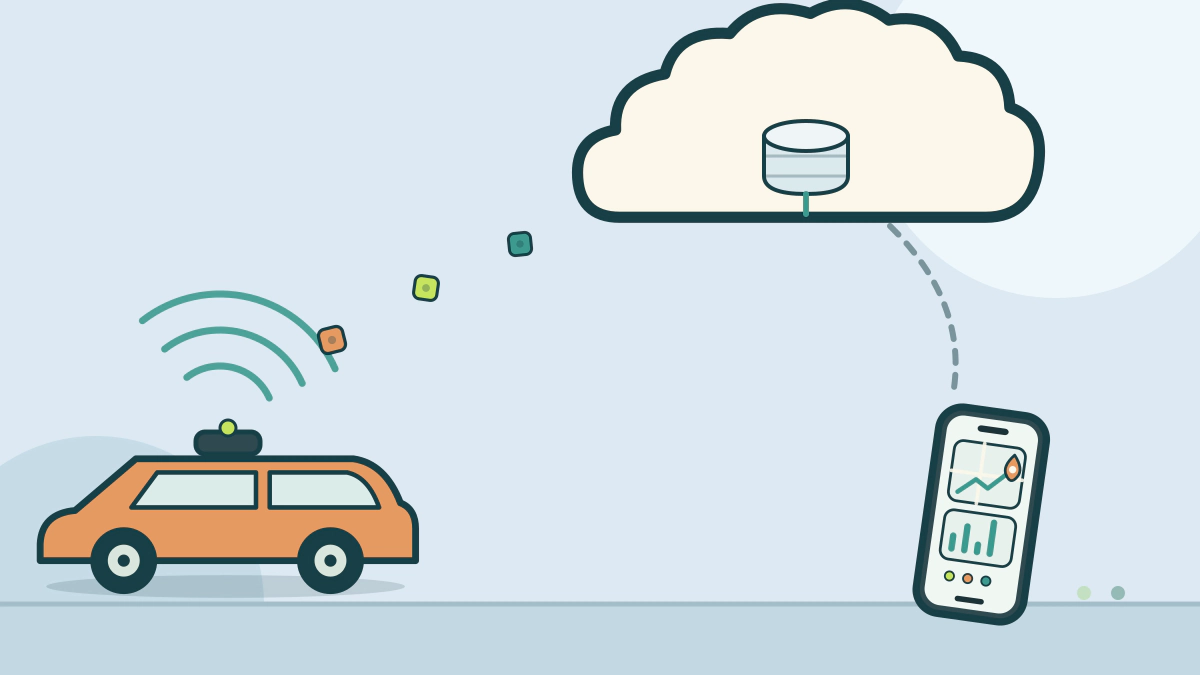
Follow vehicle data from sensors and control modules to the onboard telematics unit, the wireless link and the account where apps and reports read it.
How do telematics systems collect vehicle data?
A telematics system collects readings from vehicle sensors and control modules, passes them through an onboard unit with a wireless connection, and stores the results in an account that an app, dealer, insurer or fleet manager can reach. Massachusetts law describes the core of that process: a telematics system collects information generated by operating the vehicle and wirelessly transmits it to another device where it is stored (Mass.gov).
What kinds of data come from the car
Massachusetts calls the result mechanical data used for diagnosis, repair or maintenance. It says the data varies by vehicle but can come from sensors on the airbags, battery, engine or motor, transmission, brakes and tires.
Convenience features add more. Ford says its app can remotely show current mileage, fuel level and tire pressure, and can lock, unlock or start a vehicle when the service is active (Ford Connected Services).
The FTC adds categories beyond mechanical condition. It warns that connected cars can collect sensitive data such as biometric information or location, and that its collection and disclosure can threaten privacy and financial welfare.
Step one: sensors and control modules
Most readings begin at a sensor. A wheel-speed sensor, a tire-pressure sensor, a battery monitor or a crash sensor produces a signal that a control module interprets.
Those modules already need to share data. On many vehicles they do it over a CAN network, where a module broadcasts a value and other modules read it (Bosch CAN overview). That shared network is why a telematics unit can often obtain several readings without a separate sensor for every service. The CAN bus explainer covers that network in more detail.
Step two: the onboard telematics unit
The telematics unit bridges the car to the outside world. It needs a wireless connection, usually a cellular modem, and it needs access to the vehicle network.
Ford’s description shows the dependency plainly. Connected services require an activated vehicle modem, and Wi-Fi is not required because the service can use the vehicle’s cellular data connection. Ford also notes that 4G and 5G are not available everywhere.
The unit follows rules set by the manufacturer: which signals to read, when to report them and what to do when the connection drops. Two cars with similar hardware can therefore collect different data.
Step three: the wireless link and the back end
Once a report leaves the car, it travels over a cellular network to a manufacturer or service-provider server. The account tied to the vehicle identification number is what links that report to an owner, a subscription and an app.
This is where the data becomes useful to someone other than the driver. A dealer may see a fault before the car arrives if the service includes remote diagnostics, and an insurer can price a usage-based policy if the owner enrolls; the telematics insurance guide covers that trade-off.
NHTSA treats these wireless paths as security boundaries. Its vehicle cybersecurity guidance describes a layered approach that protects both wired and wireless entry points, because a remote connection can scale to many vehicles at once.
How often data is sent
There is no single reporting interval. Some data moves when the owner asks for it, such as a status check from an app. Some moves on a schedule the manufacturer sets. Some is triggered by an event.
| Data example | Where it starts | What the owner may see |
|---|---|---|
| Odometer reading | Cluster or body module | Mileage in an app or service record |
| Fuel or charge level | Powertrain control module | Remote status display |
| Tire pressures | Tire-pressure sensors | Pressure readings in an app |
| Battery and brake data | Battery monitor and brake modules | Service alerts or workshop report |
| Location | Vehicle positioning and network data | Map or vehicle-locator feature |
| Airbag deployment | Restraint sensors | Emergency or claims information |
These are illustrations, not a complete list for any one model.
Who can see the data, and what owners can change
The first audience is the account holder, followed by the dealer or service network. In Massachusetts, the law also gives owners the right to access mechanical data through an app and to authorize an independent shop to access it for diagnosis, maintenance and repair. The right-to-repair guide explains how telematics access fits that wider debate.
Beyond that, access depends on consent and contract. An insurer sees data only if the owner enrolls. A data broker is not supposed to receive it without a lawful basis; the FTC has taken action over the sale of sensitive location data.
Ford says its vehicles have privacy settings that control what the owner shares, subject to the features in use, and that it does not sell data about how a vehicle is driven to data brokers (Ford Data and Privacy). That is a company statement, not an industry-wide rule. Read the privacy notice for the specific car and account.
More context on connected features sits in the Car Technology and Electronics hub.
Frequently asked questions
Is telematics the same as GPS tracking?
No. GPS tracking is one possible input. Telematics covers a wider set of readings, including mileage, battery condition, tire pressure, fault data and service information, and it can work without a navigation display.
Does telematics work without a paid subscription?
It depends on the service. Ford says connected services require an activated modem, and some features sit behind a trial or paid plan. Check the account page and window sticker for that vehicle.
Can I switch telematics off?
Some manufacturers provide privacy settings or a way to disconnect remote vehicle access. Turning everything off can also disable features you rely on, such as remote start or crash notification. Check the owner’s manual first.
Who owns the data collected from my car?
Ownership is set by contracts and privacy notices, not by one national rule. Some states add access rights, as Massachusetts does for mechanical data. Ask the manufacturer for the privacy notice tied to your VIN and read what it permits.