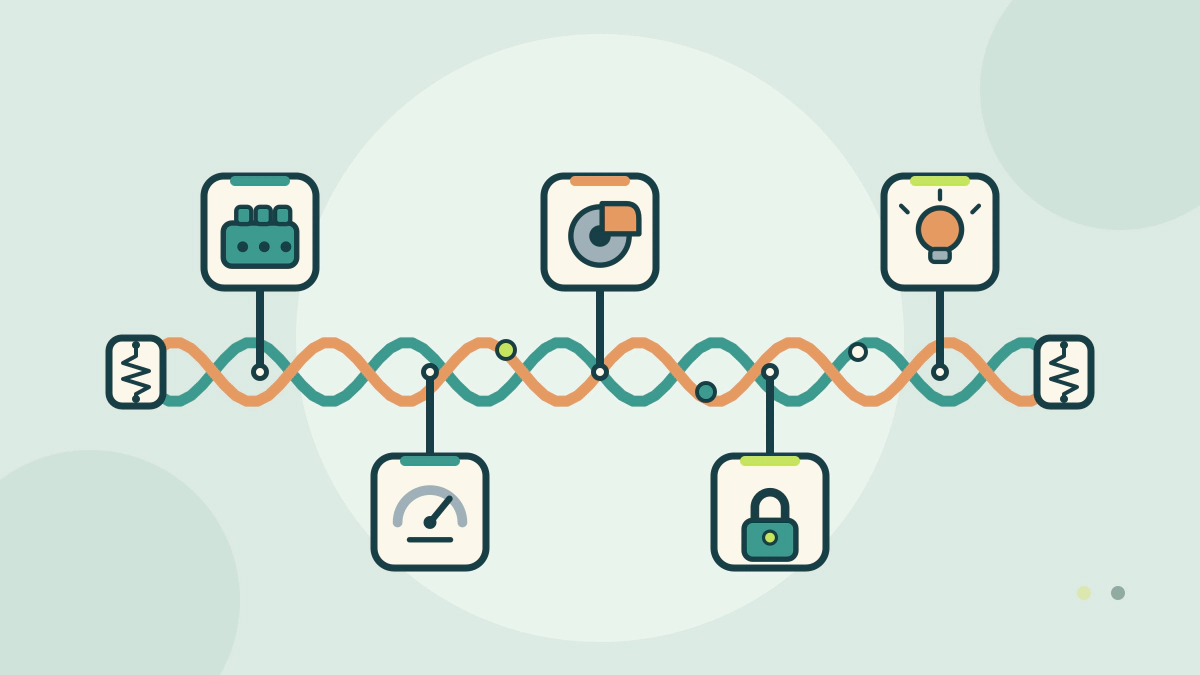
See how a car uses CAN bus networks to share sensor and control data, why vehicles run several buses, and what gateways and message priorities do.
How do cars use a CAN bus network?
Cars use the CAN bus as a shared internal network: control modules broadcast short messages, and every module that needs a value reads it from the bus instead of using a dedicated wire. The layout is standardized at the data-link layer by ISO 11898-1, which describes a serial protocol for real-time control inside road vehicles (ISO).
One value can therefore serve several systems. A wheel-speed reading can support braking, stability control, the instrument cluster and a parking aid at once. Adding a feature often means adding a module that listens to messages already present, not running new wires across the car.
The messages are not standardized across brands. The protocol is, but the identifier assigned to a value and the meaning of its data bytes are manufacturer-specific.
Why one bus is rarely enough
A car separates functions into network segments. A typical architecture might keep powertrain, body, infotainment and driver-assistance traffic on separate buses, then connect them through a gateway.
That segmentation is a security measure as much as a wiring decision. NHTSA’s 2022 cybersecurity guidance recommends segmentation and gateways with strict filtering between segments, so a device on an infotainment network cannot freely reach braking or steering controls. The agency’s vehicle cybersecurity page describes the same layered approach around wired and wireless entry points.
A gateway is both a translator and a filter. It forwards selected messages, blocks others and gives diagnostic tools a controlled route into each segment.
What a CAN frame carries
Every frame begins with an identifier, followed by a data field and error-checking bits. The identifier does two jobs: it labels the message and it sets its priority when several modules transmit at once.
The frame format has expanded over time. Classical CAN carries up to 8 data bytes per frame at bit rates up to 1 Mbit/s. CAN FD keeps the arbitration scheme but allows a faster data phase and up to 64 bytes. CAN XL extends the payload much further.
| Variant | Maximum payload per frame | Rate or role stated by the source |
|---|---|---|
| Classical CAN | 8 bytes | Up to 1 Mbit/s; defined in ISO 11898-1 |
| CAN FD | 64 bytes | Data phase faster than 1 Mbit/s; standardized as ISO 11898-1:2015 |
| CAN XL | 2,048 bytes | Data rates up to 20 Mbit/s; positioned between CAN FD and automotive Ethernet |
The figures come from the ISO 11898-1 abstract and Bosch’s CAN protocol overview. Bosch notes that CAN FD was introduced to overcome the classical limit of 1 Mbit/s and 8 bytes.
How messages take turns
CAN is a multi-master network. Any node may start transmitting when the bus is idle, and there is no central scheduler granting permission.
When two nodes start together, they compare identifiers bit by bit. The message with the higher-priority identifier continues; the other stops and tries again later. This content-based arbitration resolves the collision without destroying the winning frame. Bosch’s overview describes the same non-destructive arbitration as a defining CAN feature.
Two consequences follow. A high-priority safety message can reach the bus quickly even when it is busy, while low-priority traffic waits. Error detection is also part of the protocol, and the specification includes fault-confinement rules so a repeatedly faulty node can be separated from the network.## Where CAN sits beside other networks
CAN is not the only network in a modern car, and it is not always the fastest. Bosch describes CAN XL as filling a gap below 100BASE-T1 Ethernet. A gateway may connect CAN segments to an Ethernet backbone, and a diagnostic tool may reach some modules directly while others sit behind it. That is why a scan tool that reads the engine does not necessarily see every module in the car.
What owners and technicians can observe
From the driver’s seat, the network is invisible until something depends on it. A failed module, a low battery, a damaged connector or an aftermarket device on the diagnostic port can produce several unrelated symptoms at once.
That is the subject of the separate guide to what a CAN fault looks like, which covers symptoms, U-codes and diagnosis. This article is about how the network is used, so the owner takeaway is narrower: shared data means shared consequences.
NHTSA’s guidance adds a caution about add-on devices. It treats the OBD-II port, cellular links, Wi-Fi, Bluetooth and USB as entry points, and it recommends that connections to third-party devices be authenticated and limited. An insurance dongle is not automatically harmless because it plugs into a standard connector.
For work involving glass, cameras or radar, the network is only part of the story. ADAS camera calibration after windshield replacement explains why a repair can require a relearn procedure.
More context on vehicle electronics sits in the Car Technology and Electronics hub.
Frequently asked questions
Does every car use the same CAN message identifiers?
No. The frame format is standardized, but the identifier assigned to a signal and the layout of its data are set by the manufacturer. A message that means wheel speed on one model can mean something else on another.
Can a module read data without being asked?
Yes. CAN is a broadcast network. A transmitter puts a frame on the bus, and each node decides from the identifier whether the message is relevant, so several systems can use one value.
Is CAN FD just a faster version of the same wiring?
Not exactly. It uses a different frame format and a switchable data rate, and the controllers at each end must support it. A vehicle designed for classical CAN cannot gain CAN FD capability from a software setting alone.
Why does one fault disable several unrelated features?
Because those features may depend on the same module, power feed, ground or gateway. A single shared failure can remove data that many systems rely on, which is why diagnosis starts with the network map rather than the first warning light.