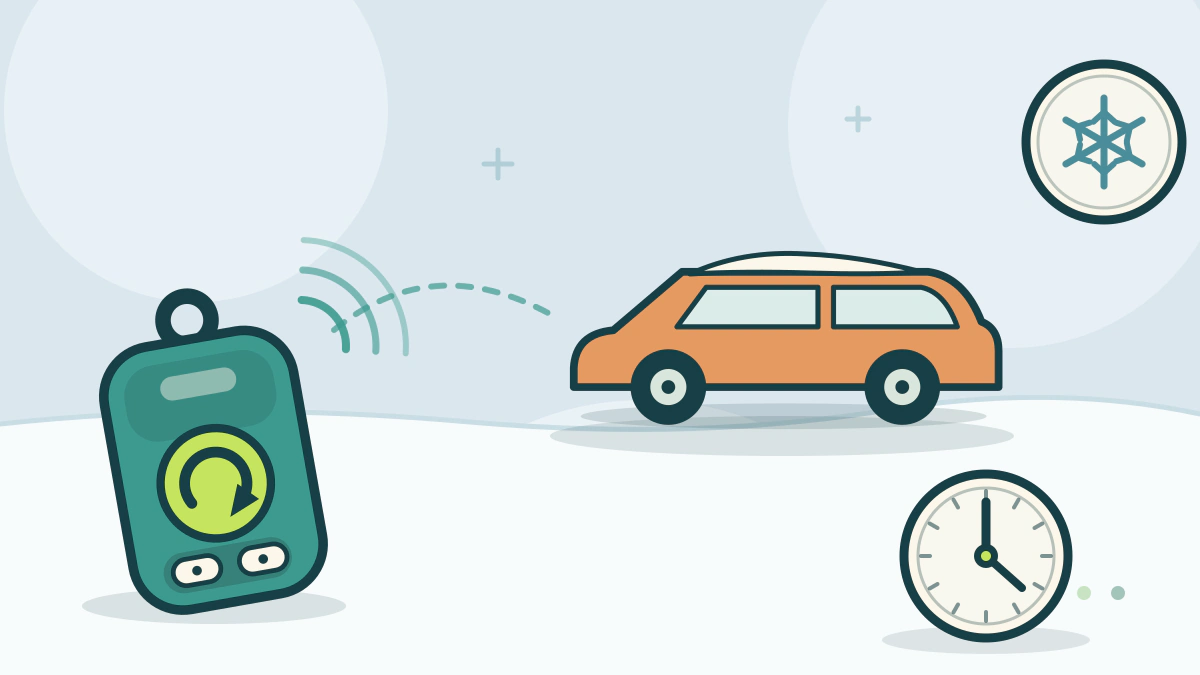
Learn what a factory remote start can and cannot do, how long it runs, when idling is restricted and why exhaust exposure is the main risk.
What remote start does and does not do
Remote start runs the engine and the climate system for a set time before you get in, so the cabin is closer to comfortable. It does not let you drive away without the key.
Kia’s smart key page gives the sequence. Lock the doors within 32 ft (10 m), then press the remote start button within 4 seconds. The vehicle must be in Park. The engine turns off after 10 minutes if you do not get in, and it will not start remotely if the hood or trunk is open.
Toyota’s Remote Engine Starter guide describes a similar cycle. The engine runs for 10 minutes, shuts down, and can be restarted for another 10. After 20 minutes in total, the vehicle must be started manually to reset the system.
The defroster can clear glass, and the cabin can lose its worst chill before you sit down.
The engine does not need it
The common belief is that idling warms the engine before driving. The fuel data points the other way.
DOE and EPA say idling gets 0 miles per gallon, and most manufacturers recommend driving off gently after about 30 seconds. The engine warms faster being driven, which brings heat to the cabin sooner and reduces fuel use and emissions. See Fuel Economy in Cold Weather.
So remote start trades fuel for comfort. A long idle is not a substitute for gentle driving on a cold morning.
Hot weather reverses the trade. A/C can cut fuel economy by more than 25% in very hot conditions, especially on short trips, so DOE suggests airing out the cabin first. See Fuel Economy in Hot Weather.
Limits built into the system
| Condition | What happens |
|---|---|
| Shift lever not in Park | Remote start will not operate |
| Hood or trunk open | Remote start will not operate |
| No registered key when you enter | The engine turns off |
| Ten minutes pass | The engine shuts off automatically |
| Twenty minutes of total run time | A manual start is needed to reset the timer |
| Key out of range | The button may not work, about 32 ft (10 m) on the Kia example |
The range and button sequence vary by brand and by fob or connected app.
Idling rules are not uniform
New York’s statewide rule limits heavy-duty vehicles over 8,500 lb to five minutes of idling, with limited exceptions. New York City is stricter: no more than three minutes for all vehicles, and one minute next to a school. The New York DEC page lists both.
Colorado handles the same issue through its unattended-vehicle law rather than a general idling cap for cars. Under C.R.S. 42-4-1206, a driver may not leave an unlocked vehicle standing unattended without stopping the engine, but using a remote starter plus adequate security measures is enough to comply. The statute lists keeping the keyless fob out of proximity as one acceptable measure.
The pattern is that most state rules target heavy-duty and commercial vehicles, while cities can cover every car. Check your state environmental agency and city code before assuming a long warm-up is allowed.
Exhaust is the risk that matters most
Carbon monoxide is the reason a garage is the wrong place for remote start.
Kia’s manual says not to operate remote start in closed areas where engine exhaust is not adequately ventilated.
The Consumer Product Safety Commission calls CO the invisible killer because it is colorless and odorless. It reports more than 200 deaths a year from accidental non-fire CO poisoning linked to consumer products, and lists headache, dizziness, weakness, nausea and confusion as symptoms.
An attached garage is the classic bad case. Start the car outside, or open the garage door and pull out before letting it run.
Manual, automatic and electric versions
Toyota’s guide says the remote engine starter is for automatic transmissions only and warns against using it on manual-transmission vehicles.
Kia documents a manual-transmission version on some models. The car must be in Neutral, on flat ground, with the parking brake pulled several notches and all doors locked. The manual-transmission page lists the conditions. Do not assume your manual car can be remote started just because another model can.
An EV is different again. There is no engine to idle, so remote climate runs the cabin heater from the battery. DOE says preheating the cabin while plugged in can extend range, and the same applies to pre-cooling in hot weather. That is the EV version of remote start, and it is covered in EV battery preconditioning.
Before a long park, see how to prepare a car for long-term storage. The Car Technology hub has related features. If a car is slow to start in the cold even without remote start, read why a car takes longer to start when cold.
Frequently asked questions
Does remote start warm the engine enough to skip gentle driving?
No. Idling warms the engine slowly and returns 0 mpg, while driving gently warms it faster. Use remote start for comfort, then drive gently.
Is remote start illegal?
Not usually by itself, but idling limits can apply. Some rules cover only heavy commercial vehicles, while cities such as New York may limit all vehicles to a few minutes, so check local law.
Can I remote start a car with a manual transmission?
Some manufacturers offer a manual-transmission version with strict conditions, and Toyota says its unit is automatic only. Check your owner’s manual before assuming the feature is available.
Does remote start work on an electric car?
An EV has no engine to start, but remote climate can heat or cool the cabin. Preconditioning while plugged in uses grid power and can preserve driving range.