See how a GPS tracker finds a car, what OBD, hardwired and battery units each need, and what to check before sharing a vehicle's location data.
How does a GPS tracker know where the car is?
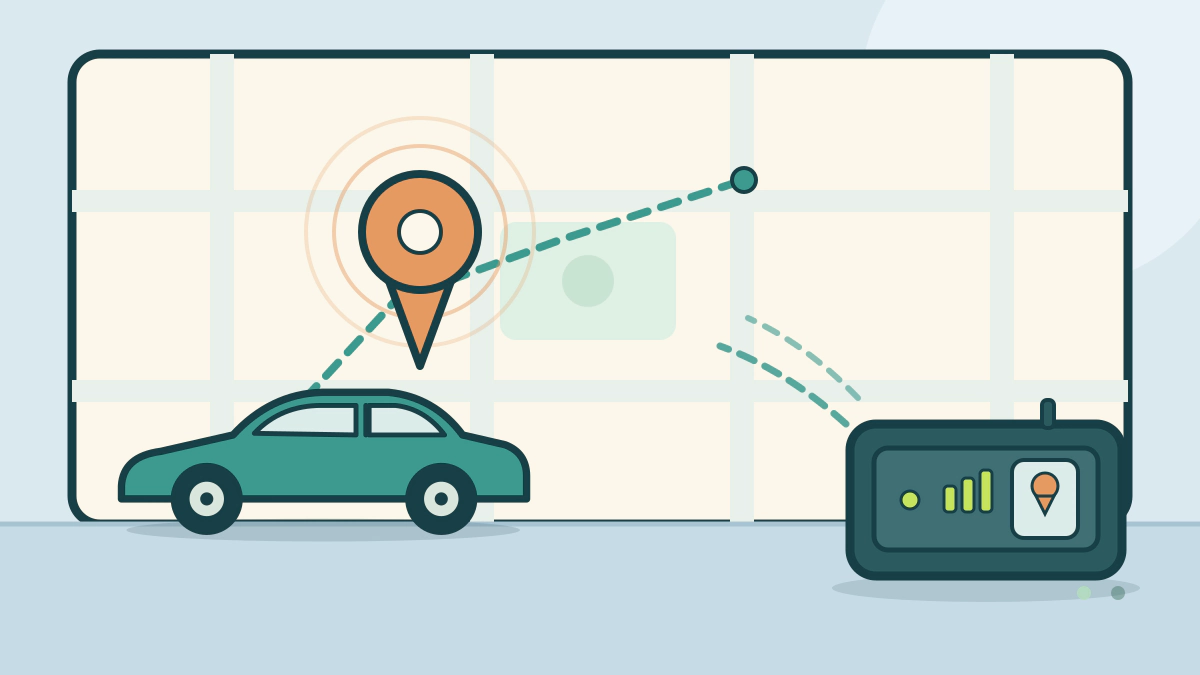
The tracker receives one-way timing signals from GPS satellites, calculates its own position, and then sends that position to you over a separate connection. The satellites do no tracking themselves.
GPS.gov is explicit: the satellites “do not track anything on the ground.” They are one-way beacons, like lighthouses. The government operators of GPS cannot locate your device. Any location report comes from the tracker and the company that runs its service.
Accuracy is not perfect. GPS.gov says smartphones are typically accurate to within a 4.9 m (16 ft) radius under open sky. Accuracy worsens near buildings, bridges and trees, and a tracker in a garage or underground ramp may have no position at all.
The three common ways a tracker is fitted
| Type | Power source | Where it goes | Main thing to check |
|---|---|---|---|
| OBD port | The car’s diagnostic connector | Under the dashboard | Whether the port stays powered when parked, and access for service |
| Hardwired | Vehicle wiring | Hidden behind trim | Who installs it, and what the manual says about add-on electrical equipment |
| Battery | Its own battery | Anywhere in the cabin | Charging or replacement routine, and heat exposure |
An OBD unit is the least invasive. It plugs into the same diagnostic port a technician uses, so it can be removed without tools. That also makes it easy for a thief to unplug.
A hardwired unit can be hidden and can run on the car’s power, but it touches the vehicle’s electrical system. A battery unit needs no wiring, so it suits a car parked for long periods. It needs a charging plan, and a unit left in summer heat ages faster.
What the tracking service adds
A position fix is only half the system. The device must send that fix somewhere, and the service must store and display it. Some products include the connection; others need a data plan.
Before buying, ask what happens when the connection drops and whether alerts arrive by text, email or push notification. Speed, trip history, geofence alerts and engine status depend on what the device is built to read and what the plan allows.
What a tracker can and cannot do
A tracker reports where the car has been and where it is now. It does not stop the car from being taken. It is a reporting device, not an immobilizer, so it complements a steering wheel lock. It also cannot see into a garage, a container or a tunnel where satellite signals do not reach.
Recording is not new to cars. Mazda’s 2024 CX-5 owner’s manual says the vehicle computer records data about controls, operation and driving conditions. Mazda may use that data for diagnosis, research and quality improvement. A tracker adds a second stream of location data on top.
Who else can see the location
The data usually lives on a company’s servers, not only on your phone. The FTC notes that apps may ask for access to location and other device information, and advises checking privacy settings and turning off permissions an app does not need.
For a tracker, read the privacy policy before you buy. Look for what is stored, how long it is kept, who it is shared with, and whether you can delete the history.
If the car is financed or leased, the lender may already have a device fitted. The FTC explains that a lender may install a starter interrupt device that keeps the car from starting after a missed payment. It says state law may treat use of that device as a repossession or a breach of the peace. Ask the lender what is installed and where.
Only the owner, or someone with the owner’s permission, should fit a tracker. Tracking another adult without consent can raise legal issues that vary by state. If you sell the car, remove the tracker and close the account.
Fitting one without disturbing the car
Mazda’s owner’s manual warns that incorrectly chosen or installed add-on electrical equipment can damage essential systems. It names engine stalling, airbag activation, ABS and stability control inactivation, and fire. A hardwired tracker falls inside that warning.
Use a professional for a hardwired install, and ask what is tapped and how the connection is fused. For any type, mount the device so it cannot move in a crash, and keep cables away from pedals. If the unit blocks the diagnostic port, remove it before service.
The Car Accessories and Equipment hub covers other security and comfort choices. For recording rather than tracking, how to choose a dash cam explains the camera side. If you are considering a usage-based insurance plan, usage-based insurance pros and cons covers the data trade-off.
Frequently asked questions
Does a GPS tracker need a subscription?
Most trackers need some data link to send a position to you, and that link is often sold as a plan. Check what happens when the first term ends.
Can a tracker find a car inside a garage?
Usually not while the car is fully inside. GPS signals need a view of the sky, and GPS.gov says accuracy worsens near buildings and indoors. The last position before the signal was lost may still be useful.
Is it legal to track someone else’s car?
It depends on ownership, consent and state law. Tracking another adult without permission can be unlawful. Check your state’s rules or ask a lawyer.
Will a tracker drain the car battery?
A hardwired or port-powered unit draws current while the car sits, and a weak battery can be affected. Ask about standby current and any low-battery cutoff. A self-powered unit avoids the question but needs its own charging.