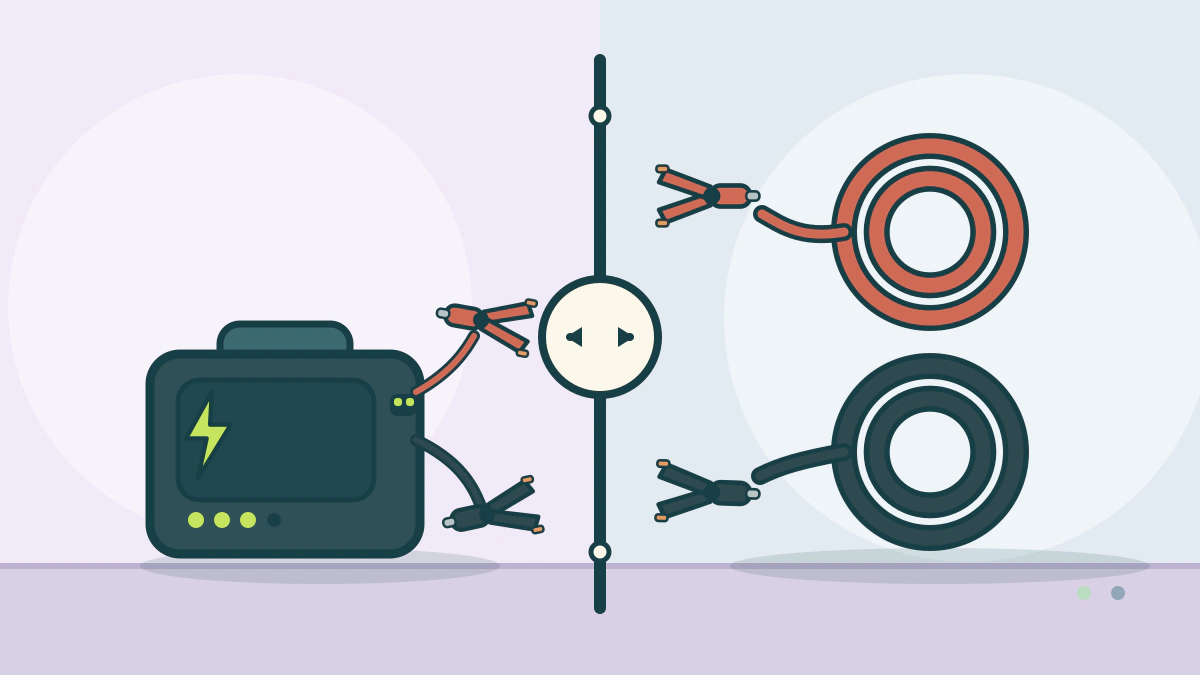
Compare a portable jump starter with jumper cables on power source, battery chemistry, cold-weather limits and upkeep, using manufacturer and AAA guidance.
Is a jump starter better than jumper cables?
Jumper cables need a second vehicle and a working battery; a jump starter works alone, but its chemistry, charge level and temperature decide whether it will start your car.
AAA describes jumper cables as standard roadside equipment because they transfer power from a working battery. A portable jump starter is a battery pack with clamp leads that can start a car without another vehicle. AAA says a jump starter makes sense if you often drive alone, travel remote routes or own a vehicle with an aging battery. A jump pack still needs a compatible battery: the lithium guide says it works only on 12-volt lead-acid batteries, not lithium or 6-volt systems.
Lead-acid jump packs
A sealed lead-acid pack is the older, heavier design. The manual for one such unit says it must be charged for 24 hours before first use, after every use, and every three months in storage. It says the pack can deliver roughly 10 to 30 starts per charge.
That manual also sets a 6-second cranking limit, followed by 3 minutes of cooling before another attempt. It says to store the unit at 50 degrees Fahrenheit or above for best jump-start performance, and that temperatures above 70 degrees Fahrenheit decrease amperage output.
Lithium jump packs
A lithium pack is lighter, but it needs different care. The guide for a 24-watt-hour unit says it can perform up to 20 jump starts per charge and holds about 70 percent of its capacity for a year. It recommends recharging at least every four to six months.
The same guide gives an operating range of -4 to 122 degrees Fahrenheit. It says thermal sensors stop the unit outside that range, that storage must stay within it, and that recharging should happen between 32 and 104 degrees Fahrenheit. It also warns against leaving the pack in direct sunlight in a car.
| Detail | Sealed lead-acid pack | Lithium pack |
|---|---|---|
| Internal battery | Sealed lead-acid | Lithium-ion |
| Cold guidance | Store at 50 F or above for jump use | Operate and store within -4 to 122 F |
| Recharge routine | After every use, plus every 3 months | Every 4 to 6 months when idle |
| Starts per charge | About 10 to 30, conditions vary | Up to 20 |
| Duty limit | 6 seconds cranking, then 3 minutes cooling | Follow the unit’s instructions |
Cold weather changes the calculation
AAA says cold reduces battery capacity, so a cold battery may need a longer charge interval or thicker cables. Kia’s manual adds a hard stop: never jump-start a vehicle if the discharged battery is frozen, because it may rupture or explode.
For the pack itself, follow its temperature limits. A lead-acid pack stored below 50 F is outside its stated best range, and a lithium pack below -4 F is outside its operating range. If a pack rides in the trunk through a hard freeze, bring it inside before you rely on it.
Cables: gauge, length and order
AAA recommends four-gauge or six-gauge cables, 10 to 20 feet long, for most passenger cars. It suggests two-gauge cable for trucks, SUVs, diesels or frequent helping, and warns that thin eight- or 10-gauge cables are slow and may struggle in cold weather. Inspect the cables for fraying and rusty clips before use.
The connection order matters. Kia says the booster battery must be 12-volt. Connect red to the dead battery’s positive post, red to the donor battery’s positive post, black to the donor’s negative post, and the last black clamp to bare metal on the dead car away from the battery. Kia says not to connect the last clamp to the discharged battery’s negative terminal because it can overheat, crack or degrade the battery. Our jump-start guide walks through the full sequence.
Which one should you carry?
| Situation | Better fit | Reason |
|---|---|---|
| You often drive alone or on remote roads | Jump pack | No second vehicle is needed |
| Two cars are usually available | Jumper cables | Simple, stores flat and needs no charging |
| You own an aging battery | Jump pack | AAA notes it suits vehicles with aging batteries |
| Deep cold is normal | Cables, or a pack kept within its range | Cold cuts capacity and can put a pack outside its limits |
| Hybrid or electric vehicle | Either, only at the 12-volt jump point | Follow the manual and never touch the high-voltage system |
A jump pack is not a battery charger. The lithium guide says it can start the car but cannot recharge the battery. After any jump, have the battery tested. Our guide to how long a car battery lasts explains the warning signs, and replacing a 12-volt battery covers the next step.
Browse Car Accessories and Equipment for more roadside equipment.
Frequently asked questions
Can a portable jump starter replace jumper cables?
Not in every case. A jump pack works without a donor vehicle, but only on a compatible 12-volt lead-acid battery and within its temperature range. Cables remain useful when a second vehicle is available.
Do lithium jump starters work in freezing weather?
One unit’s guide lists an operating range of -4 to 122 degrees Fahrenheit and says thermal sensors stop it outside that range. Storage and recharging have their own limits. Kia also says never to jump a frozen vehicle battery, whichever method you use.
How often should I recharge a jump pack?
A lithium pack should be recharged at least every four to six months when idle. A sealed lead-acid pack needs charging after every use and every three months in storage.
Can I jump-start a hybrid or electric car with either option?
Only the 12-volt battery, and only at the point the owner’s manual shows. AAA says never to touch the high-voltage battery, and some models use a dedicated jump terminal or a reset procedure instead of the battery posts.