Learn the cable order AAA describes, why the last black clamp goes on bare metal, and where hybrids and EVs differ according to a 2025 Kia owner's manual.
What is the safe order for jump-starting a car?
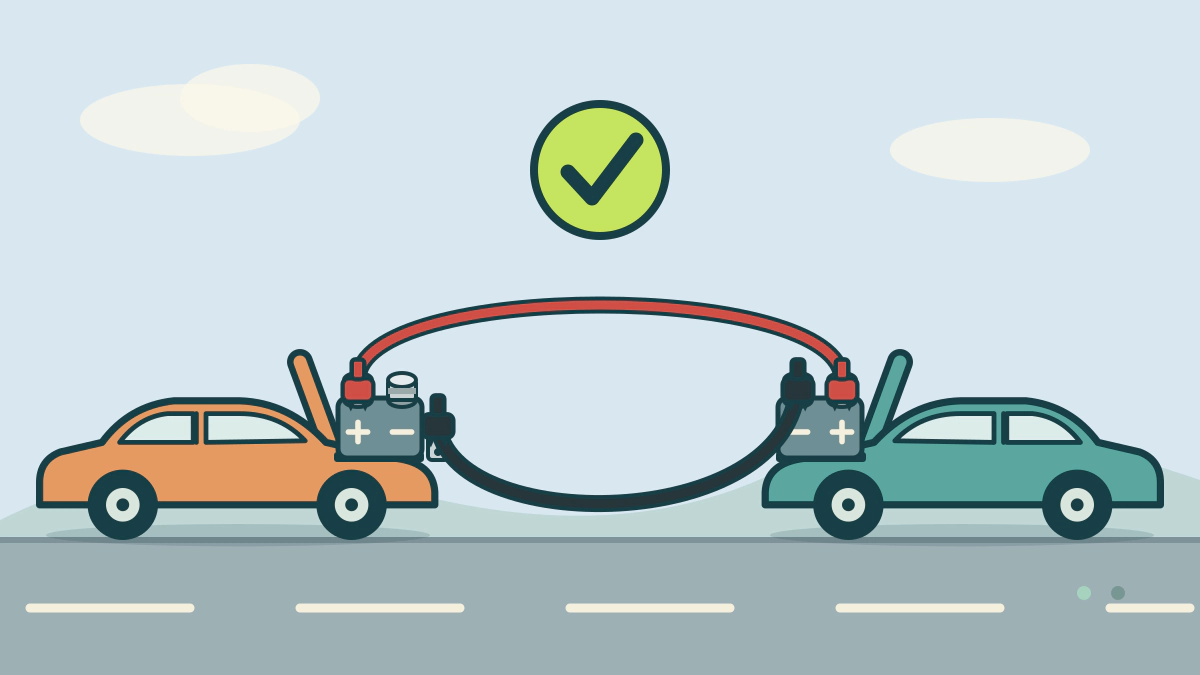
Connect red to the dead battery’s positive post, red to the donor battery’s positive post, black to the donor battery’s negative post, and the last black clamp to bare metal on the dead car, away from the battery. That is the order AAA Club Alliance gives, and it keeps the final spark away from the dead battery.
Your owner’s manual overrides any general guide. AAA Northeast notes some batteries sit under the back seat or in the trunk. Others use a separate jump terminal.
If the engine cranks but never fires, a jump may not help. See cranks but does not start.
What to check before touching a cable
Look at the cables first. AAA says to confirm they are not frayed and that the clips are free from rust.
Then work through this list:
- Park the vehicles so they do not touch. AAA Oregon/Idaho says no cable or metal part of either vehicle should contact another.
- Turn off the ignition and accessories such as headlights and the radio in both vehicles.
- Confirm the donor battery is 12-volt. A 2025 Kia manual says this directly.
- Do not jump a frozen battery. The same Kia manual warns it may rupture or explode.
- Keep flames and sparks away. The manual says a battery produces hydrogen gas.
- Wear eye protection. Kia’s battery maintenance page advises it near a battery.
The cable order, step by step
Follow the numbered order in the table. Do not lean over the battery while you work.
| Step | Clamp | Connect it to | Source note |
|---|---|---|---|
| 1 | Red | Positive (+) post of the dead battery | AAA: positive cable goes on first |
| 2 | Red (other end) | Positive (+) post of the donor battery | AAA: always positive to positive |
| 3 | Black | Negative (-) post of the donor battery | Kia: negative goes to the booster battery |
| 4 | Black (other end) | Bare, unpainted metal on the dead car’s engine | Kia: a solid, stationary point away from the battery |
AAA Oregon/Idaho warns against clamping the last cable to the dead battery’s negative terminal. It says that can cause a spark and an explosion. The Kia manual says the same connection can make the discharged battery overheat and crack.
Start the donor car, then try the dead car. If it does not start, wait longer and try again.
Idle times differ by source. AAA Club Alliance suggests five to ten minutes, while AAA Northeast says a minute or two. Kia’s manual says to run the booster vehicle at 2,000 rpm. That variation is why the manual comes first.
How to disconnect and recover afterward
Remove the cables in reverse order. Take off the black clamp from the engine metal first, then the black clamp from the donor battery. Next remove the red clamp from the donor battery, then the red clamp from the formerly dead battery. Never let the clamps touch while one end is attached.
Let the engine run for at least 30 minutes, say AAA Club Alliance and AAA Oregon/Idaho.
AAA Northeast adds that running the car for 30 to 60 minutes will usually not completely recover a drained battery. It recommends a full charge and a test at a repair shop. A jump only gets you started. It does not show why the battery went flat.
If the battery keeps going flat, see how long a car battery lasts and how to recognize a failing alternator. Corroded terminals can also stop current, so check the terminals.
Hybrids and EVs: find the jump point in the manual
AAA Northeast says only the 12-volt battery in a hybrid can be jumped. It says owners should never touch the high-voltage battery. It also says some newer vehicles need manufacturer-specific jump-start steps.
The 2025 Kia Niro hybrid manual shows how different these can be. It first points to a 12V Battery Reset button. The Niro manual says the car has no regular 12V battery needing periodic replacement. Its 12-volt battery is a lithium-ion type integrated into the high-voltage battery.
If the reset does not work, the Niro jump-start page uses a charging terminal in the engine compartment fuse panel. It does not use the battery posts. This is one model’s procedure, not a rule for all hybrids.
When to stop and call for help
Stop if the battery is frozen. Stop if you cannot tell the terminals apart. Stop if a step in the manual is unclear.
Kia’s manual says to use a competent technician or towing service if in doubt. AAA Northeast says to call roadside assistance when unsure.
For more battery work, see the DIY Car Repair hub.
Frequently asked questions
Which cable goes on first when jump-starting a car?
Start with the red positive clamp on the dead battery’s positive post. AAA Club Alliance and AAA Oregon/Idaho both begin there. Then connect the other red clamp to the donor battery’s positive post.
Why not attach the last black clamp to the dead battery?
AAA Oregon/Idaho warns that a clamp on the dead battery’s negative terminal can spark and cause an explosion. Kia’s manual says it can make the discharged battery overheat and crack. Use bare metal away from the battery.
How long should the car run after a jump-start?
AAA Club Alliance and AAA Oregon/Idaho both say at least 30 minutes. AAA Northeast says that may still not fully recover the battery. Have the battery charged and tested.
Can I jump-start a hybrid or electric car?
Often yes, but only the 12-volt system, and only at the points the manual shows. AAA Northeast says never to touch the high-voltage battery. Read your model’s emergency starting section before connecting anything.