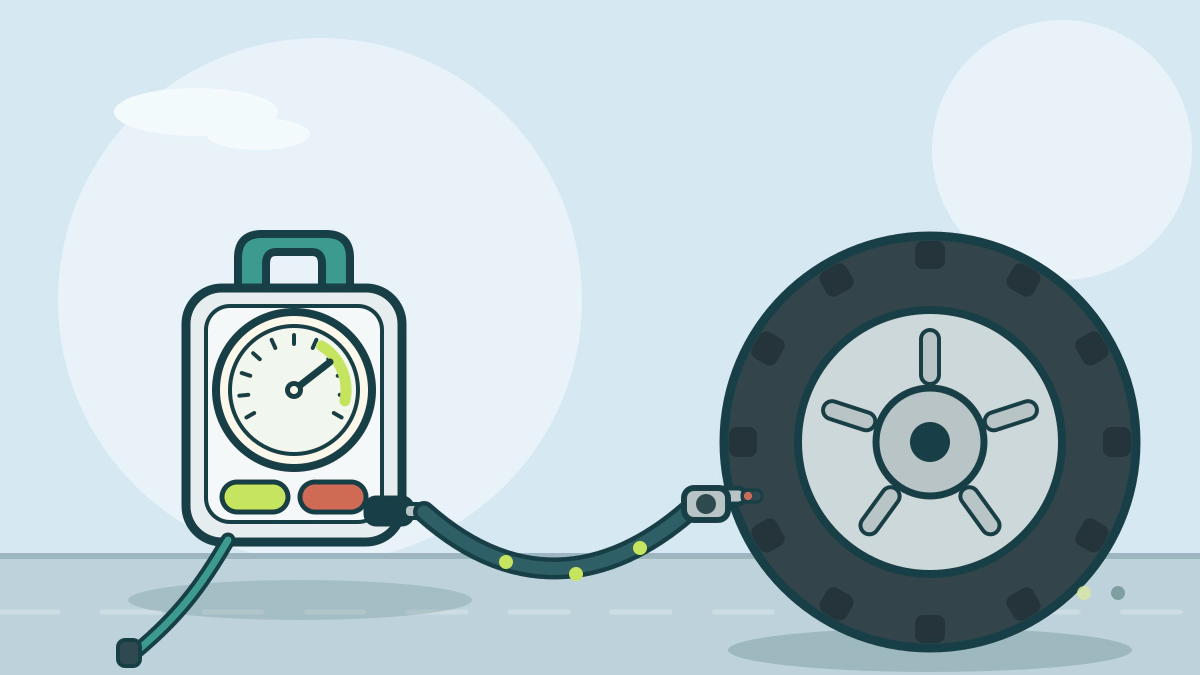
Choose a portable tire inflator by working pressure, duty cycle, gauge accuracy and power source, then match it to the cold pressure on your car's placard.
How do you choose a portable tire inflator?
Choose by maximum working pressure, duty cycle, gauge behavior and power source, then check that the inflator can reach the cold pressure on your car’s tire placard. A higher psi number alone is not a reason to buy.
NHTSA says the correct pressure is the vehicle manufacturer’s figure on the Tire and Loading Information label or in the owner’s manual, not the number molded on the tire. It also says to measure cold, after at least three hours without driving. Start with that number, then read the inflator’s rating. Our guide to the placard versus the sidewall maximum explains the difference.
Pressure rating and duty cycle are different numbers
One manufacturer’s manual for a portable compressor lists a maximum working pressure of 120 psi, a 20-amp draw and a maximum duty cycle of 25 minutes at 30 psi. The maximum pressure is a ceiling; the duty cycle is how long it can run before cooling.
Duty cycle matters because heat builds during inflation. Kia’s tire mobility kit manual is stricter. It says not to let the compressor run for more than 10 minutes at a time because it will overheat and may be damaged. It also says a fill takes about 5 to 7 minutes. A small inflator working on a large tire may need a rest before it reaches the placard pressure.
Read the duty cycle at the pressure you will use. That manual states its figure at 30 psi, not at its 120 psi maximum. If your tire needs more pressure or more air, the usable run time may be shorter.
Gauge accuracy: read it with the compressor off
The same manual says the gauge cannot give an accurate reading while the compressor is running because of air velocity. Switch the unit off, then check the pressure. Kia’s kit instructions use the same rule: to check the current setting, briefly switch the compressor off.
Do not treat the dashboard display as the final word. Kia’s TPMS section says the pressure shown on the dashboard may differ from the pressure measured by a tire gauge and can change with temperature, parking condition and altitude. NHTSA says TPMS activates only when a tire is significantly underinflated and is not a substitute for a monthly check with an accurate gauge.
Power source, heat and placement
| Type | Power source | Strength | Limit |
|---|---|---|---|
| 12-volt socket inflator | Car accessory outlet | No battery clamps to store | Outlet and kit must match; Kia warns mismatched power can cause fire or circuit damage |
| Battery-clamp compressor | Vehicle battery, engine running | Higher current draw; clamps fit the battery posts | The manual says the engine must run; keep the cord uncoiled |
| Tire mobility kit | Car outlet plus sealant | Seals some tread punctures | Temporary; one tire; not for sidewalls or damaged wheels |
Kia warns not to connect another vehicle’s tire mobility kit to the power outlet. The unmatched power requirement can cause a fire or circuit damage. Use the cable and outlet the maker specifies.
That manual says the compressor must be used with the engine running and warns that the unit becomes very hot. It also says the unit is moisture and dust resistant, not water or dust proof. Kia says to leave the engine running only when the car is outdoors, and never to leave the kit unattended. Let the unit cool before you store it.
TPMS cautions after inflating
NHTSA says the TPMS symbol should go out after the tires are properly inflated. On cold mornings it may come on briefly and then go off as the tires warm, which usually means the pressure was marginal overnight. A symbol that flashes for 60 to 90 seconds and then stays on points to a system malfunction, not a pressure problem.
Kia says its tire pressure display updates after a few minutes of driving. Use a gauge before you drive, and recheck cold later. Do not keep adding air to chase the light. The manual warns that exceeding the recommended pressure can burst an item and cause serious injury.
If the tire has a puncture, an inflator only buys time. Kia limits its sealant repair to 120 miles at 50 mph and says the tire must then be inspected or replaced. Sidewall damage and large punctures are not repairable with a kit. Our guide to inspecting tires before a road trip covers the checks for a long drive.
A short buying checklist
- Confirm the placard pressure for your car, including the spare.
- Check the maximum working pressure with margin above that number.
- Read the duty cycle and note the pressure it is rated at.
- Match the plug or clamps to your car and read the maker’s warnings.
- Check the hose length and the storage temperature range.
Browse Car Accessories and Equipment for more roadside equipment.
Frequently asked questions
Can I use the maximum pressure on the tire sidewall?
No. NHTSA says to use the vehicle manufacturer’s pressure on the placard or in the owner’s manual. The sidewall number is a limit for the tire, not the normal target for your car.
What does duty cycle mean on a tire inflator?
It is the run time before the unit must cool. One maker rates a compressor at 25 minutes at 30 psi, while Kia limits its kit compressor to 10 minutes at a time.
Why does the TPMS reading differ from my gauge?
Kia says the dashboard pressure may differ from a gauge reading and can change with temperature, parking condition and altitude. NHTSA says TPMS warns only when a tire is significantly low. Check cold with a gauge.
Will an inflator fix a flat tire?
It will refill a tire that has simply lost pressure. It will not repair a puncture. Kia’s sealant kit is a temporary fix for one tread puncture, limited to 120 miles at 50 mph. Sidewall damage or a large puncture needs a spare or a tow.