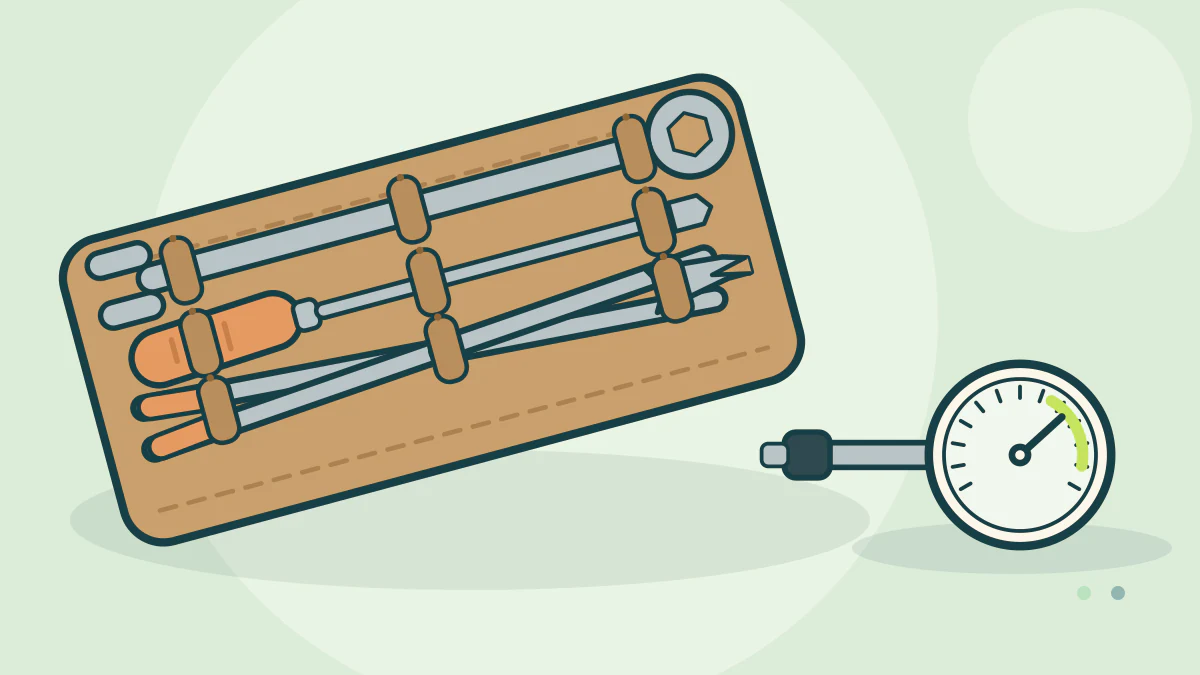
Build a small car toolkit from the tools your owner's manual lists, plus a tire gauge, gloves, eye protection and a few hand tools for routine checks.
What belongs in a compact car toolkit?
A compact car toolkit should start with the tire tools your car already carries, then add a pressure gauge, eye protection, gloves, a flashlight and a few hand tools for the checks your owner’s manual gives to owners. It is a roadside and routine-check kit, not a replacement for a workshop set.
The 2025 Kia SP2 gasoline manual lists a jack, jack handle and wheel lug nut wrench in its jack and tools section. It stores them in the luggage side trim. The same page calls the jack an emergency tire-changing tool.
If you want a larger set for home maintenance, see basic car repair tools for beginners. The list below is for the kit that stays in the vehicle.
The car’s own tire tools come first
Kia’s manual is direct about jack limits. It says never to lie under a vehicle supported only by a jack and to use vehicle support stands instead. It says to use only the marked jacking positions, never the bumpers, and not to start or run the engine while the car is on the jack. It adds that passengers should not remain in the vehicle while it is raised.
Those rules set the limit. A jack and wrench change one wheel in an emergency; they do not make work under the car safe. If you cannot find firm, level ground, Kia’s advice is to call a towing service.
Tools for the checks the manual gives owners
The same Kia manual lists owner checks in its owner maintenance section. Each month it asks for the coolant level, the operation of the exterior lights, the pressure of all tires including the spare, and a look for loose wheel lug nuts. Once a year it adds cleaning the battery and terminals and checking the brake fluid.
Those jobs need less than a full toolbox. A tire pressure gauge, a flashlight, gloves and eye protection cover most of them. NHTSA says to keep a gauge in the vehicle and check every tire, including the spare, at least once a month when the tires are cold. Our guide to the door placard versus the sidewall maximum explains which number to use.
A compact kit at a glance
| Item | What it handles | Limit stated by the source |
|---|---|---|
| Jack, jack handle, wheel wrench | Emergency wheel change | The jack is for emergency tire changing only; never work under it |
| Tire pressure gauge | Monthly cold pressure check, spare included | A TPMS warning is not a substitute for a gauge |
| Flashlight | Seeing a wheel, fuse box or engine bay after dark | Keep the batteries fresh |
| Jumper cables | Starting a car from a donor vehicle | The donor must be 12-volt and the cables undamaged |
| Gloves and eye protection | Battery, fluid and dirty roadside work | Eye protection is advised near a battery |
The Kia manual warns that battery acid must not contact skin, eyes or clothing and advises eye protection near a battery. It also warns against jewelry and loose clothing near a running engine.
The Car Care Council’s fall checklist adds jumper cables, a flashlight, blankets, clothes, water, food and a first aid kit to the roadside kit. Those are emergency supplies rather than tools. Our guide to what to keep in your car at all times covers that side separately.
Hand tools worth the space, and what to skip
A small screwdriver with interchangeable bits, a pair of pliers and an adjustable wrench handle trim clips, hose clamps and battery hold-downs on many cars. Add them only if you will use them during the checks the manual lists. Confirm the fastener type before you rely on a tool.
Skip the full socket set, the impact wrench and the tray of rarely used attachments. The Kia manual says some procedures can be done only by a dealer with special tools, and it gives instructions only for maintenance items that are easy to perform.
Pack it so it stays useful
Kia says to store the jack properly to stop it rattling. The same idea applies to the whole kit. Heavy tools belong low and secured, not loose above the spare tire. A small canvas roll or a stiff box keeps screwdrivers from becoming projectiles in a stop.
Check the kit twice a year and before a long trip. Replace flashlight batteries, worn gloves and a gauge that no longer returns to zero. The Car Care Council recommends restocking the roadside kit for winter, and NHTSA’s monthly pressure check is a natural reminder to inspect the tools you use for it.
Browse Car Accessories and Equipment for more roadside gear.
Frequently asked questions
Do I need a full socket set in the car?
No. A full set adds weight and takes luggage space. Start with the wheel tools the car came with, a gauge and the small hand tools that match your manual’s owner checks.
Can I use the car’s jack for repairs at home?
No. Kia describes the supplied jack as an emergency tire-changing tool and says never to work under a vehicle supported only by a jack. Use support stands on firm, level ground for any job that puts you under the car.
What should I check with the kit each month?
Check the pressure of every tire, including the spare, while the tires are cold. Check the lights, the wheel lug nuts and the coolant level. Kia lists these as monthly owner checks.
Where should the toolkit live in the car?
Keep it in the storage location the manual shows for the jack and wheel tools, or in a secured container nearby. Do not leave heavy tools loose in the passenger area or on top of the spare tire.